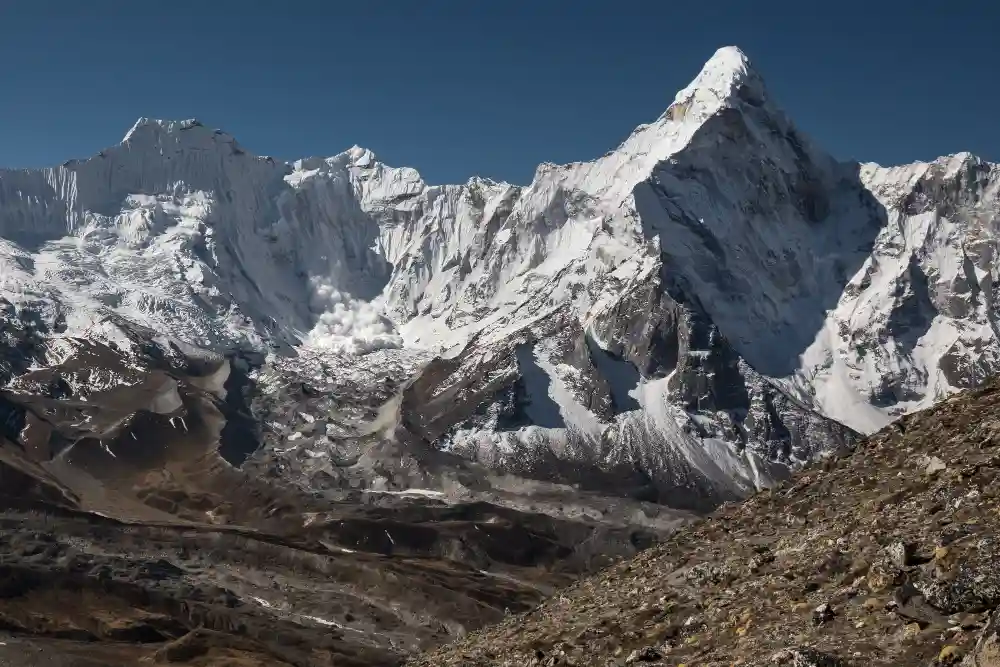
Ama Dablam Expedition 29 Days

Tour Info

trip code

EN-42

Starting Point/ End Point

Kathmandu

Accommodations

Lodge/ Tea House

Max Altitude

6812m

Duration

29 days

country

Nepal

Trip grade

Easy

Activities

Trekking

Best Season

September, October, November

Overview

Ama Dablam expedition is an Everest climb in the Nepal Everest region near Mount Everest. The trail goes through famous Sherpa-villages such as Namche Bazaar and Tengboche, and finally to Ama Dablam Base Camp. It is a journey that will involve a combination of trekking and mountaineering, complete with adequate acclimatization days and a summit window. The journey has a systematic rhythm to control altitude and safety and provide a smooth lodge-to-camp transition with improved logistics and assistance during the trip.

Details

Ama Dablam is referred to as one of the most beautiful mountains in Nepal and it is also among the more technical climbs in the Himalaya. It is not an easy hiking peak. It is most appropriate to climbers with prior experience working in high altitude and who are not afraid to use ropes and other rudimentary climbing gear. The expedition starts with a picturesque flight Kathmandu-Lukla, and a trek to the Khumbu region. On the route, you go through Sherpa villages, forests, and river valleys, until you get to the base of Ama Dablam. This is a way to make your body gradually adapt to the altitude and have a genuine experience of the Himalayan environment and culture.

Ama Dablam is unique because of the combination of technical climbing and trekking. The first part of the trail is a typical Himalayan hike, but beyond that, the ascent is strenuous. You will work on fixed ropes, traverse open ridges and cross parts of rock, ice and snow. It is a difficult and yet enjoyable experience which provides you with a real feel of mountaineering. Ama Dablam route is well established and has well defined camps and support structures. The majority of expeditions are well organized and have professional guides, and it helps to control the risks and keep the climb under control. This renders it an excellent option to the climbers who wish to venture into more serious Himalayan climbing with the necessary support.

Reaching the top of Ama Dablam is not just about the summit. It is about the whole journey walking through remote valleys, climbing a technical peak, and experiencing the raw beauty of the Himalaya. Ama Dablam is one of the most popular climbs in Nepal, especially for those seeking a challenging, structured, and rewarding climb.
Highlights

  • Climb Ama Dablam (6,812m) one of the most beautiful and technical mountain in Nepal.
  • Scenic mountain flight between Kathmandu and Lukla
  • Hike in the popular Everest area with the sight of the mount everest and the other surrounding mountains.
  • Pass through traditional Sherpa villages like Namche Bazaar and Tengboche Monastery
  • Proper acclimatization in Namche and Pheriche with well-paced itinerary.
  • During the trek, stay in comfortable mountain lodges and during the climb, fully supported tented camps.
  • Have a combination of trekking and technical climbing with fixed ropes, rock and ice.
  • Hike with professional guides and a well-organized support system.
  • Laid trail and prepared camps and system of expedition.
  • Safe summit push time depending on weather conditions.
  • Traverse woods, rivers, and high alpine scenery of the Khumbu area.
  • Have a day of rest and buffer in Kathmandu at the end of the trip.

Itinerary

Day 1: Arrival in Kathmandu and hotel transfer

You will arrive at Tribhuvan International Airport in Kathmandu. Our team will be waiting outside the terminal after finishing the immigration process and picking up your luggage and will take you to the hotel. The commute to your hotel takes about 30 to 45 minutes, depending on traffic. When you arrive, then you can take a break after the trip or have a quick stroll around the locality. During the evening, you might have a short trip briefing at which time you will meet your guide and discuss the plan of the coming expedition.

  • Max Elevation: 1,400m
  • Travel Distance: ~6 to 8 km
  • Travel Hours: 30 to 45 mins (drive)
  • Accommodation: Hotel (Kathmandu)
  • Meals Included: None

Day 2: Climbing preparation and sightseeing day at Kathmandu

To-day is one of final preparations before going into the mountains. You will meet your guide, receive your climbing gear and finalize any outstanding permits and paperwork. Once all the preparations are made, you will have a brief sightseeing tour of Kathmandu.

Major sightseeing locations include:

  1. Pashupatinath Temple: The Bagmati River near which you can witness traditional rituals and local culture is one of the most important Hindu temples in Nepal.
  2. Boudhanath Stupa: A huge and serene Buddhist stupa with its peaceful ambiance and rotating prayer wheels surrounding the location.
  3. Swayambhunath Stupa: An ancient hill-top stupa with panoramic views of Kathmandu Valley and a blend of Buddhist and Hindu culture.
  4. Patan Durbar Square: A historic royal square known for its temples, courtyards, and detailed Newari architecture.
  5. Bhaktapur Durbar Square: A well-preserved old city with traditional houses, temples, and a strong local cultural feel.

It is a relaxed and free day, allowing you to take your time to get ready, sightsee and relax prior to your flight to the mountains.

  • Max Elevation: 1,400m
  • Travel Distance: ~10 to 15 km (city travel)
  • Travel Hours: 3 to 4 hrs (including sightseeing)
  • Accommodation: Hotel (Kathmandu)
  • Meals Included: Breakfast

Day 3: Kathmandu to Lukla flight and trek to Phakding

The day begins with a beautiful mountain flight from Kathmandu to Lukla. The journey is brief, yet quite unforgettable, and one can see hills and snow-white mountains on the way.

Upon landing, you will be greeted by the trekking team and will start walking towards Phakding. It is a simple trail, mostly downhill, along the Dudh Koshi River. You will go through small villages, suspension bridges, and pine forests. It is an easy initial day to enable your body to get used to the height. In the afternoon, you will arrive at Phakding and spend the night in a nice lodge.

  • Max Elevation: 2,860m (Lukla)
  • Travel Distance: Flight + 6 to 7 km trek
  • Travel Hours: 30 to 35 mins (flight) + 3 to 4 hrs (trek)
  • Accommodation: Lodge (Phakding)
  • Meals Included: Breakfast, Lunch, Dinner

Day 4: Phakding to Namche Bazaar trekking

After breakfast, we set off following the Dudh Koshi River. On today's trek, we cross a number of suspension bridges. Along the way, we pass through the village of Monjo before entering the Sagarmatha National Park. On completion of the permit formalities, we continue on today's gentle trek.

The walk follows a series of forested ridges and river valleys before the final push up to Namche Bazaar, the day’s exertion. The climb is steep and exhausting, but if the skies are clear, you will get your first glimpse of the highest mountain in the world. Namche Bazaar is one of the biggest and prettiest trekking villages in the Himalayas, and it is recommended that you spend a day or so here acclimatizing to the higher altitude and visiting the local shops, bakeries, and cafes, or relaxing at one of the many trekker lodges.

  • Max Elevation: 3,440m
  • Travel Distance: 10 to 12 km
  • Travel Hours: 6 to 7 hrs
  • Accommodation: Lodge (Namche Bazaar)
  • Meals Included: Breakfast, Lunch, Dinner

Day 5: Rest and acclimatization day in Namche Bazaar

Today is a rest and acclimatization day. Instead of staying put in Namche, you can take a short hike up above the village and return the next day to the same lodge. On this day, trek takes you above Namche and back down again to rest. You hike up to the Everest View Hotel for a great close up view of Mount Everest, Lhotse and Ama Dablam. Alternatively visit the nearby village of Khumjung for a spot of local shopping and to experience the culture of the Sherpa people.

From Lukla you follow a scenic trail which winds up and down towards Namche. Once in Namche you can rest and enjoy the atmosphere of this trekkers town. The day acclimatizes the body for the increased altitude of the days ahead. After arriving in Namche you can go out and about in town, relax in your hotel or enjoy a café or restaurant.

  • Max Elevation: ~3,800 to 3,900m (during hike)

  • Travel Distance: 4 to 6 km

  • Travel Hours: 3 to 4 hrs

  • Accommodation: Lodge (Namche Bazaar)

  • Meals Included: Breakfast, Lunch, Dinner

Day 6: Trekking from Namche Bazaar to Deboche

After breakfast we start our trek and walk along the hillsides with constant changes up and down towards Tengboche. The views of surrounding mountains are breathtaking and we can also see some of the highest mountains of the world like Ama Dablam, Lhotse and others of Khumbu region.

The trail winds through the forest and villages before eventually arriving in Tengboche, home to one of the largest Buddhist Monasteries in the Himalayas (5060m) where we will take a short visit. Descending slightly, the trail leads to a peaceful forest zone and then to Deboche. Deboche is a lovely peaceful spot surrounded by Rhododendron and Pine forest, less busy than Tengboche making it a nice place to overnight before venturing on higher to more remote destinations.

  • Max Elevation: 3,820m
  • Travel Distance: ~10 km
  • Travel Hours: 5 to 6 hrs
  • Accommodation: Lodge (Deboche)
  • Meals Included: Breakfast, Lunch, Dinner

Day 7: Deboche to Pheriche trek

Following breakfast, the day’s trekking gradient is gradually introduced as you ascend towards higher pastures. Initially the walk follows a tree-lined valley bottom before opening up onto open alpine pasture. As the trek progresses the trees vanish and the valley floor becomes more rocky and formidable.

On your way, you will stop at the old Sherpa village Pangboche, one of the oldest villages in the area. In between the high mountains, Imja Khola flows down to the valley, on its banks the path leads through to the foot of Ama Dablam.While trekking toward Dingboche, you will also pass through the village of Langzhoa.Before you arrive at the final destination of your trek, you will pass through Pangboche, the second-highest settlement in the area and one of the oldest Sherpa villages. Fantastic views of Ama Dablam and other main mountains in the area are included in your trek. We arrive at the windy high-altitude village of Pheriche in the afternoon. Pheriche is situated in an open valley surrounded by mountains. Our trekking lodges are basic but comfortable and provide a much-needed rest and acclimatization to the higher altitude.

  • Max Elevation: 4,240m
  • Travel Distance: 9 to 10 km
  • Travel Hours: 5 to 6 hrs
  • Accommodation: Lodge (Pheriche)
  • Meals Included: Breakfast, Lunch, Dinner

Day 8: Acclimatization and exploration day at Pheriche

Today is a day for rest and acclimatization, with the option of a short hike. We stay at the village of Pheriche and spend the night there.

For those who want a slightly longer day out from Pheriche, a hike up the ridge above town offers spectacular views of the surrounding valley and mighty peaks such as Ama Dablam, Lhotse, and Taboche. It is a long, gentle hike that will help acclimatize your body to the thinner air of the high valley. We returned to the Gobefei Safari Lodge, hobbled around in the shade, had a cold beer or two, and generally allowed our aching bodies to repair themselves for the steeper and drier trails we would be encountering the next day.

  • Max Elevation: ~4,600m (during hike)
  • Travel Distance: 2 to 4 km
  • Travel Hours: 2 to 3 hrs
  • Accommodation: Lodge (Pheriche)
  • Meals Included: Breakfast, Lunch, Dinner

Day 9: Trekking from Pheriche to Ama Dablam Base Camp

Starting from Pheriche, the day’s trek ascends gently up the wide, open, and increasingly remote valley, with spectacular scenery. Eventually, we arrive at Ama Dablam Base Camp. Every day, the views of Ama Dablam get more impressive, and today is no exception as Ama Dablam towers above. After breakfast, we trek up to Ama Dablam Base Camp.

By midday or afternoon, we arrive at Ama Dablam Base Camp at 5,600m. The Base Camp is in an exposed location at high altitude, surrounded by nothing but mountains, but by then we are established in a fully organised tented camp with separate dining tents, sleeping tents, and various other facilities that the expeditions require.

We will first find some rest, to acclimate better, also to fine-tune our climbing gear and receive some basic climbing training if required. It is cold and rugged, marking the beginning of mountaineering on our expedition.

  • Max Elevation: 4,600m
  • Travel Distance: 7 to 8 km
  • Travel Hours: 4 to 5 hrs
  • Accommodation: Tented Camp (Ama Dablam Base Camp)
  • Meals Included: Breakfast, Lunch, Dinner

Day 10: Acclimatization day at Ama Dablam Base Camp

Our day was spent resting and acclimatizing at base camp. Everyone today remained at base camp and completed some light activity to help assist the body to acclimatize at high altitude and then prepare the body for the climbing portion of the trip.

There is instruction during the day with guides on basic climbing skills. This will be over fixed rope and you would be learning basic climbing skills such as anchoring, tying knots, using an ice axe, etc. and reviewing higher mountain safety issues. Guides will also be inspecting your equipment and helping you to organize and prepare gear for the summit rotation.

We also use this time for eating well, resting and hydrating in order to prepare for the steeper and more remote terrain that awaits. Our base camp is quiet and secluded allowing you to settle into the rhythm of the expedition before ascending to higher altitudes.

  • Max Elevation: 4,600m
  • Travel Distance: 0 km
  • Travel Hours: 2 to 3 hrs (light training activity)
  • Accommodation: Tented Camp (Ama Dablam Base Camp)
  • Meals Included: Breakfast, Lunch, Dinner

Day 11 to 23: Summit Ama Dablam and return to base camp

The main climb of the expedition begins over several days trekking and climbing up towards the higher camps on Ama Dablam. Fixed ropes are used in certain sections of the climb and several quite steep ridges are encountered along with various other mixes of rock, ice and snow. Our climb rotations include ascending above base camp to higher camps for acclimatization and then returning down to base camp for rest and rejuvenation. These climbs are planned carefully by our guides based on the current weather and the teams' acclimatization status.

Once the weather forecast shows a stable window, we will attempt the summit of Ama Dablam. This climb is long and demanding, and technically very difficult. Our guides are experienced, and there are fixed ropes in place to aid the ascent. The entire expedition is supported by full logistical backing. It’s hard to believe it’s already come to this. The days at high altitude are pretty simple eat, climb, sleep, and hopefully stay healthy. The idea is to put together as solid of a descent as possible and descend together in the best shape possible.

  • Max Elevation: 6,812m (summit)

  • Travel Distance: Variable (rotations between camps)

  • Travel Hours: 6 to 10 hrs on climbing days (varies)

  • Accommodation: Tented Camps (various high camps + Base Camp)

  • Meals Included: Breakfast, Lunch, Dinner

Day 24: Trek from Ama Dablam Base Camp to Tengboche

After a long day of climbing the valley side, the descent follows a long but manageable, downhill path. The trail follows familiar tracks through beautiful alpine meadows and occasionally steepened valleys with spectacular mountain views.

The trail mostly follows back to previous villages, and to our relief, returns to a greener landscape. As you approach Tengboche, you enter forested sections again, with rhododendron trees and peaceful surroundings. We trekkers arrive in Tengboche in the afternoon, a serene Base Camp for the famous Tengboche Monastery. There is basic, comfortable lodge accommodation available here.

  • Max Elevation: 4,600m (start)

  • Travel Distance: 10 to 11 km

  • Travel Hours: 5 to 6 hrs

  • Accommodation: Lodge (Tengboche)

  • Meals Included: Breakfast, Lunch, Dinner

Day 25: Tengboche to Namche Bazaar

On this day after breakfast we begin our descent to Namche. The trail is steep down at first through forest and then a mix of up and down hill walking, following the side of the hill. It is much easier than the uphill trek to get to Namche, but still requires some pretty vigorous walking.

The trail intermittently goes back through villages and across rickety suspension bridges, offering fantastic views down into the steep sided river valley as it winds its way down towards Namche. As Namche gets closer the trail becomes more familiar until it is largely paved and well developed. We make our way down to Namche Bazaar in the afternoon, where we can relax in a comfortable lodge, enjoy better facilities than in recent days.

  • Max Elevation: 3,860m

  • Travel Distance: 9 to 10 km

  • Travel Hours: 5 to 6 hrs

  • Accommodation: Lodge (Namche Bazaar)

  • Meals Included: Breakfast, Lunch, Dinner

Day 26: Trekking from Namche Bazaar to Lukla

After breakfast, we begin our descent to Namche. The trail is steep down at first through the forest and then a mix of up and downhill walking, following the side of the hill. It is much easier than the uphill trek to get to Namche, but it still requires some pretty vigorous walking.

The trail intermittently goes back through villages and across rickety suspension bridges, offering fantastic views down into the steep-sided river valley as it winds its way down towards Namche. As Namche gets closer, the trail becomes more familiar until it is largely paved and well developed. We make our way down to Namche Bazaar in the afternoon, where we can relax in a comfortable lodge and enjoy better facilities than in recent days.

  • Max Elevation: 3,440m (Namche start)

  • Travel Distance: 18 to 20 km

  • Travel Hours: 6 to 7 hrs

  • Accommodation: Lodge (Lukla)

  • Meals Included: Breakfast, Lunch, Dinner

Day 27: Flight from Lukla to Kathmandu

Take an early morning flight from Lukla to Kathmandu, followed by breakfast at your hotel. Today is a free day to relax, do some shopping, or visit Thamel for further exploration.

After your flight to Kathmandu, you will be transferred to your hotel. This is followed by a well-deserved rest, shower, and trek/ climb recovery. Depending on your stamina, you may also choose to explore the city and its shops or bars. Today was a gentle, smooth drive back from the mountains to the city.

  • Max Elevation: 2,860m (Lukla)

  • Travel Distance: Flight (~138 km) + 6 to 8 km (airport to hotel)

  • Travel Hours: 30 to 35 mins (flight) + 30 to 45 mins (drive)

  • Accommodation: Hotel (Kathmandu)

  • Meals Included: Breakfast

Day 28: Leisure day in Kathmandu

The day is left to you to relax at the hotel or to travel around Kathmandu at your own leisure as you wish. You can also venture out for some light tourism/shopping / exploring the local cultural scenes, such as markets, heritage-style streets, and vintage cafes. This is also a good day to recover and reorganise gear, for those who need to. Climbers typically spend the day relaxing and preparing for the descent the following day.

  • Max Elevation: 1,400m

  • Travel Distance: Optional (city travel ~5 to 15 km)

  • Travel Hours: Flexible

  • Accommodation: Hotel (Kathmandu)

  • Meals Included: Breakfast

Day 29: International departure day

After breakfast, depending on flight time, you will be transferred to Tribhuvan International Airport. Travel time to the airport from city hotels is approximately 30 to 45 minutes, depending on traffic. Our trekking team will see you to Kathmandu, where we can assist with your airport transfer and the end of your Ama Dablam trek in Nepal.

  • Max Elevation: 1,400m

  • Travel Distance: ~6 to 8 km

  • Travel Hours: 30 to 45 mins (drive)

  • Accommodation: None

  • Meals Included: Breakfast

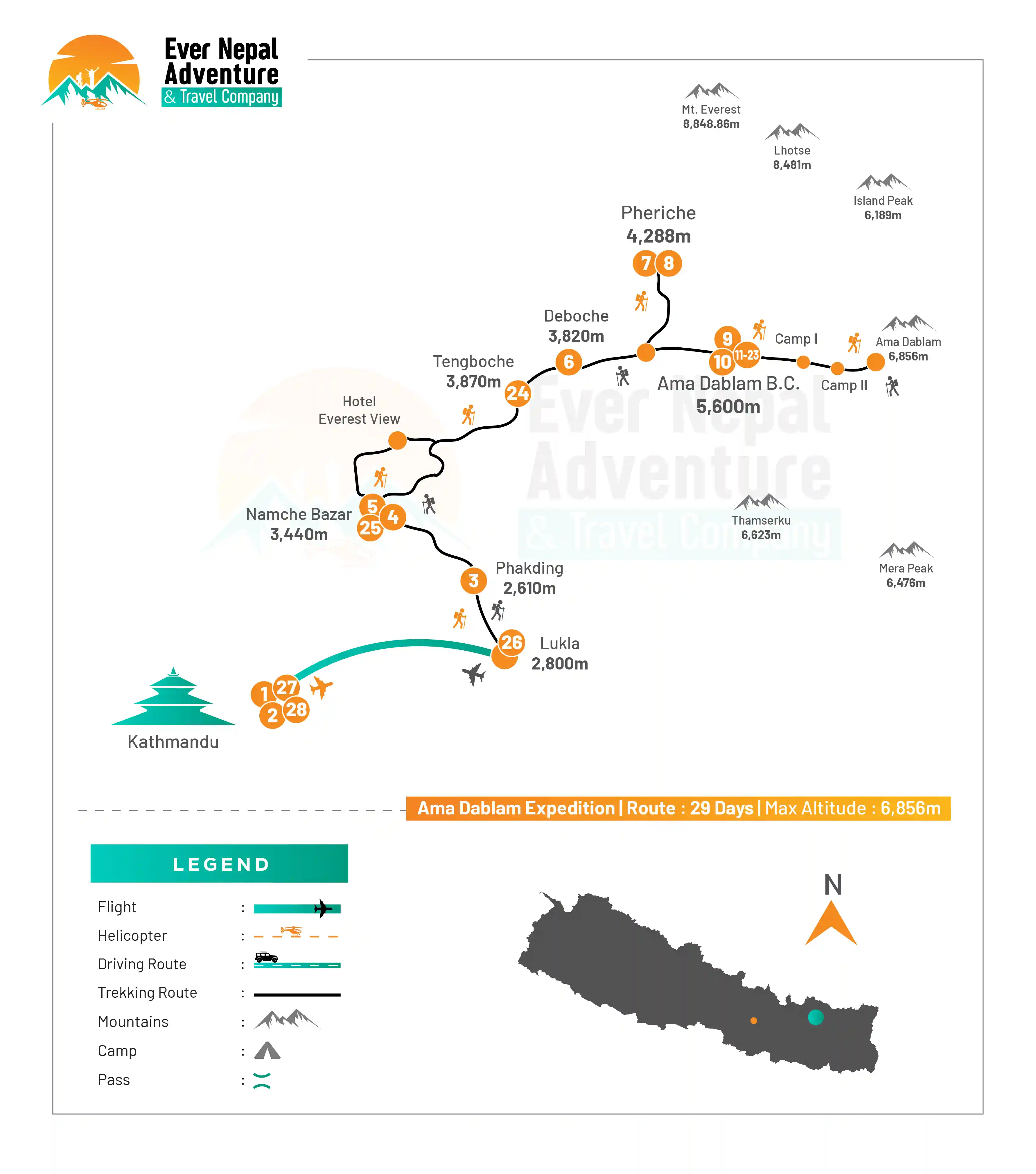
Trek Route

Ama Dablam Expedition  route map

What's included

  • Airport pickup and drop-off in Kathmandu
  • 5 nights hotel accommodation in Kathmandu
  • These are for domestic flights to and from Lukla, the starting point for the trek.
  • During the peak season, these flights sometimes depart from Manthali instead of Kathmandu.
  • Ama Dablam climbing permit and royalty fee
  • Liaison officer's fee for the expedition
  • Sagarmatha National Park and local municipality permits
  • Meals and accommodation on the approach trek.
  • Full expedition food and supplies were placed at base camp and higher camps.
  • Experienced private climbing Sherpa guides
  • Porters/mules for luggage.
  • Fixed ropes, dynamic ropes, and climbing route equipment
  • Base camp and high camp tents and setup
  • Base camp services (including solar charging system)
  • First aid medical kit for team and staff
  • Our treks are set against the stunning backdrop of the Himalayas. In addition to expert guidance, we will supply you with a Walkie-talkie so that you will always know where you are. Also available is a satellite phone for personal calls at an extra charge.
  • Insurance, wages, food, and allowances for guides, porters, and base camp crew
  • Icefall / route fixing support and related logistics
  • Government taxes and service charges
  • Welcome and farewell dinner in Kathmandu
  • Duffle bag for expedition gear

What's excluded

  • Lunch and dinner in Kathmandu
  • Personal climbing gear (boots, crampons, harness, helmet, etc.)
  • International flights to and from Nepal
  • We need to know about any personal travel insurance and/or health insurance that you have. If you are planning to trek to high altitude then you need to take high altitude cover as well.
  • Tips for guides, Sherpas, and porters
  • Summit Bonus. This is a one time fee for the summit that can range from $700-$1000 USD depending on the agreement with theSherpa.

Packing List for Ama Dablam Expedition

It is essential to have high-quality climbing equipment if you plan on attempting the Ama Dablam Expedition. This expedition includes trekking through the Everest Region and then progressing to steep rock, mixed climbing terrain, and ice above 6,000 metres. Packing correctly is essential for safety, warmth, and efficiency on the approach trek as well as the summit rotation. The following is the complete packing list for the Ama Dablam Expedition.

  • Head

    • Wide-brimmed sun hat

    • Neck gaiter/buff

    • Warm Expedition-grade Beanie

    • Balaclavas for high-altitude winds

    • Extra batteries are included in the lightweight headlamp

    • High-SPF sunblock (50+).

    • Glacier sunglasses with UV protection (Category 4)

    • Lip balm with SPF protection

    • Facial wipes

  • Hands

    • Light fleece gloves (for trekking days)

    • Heavy-duty insulated climbing gloves for summit push

    • Waterproof shell gloves

    • Liner gloves with thin lining for handling rope

  • Upper Body

    • Base layers that wick moisture away (thermal tops).

    • Thermal inner layers

    • Fleece Jacket (Middle Layer)

    • Insulated Down Jacket (Expedition Grade)

    • A shell jacket that is waterproof and windproof

    • T-shirts for trekking that dry quickly

    • Long-sleeved trekking shirt with breathable material

    • Light puffy jackets for camping

  • Lower Body

    • Thermal base layer leggings

    • Fleece trekking pants

    • Shell pants that are waterproof and windproof

    • Insulated climbing trousers (for high camp)

    • Light trekking trousers

    • Softshell pants for climbing sections

  • Footwear

    • Mountaineering Boots (double boots are recommended for the summit).

    • Light trekking shoes for lower elevations

    • Crampons that are compatible with boots

    • Gaiters (waterproof & snow protection)

    • Warm wool trekking socks (4-6 pair)

    • Expedition Summit socks (thick pairs of thermal socks)

    • Camp slippers for base camp comfort

  • Climbing Equipment

    • Climbing harness with UIAA certification

    • Ice axe

    • Helmet (climbing-grade protection)

    • Crampons, steel (anti-balling).

    • Ascender (Jumar).

    • Descender/belay device

    • Carabiners (locking + non-locking)

    • Climbing rope

    • Prusik cords

    • Personal safety leash/cow's tail

  • Accessories

    • Large expedition duffle bag (100-120L)

    • Daypack (30-40L).

    • Sleeping bag (rated from -30 °C up to -40 °C)

    • Trekking poles (adjustable)

    • Water bottles and hydration systems

    • Filters or tablets for water purification

    • Dry bags for organizing gear

  • Toiletries

    • Toothbrushes and toothpaste

    • Biodegradable soap

    • Quick-dry towel

    • Toilet paper/wet wipes

    • Hand sanitizer

    • Small shampoo bottle

    • Moisturizer for dry skin at altitude

  • First Aid Kit

    • Diamox is a medication that prevents altitude sickness.

    • Ibuprofen/painkillers

    • Antibiotics (as prescribed)

    • Antiseptic wipes

    • Bandages and gauze

    • Blister Treatment Kit

    • Anti-diarrhea medicine

    • Prescription medications for personal use

  • Miscellaneous Items

    • Power Bank (High Capacity)

    • Batteries for headlamps

    • Travel adapter

    • Use a camera or smartphone

    • Binoculars are optional.

    • Notebook and Pen

    • Energy Bars / Light Snacks

    • Straps for Sunglasses and Extra Lenses

  • Special Equipment for Women

There are some special pieces of equipment and supplies required by women taking part in the Ama Dablam Expedition to ensure their comfort and safety during their climbing journey. The following equipment is useful, especially when on an extended period of expedition at high altitudes.

  • Sports Bra, quick-drying and supportive

  • Thermal Underwear

  • Sanitary Napkins / Tampons

  • Personal Skincare Products

  • Dry Skin / Lip Balm

  • Ear Warmers or Headband

  • Trekking Leggings

  • Sleepwear for Base Camp

Documents Required

Some permits and documents will be needed if you wish to successfully complete your Ama Dablam Expedition. The following documents are important and necessary in ensuring that the climbing process is safe. This climbing expedition is quite technical, and thus, the documentation is very important. The documents needed include the following:

  • Ama Dablam Climbing Permit: This is a compulsory climbing permit for Ama Dablam (6 812m) by the Nepal Mountaineering Association. The cost of the permit varies according to season (spring/autumn, winter/summer), and is usually arranged by a registered adventure operator in Kathmandu.

  • Sagarmatha National Park permit: This permit is needed to enter the Everest region, including Namche Bazaar, Tengboche, and Ama Dablam Base Camp. You can obtain it at the Nepal Tourism Board, Kathmandu, or at entry checkpoints. For foreigners, the charge is NPR 3,500 ($19), for SAARC nationals it's NPR 1,500 dollars ($10), and for Nepalese citizens, NPR 100.

  • Khumbu Pasang Lhamu Rural Municipality Permit: All trekkers and climbers who enter the Khumbu area must obtain this local entry permit. The permit is available at the Lukla Airport and Monjo Check Post. For foreign climbers, the cost is NPR 2,000 to 3,000 ($13-$19).

  • Liaison Officer Permit: The Nepal Government assigns liaison officers to supervise compliance and safety regulations for expedition peaks such as Ama Dablam. This permit must be obtained by the expedition operator for any organized climb.

  • Passport: Ama Dablam Expedition requires an original passport valid for at least six months from the date of entry to Nepal. This document is also used to register permits and climb documentation.

  • Passport-size Photos: In Kathmandu and Khumbu, you should have at least 6 passport-sized photographs for climbing permits, insurance verification, and expedition paperwork.

  • Insurance: Ama Dablam Expedition requires travel insurance and high-altitude coverage. This must cover high-altitude climbing and trekking (coverage above 7,000m is recommended), as well as medical treatment and emergency helicopter evacuation in Nepal.

Frequently Asked Questions

How difficult is the Ama Dablam Expedition?

Ama Dablam, also known as Ama Dablam, is one of the most difficult trekking peaks to climb in Nepal. Fixed ropes are used for rock, ice, and mixed climbing. It is recommended that you have prior experience with high-altitude mountaineering.

Do I need previous mountaineering experience for the Ama Dablam climb?

One needs to be experienced in rope skills and high-altitude treks. One must be comfortable using crampons and harnesses. For beginners who have never climbed, this is quite a challenge.

How long does the Ama Dablam expedition take?

The total duration of the expedition could be anywhere between 25 and 30 days. Depending on the weather conditions and acclimatization, additional days may be incorporated.

When is the best time to climb Ama Dablam?

Spring and fall are the best times for the ascent. The best seasons are spring (April to May) and autumn (October to November). The risk is generally higher during the winter and monsoon season.

How high is the Ama Dablam Base Camp located?

Ama Dablam Base Camp lies at a height of approximately 4,600 metres. This is the main staging area for acclimatization and rotations of climbing. The climbers stay here for several days before moving on to higher camps.

What kind of accommodation is offered during the expedition?

For the trekking part of the expedition, you will be accommodated in mountaineering huts, which offer only basic facilities. Tent camping will be your place to sleep, which resembles expeditions. Higher elevation camps are rudimentary, where survival and rest become the primary focus.

What is the minimum fitness level needed to join the Ama Dablam expedition?

The minimum fitness level that would allow you to join the Ama Dablam expedition is being fit enough physically, with great endurance. Additionally, stamina and strength are essential during the trekking and climbing stages.

User Review