Rubi Valley Trek For 13 Days

Tour Info

trip code

EN-034

Starting Point/ End Point

Kathmandu

Accommodations

Lodge/ Tea House

Max Altitude

3,850

Duration

13 days

country

Nepal

Trip grade

Challenging

Activities

Trekking

Best Season

Autumn (September-November) and Spring (March-May)

Overview

Rubi Valley Trek is recommended to those trekkers who prefer an authentic and silent Himalayan experience. This place is relatively untouched, unlike the crowded Everest and Annapurna routes. It suits people who prefer to travel alone, in an authentic and more cultural way. This valley lies between the Langtang and Manaslu ranges and boasts of large mountains, forest ridges, river valleys and expansive highland regions with minimal tourist traffic. A strong sense of exploration is further enhanced since most of the trails pass through villages where people live a traditional lifestyle with minimal external influence.

The culture of the Rubi Valley is one of the primary reasons to visit it. The walk goes through the villages of primarily Tamang and Gurung. You will find prayer flags, mani walls, chortens, and ancient traditions of daily life there. By staying in the local teahouses and community lodges, the trekkers contribute to the village economy and receive warm hospitality, home meals and a relaxed atmosphere that is personal and not commercial.

Rubi Valley is very diverse as far as trekking is concerned. The landscape changes to include green hills and terrace fields, pine woods, open high pastures and mountain views. The trail offers some easy ascents and some steep passes, making it suitable for trekkers who would like a good challenge without involving technical climbing. It is particularly suitable to those who have already completed popular treks and wish to have something more special or to those who are new to trekking and wish to have a quiet and peaceful introduction to the Himalayas.

Another major reason to choose this trek is the balance it provides between wilderness and comfort. Although the place is somewhat isolated,there are a few chosen teahouses and lodges with clean rooms, warm bed, good food and caring service. This makes it a safe enough adventure, rustic and comfortable. Rubi Valley Trek is a good vacation that can be taken by those who desire the beauty of nature, cultural experience, and an elegant getaway in a single trip.
Highlights

  • Remote and uncrowded trails through one of Nepal’s least-visited trekking regions, ideal for trekkers seeking peace, privacy, and a more exclusive Himalayan experience.

  • It is situated between Langtang and Manaslu mountains. The region is beautiful with expansive mountainous landscapes, wooded mountains, deep valleys, and high alpine landscapes.

  • The Tamang and Gurung culture is rich in the region. Tourists have the opportunity to explore the traditional villages, old practices, prayer flags, mani walls, monasteries, and the normal rural life.

  • The scenery changes a lot. You are able to observe terraced farms, rhododendron forests, open pastures and high mountain passes.

  • It has mountain top views and passes, and there are also ridges that offer you spectacular Himalayan views without involving technical climbing.

  • You may also spend the night in actual villages in local teahouses or community lodges. They provide hospitable service, tidy rooms and new food.

  • It is an off-the-beaten-track adventure, which is best enjoyed by trekkers who do not want to experience Everest or Annapurna.

  • The difficulty of the trekking is even. It is good with moderate-fit trekkers who would like a challenging adventure but not at extreme altitude.

  • It has good cultural immersion. You will have a chance to communicate in close contact with the local communities and to know the traditional Himalayan lifestyles.

  • Balanced trekking difficulty, suitable for moderately fit trekkers looking for a rewarding challenge without extreme altitude risk.

Itinerary

Day 01: Arrival at Kathmandu and transfer to the hotel (1,350 m).

You arrive at Tribhuvan international airport and are picked up by a representative of Ever Nepal Adventure who welcomes you and directs you to the hotel in Kathmandu. The following drive is the short one through the capital streets, which will provide you with the initial impression of the Nepalese culture and the old buildings, as well as the regular city life.

Once you have been checked into the hotel, you can rest and clean up after your trip. The hotel is comfortable, well-located, and has a serene environment, small rooms, private bathrooms, and contemporary facilities. It provides you with a good and easy beginning of the adventure. At night, you get a comprehensive briefing of the trek which discusses the Rubi Valley region, the nature of the trails, the kind of accommodation, and the whole experience. This will ensure that all is in order and that you are well informed before heading to the mountains.

It is a calming and cool day, to relax your body after traveling and to start the journey with the hospitality of Kathmandu and relaxing atmosphere.

  • Max Elevation: 1,350 m

  • Travel Distance: approx. 6 km (airport to hotel)

  • Travel Time: 20–30 minutes

  • Accommodation: Comfortable city hotel

  • Meals: Welcome drink (other meals depending on arrival time)

Day 02: Free day in Kathmandu for sightseeing and preparing for the trek (1,400 m).

We are in Kathmandu today, combining sightseeing with lazing around, preparing to go on the easy trek. You could go to ancient temples, royal squares, markets and Buddhist places. They provide an impression of the spiritual history of Nepal and vibrant city life. During sightseeing, you also get time to prepare on the final trek. YYou have time to organize your gear, replace any missing items, and review travel plans in a relaxed and organized setting. Kathmandu’s shops offer a wide selection of quality trekking gear, clothing, and souvenirs.The hotel offers an easy retreat between activities, with a relaxing environment, hospitable staff, and comfortable rooms. It is a loose and pleasurable day, with a share of leisurely walking and rest, and both the mind and body are prepared for the trails in the distance.

  • Max Elevation: 1,400 m
  • Travel Distance: approx. 10–15 km (city sightseeing, optional)
  • Travel Time: 3–5 hours total (depending on activities)
  • Accommodation: Comfortable city hotel
  • Meals: Breakfast

Day 03: Drive from Kathmandu to Syabrubesi (1,460 m).

Your journey begins with a scenic drive out of Kathmandu Valley, following winding mountain highways toward the northern hills. Trail cuts across terraced agricultural fields, classical roadside villages, and wide river canyons, slowly unveiling larger Himalayan sceneries. Road passes the Trishuli River along the way, and has occasional glimpses of far snow-capped mountains and wooded ridges.

The landscape gets more dramatic as the drive progresses and steep slopes, suspension bridges, and falling rivers are the characteristics of the landscape. Comfort stops are taken in short intervals, which give time to rest and have fun.

Your arrival will be in a small mountain town of Syabrubesi, which is the entry point to the Langtang region, located along the banks of the river and encircled by green hills. Accommodation is done in a well-chosen lodge or hotel that has comfortable rooms, warm dining areas, and hospitable services. Evening is casual, and one has time to relax, have a nutritious meal and absorb the peaceful mountain atmosphere before the trekking days set in.

  • Max Elevation: 1,460 m
  • Travel Distance: approx. 120–130 km
  • Travel Time: 6–7 hours
  • Accommodation: Comfortable local hotel/lodge
  • Meals: Breakfast, dinner

Day 04: Trek from Syabrubesi to Gatlang (2,240 m)

Your expedition begins at Syabrubesi and passes through mountain tracks that gradually ascend through wooded hills, ancient foot paths and tiny villages. The road passes over open terrace lands, interspersed with farmhouses, and shadowy woods that provide a peaceful and beautiful start to the Ruby Valley region.

On the way up, green hills and distant Himalayan mountains are visible. You get a better glimpse of the daily life of the people along the lines, where farmers are tending to the fields, and stone houses are situated along the trail. The region is largely dominated by the Gurung and Tamang communities as depicted in the village structures, attire, and daily practices.

Arrival takes place at Gatlang, a village on the hillside, and neatly made of stone houses with neat terrace farms where they cultivate potatoes, wheat, and barley. The village is relaxed and natural, and has broad perspectives of the valley beneath.

You end the day with an overnight stay at a local guesthouse or community lodge that is friendly with simple yet comfortable rooms, warm bedding and freshly cooked meals. On the first night on the trail, you can feel at home as you relax in the village in the evening and take in the quiet mountain environment and warm reception.

  • Max Elevation: 2,240 m

  • Travel Distance: approx. 8–10 km

  • Travel Time: 5–6 hours

  • Accommodation: Local guesthouse/community lodge

  • Meals: Breakfast, lunch, dinner

Day 05: Trek from Gatlang to Somdang (3,271 m).

The trail continues to lead out of Gatlang, rising gradually by mountain country, open hills, and high meadows.  As altitude increases, the view becomes broader and more dramatic. Wooded hills lead to vast sceneries of the surrounding Himalayan mountains.

On the route, you have large panoramic views of the Langtang Himal and Ganesh Himal. During sunny days, one can observe such mountains as Paldor (5,896 m) and other snow-white tops that are distinguished with the blue sky. The path is a combination of scenery: grazing fields, deserted ridges, and lonely mountainous terrain, which becomes more and more distant.

Arrival take place at Somdang in the upper highlands, which once had a mining settlement, and has broad and open sides of the Alps. It is situated in an open mountain basin and creates a serene impression, cool air and proximity to the Himalayas.

You spend the night at a mountain guesthouse or lodge which is well selected. It possesses cozy rooms, comfortable beds, and quality meals. The peaceful atmosphere and hospitable employees do make it a comfortable place to rest and see the mountain and get accustomed to the altitude.

  • Max Elevation: 3,271 m
  • Travel Distance: approx. 9–11 km
  • Travel Time: 5–6 hours
  • Accommodation: Local guesthouse/mountain lodge
  • Meals: Breakfast, lunch, dinner

Day 06: Acclimatisation day at Somdang (3,271 m).

This day is to acclimatize in Somdang in order to get used to the elevated altitude. You can take in the mountain view. The day is best suited for light activities, allowing the body to stay active without becoming overly tired. It is possible to hike to the local viewpoints or the former Lari lead and zinc mine. Those places provide a wonderful view of Paldor Peak and the Ganesh Himal Range.

The alpine region around Somdang is open meadow, rocky and pure mountain air. It provides a peaceful location to relax and observe local life. Hikers are free to roam around, breathe the fresh air at the high altitude, and capture pictures of beautiful Himalayan scenery.

You stay in the same guesthouse or lodge in Somdang. It is equipped with cozy rooms, comfortable beds, and meals. The serene environment is able to make you rest and get back on your feet hence you are prepared to face the next day more hectic pass and descent.

  • Max Elevation: 3,271 m
  • Travel Distance: Optional hikes: 3–5 km
  • Travel Time: 2–4 hours (depending on activity)
  • Accommodation: Local guesthouse/mountain lodge
  • Meals: Breakfast, lunch, dinner

Day 07: Trek from Somdang to Pangsang Bhanjyang Pass (3,850 m) and descend to Tipling (2,200 m).

You begin the day by passing slowly out of Somdang, to the Pangsang Bhanjyang Pass, in the southwest of the village. Road passes over open and high pastures and low ridges. Views here are broad of the Ruby Valley and mountain ranges.

The tall Manaslu and Ganesh Himal Range peaks are visible to us in the pass. Summits are covered with snow, and there is no direction in which distant ridges are not visible. Landscape is rugged mountains, high meadows, small farm houses, and this demonstrates how remote and untouched the location is.

When we come to the pass the trail leads down to Tipling, a small village in the highlands, very quiet, in a broad valley. Tipling is mountain-like and has wide scenery of the surrounding ridges and mountains. One can rest there after a long day of trekking.

You are lodged in a local guesthouse or lodge. The rooms are cozy, the beds are comfortable and the meals are hearty. During the evening you will be able to unwind in this serene environment with an expansive mountainous view and the serenity of a village in the Himalayas.

  • Max Elevation: 3,850 m
  • Travel Distance: approx. 15 km
  • Travel Time: 7–8 hours
  • Accommodation: Local guesthouse/lodge at Tipling
  • Meals: Breakfast, lunch, dinner

Day 08: Trek from Tipling to Shertung (1,875 m).

Your trek starts with a descend journey of Tipling to the river Adha Khola through the green wooded hills and the bare terraces. The road slowly leads into the towns of Shertung and Chalish, and these are established on the fields of the valley.

Shertung is a village that is a typical Tamang settlement, which is culturally attractive and beautiful. The village name means the place of gold, as the land is fertile and the agricultural terraces are in good condition, which characterizes the village. On the way, the hikers are able to see the day-to-day rural activities such as small farmsteads and local animals grazing on the hills.

The landscape around it is a blend of fertile farmlands in the valley and woodland hills and the Himalayan mountains in the distance, which forms a serene and scenic trekking experience.

Accommodation is organized in a cozy local lodge or guesthouse, with comfortable rooms, good meals and good service. The serene village and picturesque location are a relaxing experience following the downward spiral of the day and a true feeling of rural mountain life.

  • Max Elevation: 1,875 m
  • Travel Distance: approx. 12 km
  • Travel Time: 5–6 hours
  • Accommodation: Local lodge/guesthouse
  • Meals: Breakfast, lunch, dinner

Day 09 : Trek from Shertung to Chalish Gaon (1,675 m).

The walk starts at Shertung, and is through forested hills and terraced fields, in a trail which runs gently down. The trail leads to the Village of Chalish Gaon, a small village, in approximately 30 minutes, and it is surrounded by agricultural lands.

At Chalish Gaon, the road leads to Tatopani, where there are natural hot springs that make a stopover. Trekkers would also have a chance to relax in the warm waters and have a relaxing experience in the picturesque Himalayan scenery. Trail goes back to Chalish Gaon in the evening after the visit to the hot springs. Village environment is very quiet and serene, where the surrounding hills, terraced fields, and mountains are seen in the distance.

Accommodation will be booked at a local lodge or guesthouse, which will provide comfortable rooms, warm beds, and freshly cooked meals. Light hiking, the scenic nature, and the refreshing hot springs are all that makes it a relaxing and unforgettable day. Your walk starts at Shertung, and is through forested hills and terraced fields, in a trail which runs gently down. Trail leads to the Village of Chalish Gaon, a small village, in approximately 30 minutes, and it is surrounded by agricultural lands.

At Chalish Gaon, the road leads to Tatopani, where there are natural hot springs that make a stopover. Trekkers would also have a chance to relax in the warm waters and have a relaxing experience in the picturesque Himalayan scenery. The trail goes back to Chalish Gaon in the evening after the visit to the hot springs. The village environment is very quiet and serene, where the surrounding hills, terraced fields, and mountains are seen in the distance.

Accommodation will be booked at a local lodge or guesthouse, which will provide comfortable rooms, warm beds, and freshly cooked meals. The light hiking, the scenic nature, and the refreshing hot springs are all that makes it a relaxing and unforgettable day

  • Max Elevation: 1,675 m
  • Travel Distance: approx. 10 to 12 km
  • Travel Time: 6–7 hours
  • Accommodation: Local lodge / guesthouse
  • Meals: Breakfast, lunch, dinner

Day 10: Trek from Chalish Gaon to Jharlang (3,000 m).

Your journey for the day starts with a brief walk, Chalish Gaon to Mani Danda, which provides a breathtaking panoramic scenery of the Ganesh Himal range and other valleys. The road then proceeds through a series of hills and through a number of small villages such as Deul Danda, Gobre, Chhap Danda and Bandari, presenting the traditional rural life and terraced farmland on the way.

The landscape is slowly rising with wooded slopes, plains, and some stone-made paths, which make the trekking adventure diverse and picturesque. The road is not only scenic but also provides historical knowledge, as the local villagers are busy in their daily activities, which include farming.

Arrival is at Jharlang, a high-altitude village, which is surrounded by hills and has views of the surrounding hills. The accommodation will be organized in a local guesthouse or lodge where warm rooms, comfortable bedding and freshly cooked meals will be offered. The highland scenery and the serene atmosphere provide a relaxing night following the gradual uphill hike of the day.

  • Max Elevation: 3,000 m
  • Travel Distance: approx. 12–14 km
  • Travel Time: 5–6 hours
  • Accommodation: Local guesthouse / lodge
  • Meals: Breakfast, lunch, dinner

Day 11 : Trek from Jharlang to Darkha Gaon (~850 m).

The journey starts with a slow downward journey from Jharlang to Jharlang Phedi, through terraced fields, green vegetation and small settlements of farms. In the process, there are a number of suspension bridges that span streams and rivers and this provides diversity to the scenic trail.

The landscape includes the river of Ankhu Khola and the villages around the river such as Chyamchyat and Ri to give an idea of traditional rural life and fertile landscapes of the lower valleys. Landscape is a mixture of forested hills, open fields and low hills, so the descent is visually diverse and enriched.

Your journey begins at Darkha Gaon, a peaceful village set among lush greenery and terraced farmland. Accommodation is organized in local lodge or guesthouse which offers warm interiors, comfortable bedding and freshly prepared meals. The village location is a relaxing place upon the decline of the day and a real feel of the countryside living in the area.

  • Max Elevation: 850 m
  • Travel Distance: approx. 15 km
  • Travel Time: 6–7 hours
  • Accommodation: Local lodge / guesthouse
  • Meals: Breakfast, lunch, dinner

Day 12: Trek from Darkha Gaon to Dhading Besi and drive to Kathmandu (1,350 m).

Day 12 starts with a brief 45 minute walk between Darkha Gaon and Darkha Phedi, which goes downhill on terraced fields and village lanes. In Darkha Phedi, there is a local jeep that transports people to Dhading Besi with picturesque scenery and crosses the river Ankhu Khola. The drive offers the view of the rural life, cultivated hillsides, and forested slopes as it goes through villages like Kimdang Phedi, Katunje, and Jyamrung along the route.

On reaching Dhading Besi, the trip is followed by a bus ride to Kathmandu. Route is about 5 hours long and traverses a combination of river valleys, agricultural land and small villages providing a last view of the Nepalese countryside on the way back to the capital.

The accommodation will be made in a comfortable hotel in Kathmandu, which will have modern facilities, comfortable rooms, and a relaxing atmosphere. The night is at liberty to rest, meditate, and get ready to leave, and the trekking part of the journey is finished in ease.

  • Max Elevation: 1,350 m

  • Travel Distance: Trek: approx. 3 km; Jeep/Bus: approx. 120 km

  • Travel Time: 8–9 hours (trek + drive)

  • Accommodation: Comfortable city hotel in Kathmandu

  • Meals: Breakfast, lunch, dinner

Day 13: Transfer to Tribhuvan International Airport for departure (1,350 m).

On the final day, Ever Nepal Adventure employees transfer you from the hotel to Tribhuvan International Airport so that you can leave. The inspiration passes through Kathmandu street that gives the last glimpse of the culture and the day-to-day life in the city.

It is the end of the Ruby Valley Trek and the end of the journey of the isolated valleys, high passes, and culturally rich villages. Tourists leave behind them the recollection of peaceful scenery, Himalayan scenery, and the good hospitality they had on their way.

  • Max Elevation: 1,350 m
  • Travel Distance: approx. 6 km (hotel to airport)
  • Travel Time: 20–30 minutes
  • Accommodation: N/A (departure day)
  • Meals: Breakfast

Day 13: Transfer to Tribhuvan International Airport for departure (1,350 m).

On the final day, Ever Nepal Adventure employees transfer you from the hotel to Tribhuvan International Airport so that you can leave. The inspiration passes through Kathmandu street that gives the last glimpse of the culture and the day-to-day life in the city.

It is the end of the Ruby Valley Trek and the end of the journey of the isolated valleys, high passes, and culturally rich villages. Tourists leave behind them the recollection of peaceful scenery, Himalayan scenery, and the good hospitality they had on their way.

  • Max Elevation: 1,350 m
  • Travel Distance: approx. 6 km (hotel to airport)
  • Travel Time: 20–30 minutes
  • Accommodation: N/A (departure day)
  • Meals: Breakfast

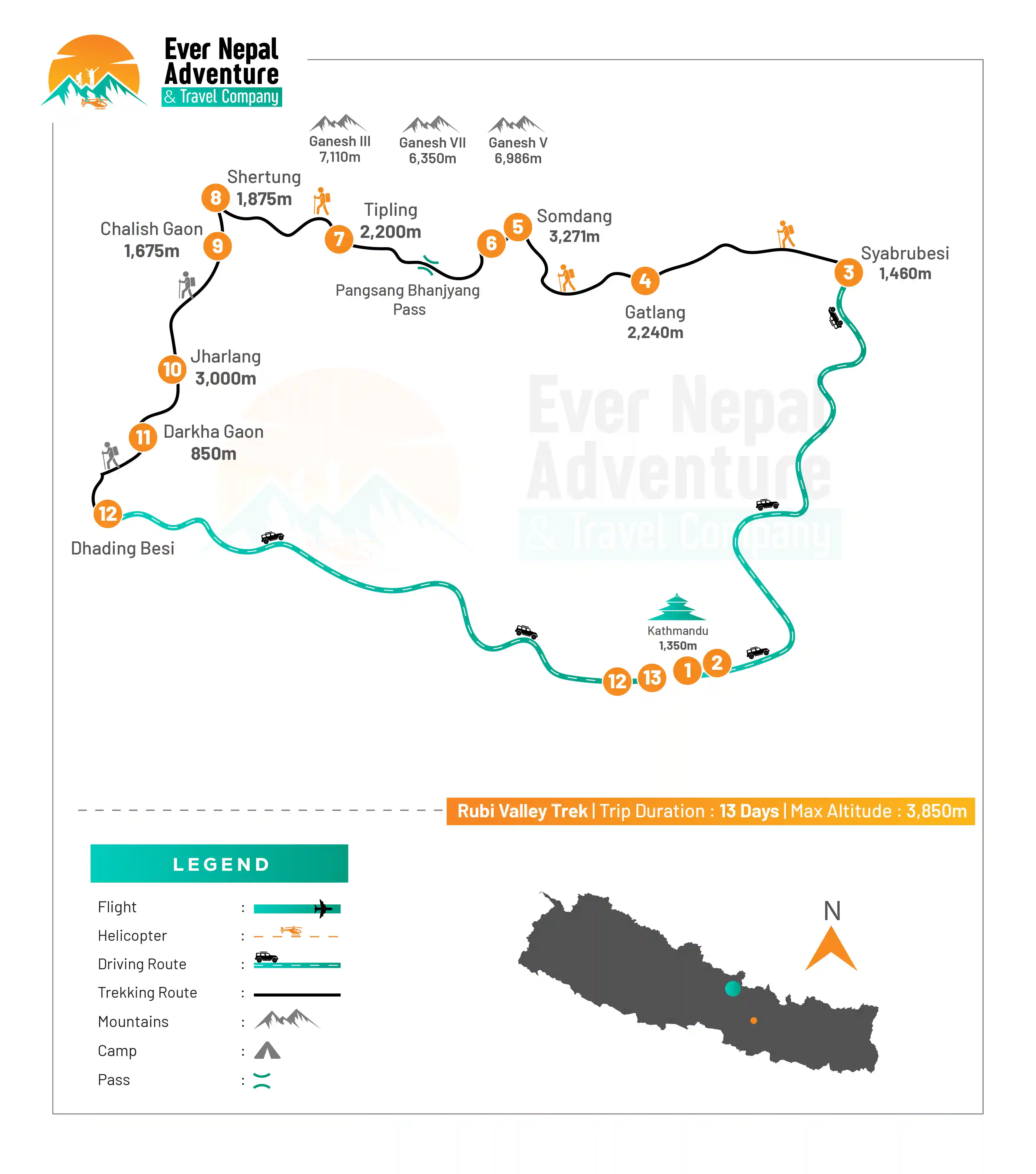
Trek Route

Ruby valley trek route

Packing List for Rubi Valley Trek (13 Days)

Rubi Valley is one of the best trekking destinations in Nepal, and if you are planning to go on this trek, carrying the right set of gear is essential for both your safety and comfort. Additionally, the right set of gears also allows you to adapt to the changing weather and terrain as well. To ensure that you get the best experience during the Rubi Valley Trek, the key gears for your packing list include: 

Head

  • Wide-brimmed sun hat
  •  Warm woolen beanie
  •  Neck gaiter or buff
  •  UV-protected sunglasses
  •  High-SPF sunscreen
  •  Lip balm
  •  Facial wipes
  •  Lightweight headlamp with extra batteries
  •  Sun cap or trekking hat
  •  Fleece headband for ear protection

Hands

  • Waterproof gloves
  •  Insulated warm gloves
  •  Light fleece gloves for mild weather
  •  Hand warmers (optional)

Upper Body

  • Moisture-wicking thermal base layers
  •  Quick-drying trekking t-shirts
  •  Breathable long-sleeved trekking shirts
  •  Fleece jacket for insulation
  •  Lightweight down jacket
  •  Waterproof and windproof outer shell jacket
  •  Light puffy jacket for cold evenings
  •  Raincoat or poncho
  •  Warm mid-layer sweater or fleece

Lower Body

  • Thermal innerwear
  •  Full-length trekking pants
  •  Waterproof trekking pants
  •  Insulated trekking trousers
  •  Comfortable cotton pants for evenings
  •  Light fleece trekking trousers
  •  Lightweight hiking shorts (optional)

Footwear

  • Durable waterproof hiking boots
  •  Lightweight sandals or camp shoes
  •  Gaiters for mud and dust protection
  •  Moisture-wicking wool socks (4–5 pairs)
  •  Light inner socks for comfort
  • Toiletries
  • Toothbrush and toothpaste
  •  Quick-dry towel
  •  Soap or body wash
  •  Small shampoo bottle
  •  Hand sanitizer
  •  Toilet paper
  •  Wet wipes
  •  Nail cutter
  •  Moisturizer and skin cream
  •  Personal hygiene items

Accessories

  • Sleeping bag suitable for cold nights
  •  Large duffle bag
  •  Small backpack or daypack
  •  Reusable water bottle or hydration bladder
  •  Water purification tablets or a filter
  •  Lightweight trekking poles
  •  Dry bags or waterproof covers
  •  Map or trekking guidebook
  •  Notebook or journal
  •  Energy bars and snacks
  • First Aid Kit
  • Diamox for altitude adjustment
  •  Painkillers (ibuprofen or paracetamol)
  •  Bandages and medical tape
  •  Antiseptic cream and wipes
  •  Blister care kit and foot tape
  •  Anti-diarrhea medicine
  •  Cold and flu tablets
  •  Personal prescription medicines
  •  Basic gauze and dressing materials

Miscellaneous Items

  • Camera or smartphone
  •  Power bank(s)
  •  Travel adapter
  •  Extra charging cables
  •  Spare batteries
  •  Binoculars (optional)
  •  Reusable shopping bag
  •  Lightweight thermos flask
  •  Dust mask
  •  Small sewing kit
  •  Ziplock or plastic bags for organization

Specific Gears for Women

While on this trek, women trekkers may need additional gear for additional comfort, hygiene, and convenience. These items not only help women feel at ease but also enhance their confidence and readiness during the trek as well. Some of the key women-specific gears for this trek include: 

  • Undergarments
  • Sports bra
  • Sanitary pads
  • Tampons
  • Travel-size shampoo
  • Skincare products (moisturizer, sunscreen, cleanser)
  • Fleece headband
  • Comfortable leggings or thermal tights
  • Personal hygiene wipes 

Documents

Certain documents are required to successfully complete the Rubi Valley Trek (13 Days). These permits shall aid you in ensuring that your trekking experience is safe and smooth. The key essentials for this trek include:

  • Langtang National Park Permit: This is a mandatory permit for accessing the area of Langtang National Park, considering that the trekking route of Rubi Valley goes through forest areas and biodiversity regions connected to the Langtang region. It can be obtained from the Nepal Tourism Board in Kathmandu or at designated entry points along the trail. The charges are NPR 3,000 ($23) for foreigners, NPR 1,000 ($8) for SAARC nationals, and NPR 100 for Nepalese citizens, respectively.
  • TIMS Card (Trekkers’ Information Management System): It is an obligatory trekking card that ensures trekkers’ monitoring and recording. It assists trekkers in being monitored by concerned bodies in isolated places such as the Rubi Valley for their safety reasons. It can be acquired either from the Nepal Tourism Board or from any trekking agency in Kathmandu. The price is NPR 2,000 ($15) for foreign visitors. 
  • Permit of Local Rural Municipality (Rubi Valley Permit): It is an essential permit for treks along the local rural municipalities in the Rubi Valley trekking route connecting to both the Langtang and Manaslu regions. It is usually arranged through a licensed trekking agency or collected at entry points on the route. The cost ranges from NPR 1,000–2,000 ($8–$15) depending on the area. 
  • Passport: A valid passport must be carried, which should have validity for at least 6 months after the date of entry into the country.Passport Photos: At least 2 to 4 passport-size photos should be carried by the visitors while trekking, as they would be needed to obtain permits as well as for other purposes.
  • Travel Insurance: Travel insurance is necessary for all trekkers. The travel insurance policy needs to cover high-altitude trekking, emergency helicopter evacuation, and medical expenses in remote areas.

What's included

  • Car or jeep pick-up and transfer to the airport privately.

  • Two days stay in Kathmandu in a 3-star hotel that includes breakfast.

  • Kathmandu to Syabrubesi and Dhading Besi to Kathmandu by public bus.

  • Food on the trek (breakfast, lunch and dinner).

  • Lodging accommodation on the trek in trekking lodges (tea houses) or tented camps.

  • Guide services of a licensed, English-speaking trek leader (an assistant guide is offered on a group of 10 or above) and luggage carrier, a porter.

  • Well trained Sherpa porters with adequate safety and trekking equipment; porter service includes salary, food, accommodation and insurance (one porter to every two trekkers).

  • Sherpa Expedition and Trekking provide all the guides and porters with meals, insurance, accommodation, transportation, and equipment.

  • Necessary documents and licenses such as Langtang National Park permit and TIMS card.

  • All taxes of the government and the localities, and all official expenses.

  • Carm/jeep Sightseeing Kathmandu valley.

  • Emergency rescue or health problems (like altitude sickness) are covered by travel insurance.

  • One Sherpa Expedition and Trekking t-shirt with a souvenir.

  • Trekking equipment will be used (sleeping bag, down jacket, duffel bag, walking poles (when necessary), which will be returned at the end of the trek).

  • Sherpa Expedition and Trekking certificate of completion on completion of the trek.

  • Monitoring of health daily by use of oxygen meter to measure pulse, oxygen levels and heart rate to prevent altitude sickness.

What's excluded

  • International airfares

  • Nepal entry visa charge (easy to get visa on arrival at Tribhuvan International Airport - Kathmandu). 30 USD 15 days, 50 USD 30 days, and 125 USD 90 days visa.

  • Additional accommodation in Kathmandu because of early arrival or late departure or early coming back of trek.

  • All the alcoholic and nonalcoholic, soup, tea, coffee, hot chocolate, cocoa, mineral water, extra food, cold and hot drinks on trek ( i.e. what you wish to buy on the trek and in the tea houses during evenings)

  • Everything sweet such as chocolate, cake, pie, pudding.

  • Battery charging and hot shower in the tea houses.

  • Dinner and lunch in Kathmandu.

  • Personal clothing and gear

  • Travel insurance that must include emergency high-altitude evacuation and rescue (compulsory)

  • Guide and porter tips (which is advisable in our society - and deserved too)

  • Other expenses or delay due to events that were not under our control such as landslides, bad weather, itinerary alteration due to safety reasons, sickness and government policies and strikes.

  • Any costs and expenses not mentioned in the list of costs include will be included under exclusions.

Frequently Asked Questions

Is the Rubi Valley Trek isolated from other trekking routes?

The Rubi Valley Trek trail is among the most isolated trekking routes in Nepal, which is even quieter than the Everest and Annapurna regions. You may need a few hours until you encounter other trekkers. This isolation is what makes the route unique.

Can I charge my gadgets along the way?

Yes, but it might be hard since the available charging points will be scarce. You will have to pay for charging your mobile phones and cameras. It would be wise to carry a battery pack or a solar charger.

Are there any medical facilities on the route?

There are no fully equipped hospitals en route to Rubi Valley, given its remoteness. The only help one can receive on this trip is first aid in some villages or provided by your guide. In case of severe problems, you'll need to be evacuated to Kathmandu.

How cold does it become while trekking?

The temperature depends on the time of year and altitude. Nighttime in general becomes extremely cold at altitudes higher than 3000 m. During spring and fall, the weather is nice during the day but may become close to freezing in the evening.

Is it necessary to have any experience of trekking in order to undertake the Rubi Valley?

Having experience will certainly be helpful, but not compulsory. Rather, this trek is a matter of enduring physical strength, and people with less experience can do it as well as long as they are physically prepared.

Can I withdraw cash using my ATM card?

There are no ATMs at all once you leave Kathmandu; hence, you should carry Nepali currency along with you right from the start of your trek.

What will be the culture I will come across during my trek?

You will be exposed to a blend of both Tamang and Gurung cultures on your way. There are monastery buildings, prayer flags, mani walls, and the entire Himalayan lifestyle in the villages. Cultural engagement is one of the most thrilling facets of the trekking adventure.

Is the water from taps or streams safe to drink during the trek?

Water that can be found in taps and streams should be purified first to be able to consume it safely. Water purifying tablets or filters should be used by the trekkers. Otherwise, it can be boiled in teahouses.

How much should my pack weigh?

Daypacks are best kept within the 6 to 10 kilograms range. Porters tend to transport all the main luggage. Thus, you have to take along only essential items for the day.

What sets Rubi Valley apart from other trekking regions in Nepal?

One unique characteristic of Rubi Valley is that it remains untouched and highly non-commercialized. The trails within this region are peaceful and culturally rich, making them great connections to the mountains surrounding the region.

User Review