Lobuche Peak Expedition for 18 Days

Tour Info

trip code

06

Starting Point/ End Point

Kathmandu

Accommodations

Lounge and tea house

Max Altitude

6119m

Duration

18 days

country

Nepal

Trip grade

Challenging

Activities

Trekking

Best Season

February, March, April, May, June, September, October, November and December

Overview

Lobuche East Peak Climbing is a well-known trekking peak in Nepal, designed for trekkers who want to experience real alpine climbing. It reaches 6,119 meters and includes a mix of glacier walking, steep snowy sections, and fixed rope climbing. The route is physically demanding and requires basic climbing skills along with good fitness. Climbers usually progress step by step through high-altitude terrain, making it a good training peak for those aiming for bigger Himalayan expeditions in the future.

The climb involves moving across icy slopes and navigating a false summit before reaching the true top of Lobuche East. Final section is steeper and more technical, requiring focus and the use of climbing gear. From the upper sections of the mountain, the surrounding Himalayan landscape becomes more dramatic, giving a strong sense of height and isolation. With proper guidance and preparation, it offers a rewarding high-altitude adventure in the Everest region.

Highlights

  • Explore Kathmandu before starting your journey and get ready for the adventure ahead

  • Enjoy a scenic flight to Lukla, one of the most exciting flights in the mountains

  • Walk through the beautiful Everest region and enter Sagarmatha National Park

  • See different plants, landscapes, and natural beauty along the trail

  • Visit Everest Base Camp and hike to Kala Patthar for amazing views before climbing Lobuche Peak

  • Enjoy wide mountain views, including Mount Everest (8,848 meters)

  • See other beautiful peaks like Lhotse, Nuptse, Pumori, Ama Dablam, and Cholatse

  • Stay in simple tea houses and experience local life

  • Learn about Sherpa culture, traditions, and daily lifestyle during the trek

  • Enjoy the warm welcome and friendly nature of the local people throughout the journey

Itinerary

Day 01: Arrival in Kathmandu and trip preparation 1,350 meters/4,429ft

Upon arrival at Kathmandu, a team member will meet you at the airport and transfer you to your hotel. After check-in, you can rest and recover from your journey. Later, there will be a short briefing at the office where you meet your trekking guide and team members. You will get important information about the Lobuche Peak climbing trip and can ask any questions. In the evening, you are free to walk around Thamel and explore the local shops, cafes, and streets at your own pace.

  • Max Elevation: 1,350 meters

  • Travel Distance: 6 to 8 kilometers airport to hotel transfer (short drive)

  • Travel Hours: 20 to 30 minutes

  • Accommodation: 3-star hotel

  • Meal: Dinner

Day 02: Full day guided tour and sightseeing in Kathmandu valley

After having breakfast, your guide from Ever Nepal Adventure will come to the hotel to pick you up. Thereafter, you will undertake a full-day guided sightseeing tour around the Kathmandu Valley. In order to ensure you have enough time at each place, the schedule for the day has been arranged accordingly. The guide will tell you about the significance of all the sites visited today so that you can learn more about Nepal prior to climbing up into the mountains.

During the sightseeing tour, you will visit several UNESCO World Heritage Sites.

  • Swayambhunath Stupa

It is one of the oldest Buddhist stupas located in the hill overlooking the valley of Kathmandu. The temple has earned its nickname because there are monkeys living around there. However, the temple is mostly known due to its peaceful atmosphere, colored prayer flags, and the Buddha Eye symbolizing wisdom and knowledge. The stupa is considered holy by both Hindus and Buddhists and offers amazing vistas over the whole city.

  • Pashupatinath Temple

Pashupatinath, located along the banks of the Bagmati River, is one of Hinduism's most sacred temples. The complex is characterized by traditional pagoda architecture, sacred shrines and riverside ghats. Hindu cremation rituals take place on these ghats. The main temple is only open to Hindus. However, the surrounding area offers a fascinating insight into Nepalese spiritual traditions.

  • Boudhanath

Boudhanath, one of the biggest Buddhist stupas around the world, is an important center for Tibetan Buddhism in Nepal. It was built in the 5th Century and is easily recognized by its white dome, which represents the all-seeing eye of Buddha. Around the stupa are monasteries and shops as well as prayer wheels. Pilgrims and monks chant prayers while they circle clockwise around it.

  • Bhaktapur Durbar Square

Bhaktapur Durbar Square reflects the best of Newari architecture, traditional craftsmanship and Newari culture. It was once the seat of the Malla Kings and is full of ancient palaces. The 55-Window Palace and Nyatapola Temple are among the highlights of Nepal's cultural and artistic legacy.

You return to your hotel at night after the tour. You can relax, rest, and prepare for your Lobuche Peak adventure.

  • Max Elevation: 1,500 meters (sightseeing points in valley)

  • Travel Distance: 20 to 25 kilometers (throughout the sightseeing tour)

  • Travel Hours: 5 to 6 hours

  • Accommodation: 3-star hotel 

  • Meal: Breakfast, Lunch, and Dinner

Day 03: Fly to Lukla and trek to Phakding 2,610 meters/9,187ft

Early in the morning, you take a short scenic flight from Kathmandu to Lukla. During the 35-minute scenic flight, you can enjoy views of hills, rivers, terraced fields, and snow-covered peaks. After a smooth but dramatic landing at Lukla Airport, the trekking journey begins. From Lukla, the trail follows a well-marked path along the Dudh Koshi River. The walk is gentle and pleasant, passing through small Sherpa settlements, monasteries, prayer flags, and Mani stone walls. You cross villages like Chheplung (2,660m), Thado Koshigaon (2,580m), and Nuring (2,492m), enjoying the peaceful mountain atmosphere along the way. After a few hours of walking, you reach Phakding (2,610m), a quiet riverside village where you stay overnight in a teahouse and rest for the next day’s journey toward Namche Bazaar.

  • Max Elevation:  2,610 meters

  • Travel Distance: 8 to 9 kilometers

  • Travel Hours: 3 to 4 hours

  • Accommodation: Teahouse in Phakding

  • Meal: Breakfast, Lunch, and Dinner

Day 04: Phakding to Namche Bazaar 3,438 meters/11,280ft

After breakfast in Phakding, the trail continues through beautiful pine forests and follows the Dudh Koshi River. Along the way, you enjoy views of surrounding hills and distant peaks like Thamserku. The route passes small villages such as Toktok and Benkar before reaching Monjo, where the entrance to Sagarmatha National Park is located. From Monjo, the trail becomes more challenging after crossing several suspension bridges, including the famous Hillary Bridge. After crossing the river system of Dudh Koshi and Bhote Koshi, the path climbs steeply uphill. This is the most demanding part of the day but also very rewarding. As you approach Namche Bazaar, the first clear views of big peaks like Mount Everest, Lhotse, and Nuptse appear on a clear day. Trail also passes through Jorsale, where trekkers often stop briefly to rest and refresh. Finally, you reach Namche Bazaar, a lively mountain town where you stay overnight in a teahouse and prepare for acclimatization.

  • Max Elevation: 3,438 meters 

  • Travel Distance: 10 to 11 kilometers

  • Travel Hours: 5 to 6 hours

  • Accommodation: Teahouse in Namche Bazaar

  • Meal: Breakfast, Lunch, and Dinner

Day 05: Acclimatization Day at Namche Bazaar 3,438 meters/11,280ft

Often known as “Sherpa capital” or “Gateway to Mt. Everest”; Namche Bazaar located at 3,440 meters is a prosperous Sherpa town that provides an excellent place to trekkers for acclimatization purposes. Spending a day here helps your body adapt to lower oxygen levels before going higher into the mountains, reducing the risk of altitude sickness. To stay active, you take a short hike around Namche. A popular option is walking up to a nearby viewpoint where you can see stunning mountain scenery on a clear day. You can also explore the town, visit the Sagarmatha National Park Visitor Centre, or learn about local culture at the Sherpa museum. The rest of the day is free for you to relax, explore local bakeries, shops, and enjoy the mountain atmosphere. This easy day helps your body recover and prepares you for the higher altitude ahead on the Lobuche Peak journey.

  • Max Elevation: 3,880 meters (optional hike to viewpoint)

  • Travel Distance: 3 to 4 kilometers (Short hike around Namche)

  • Travel Hours: 4 hours (hike and exploration)

  • Accommodation: Teahouse in Namche Bazaar

  • Meal: Breakfast, Lunch, and Dinner

Day 06: Namche Bazaar to Tengboche 3,870 meters/12,697ft

After leaving Namche Bazaar, you follow a gentle path along the hillside with beautiful views of the valley below. As you walk, you can enjoy wide mountain scenery including peaks like Ama Dablam, Lhotse, Nuptse, and Mount Everest in the distance. The trail continues through peaceful forest areas and small settlements. After reaching Phunki Tenga (3,260m), the path crosses the river and begins a steep uphill climb. This is the most challenging part of the day, but the forest surroundings make the walk more enjoyable. You reach Tengboche (3,870m), a beautiful village surrounded by mountains, after a steady ascent. Here you can visit the famous Tengboche Monastery, a peaceful spiritual site with amazing views of the Himalayas. In the evening, you stay in a teahouse, relax, and enjoy the calm mountain atmosphere.

  • Max Elevation: 3,870 meters

  • Travel Distance: 9 to 10 kilometers

  • Travel Hours: 5 to 6 hours 

  • Accommodation: Teahouse in Tengboche

  • Meal: Breakfast, Lunch, and Dinner

Day 07: Tengboche to Dingboche 4,360 meters/14,305ft

The trail starts with a gentle descent through forested sections filled with rhododendron and pine trees, after leaving the Tengboche Monastery area. As you continue, you pass small villages like Deboche and cross suspension bridges over the Imja Khola River, enjoying peaceful mountain surroundings along the way. The route then climbs steadily toward Pangboche village, one of the oldest Sherpa settlements in the region. From here, the landscape begins to change, with fewer trees and more open alpine terrain. You can see stone walls, yak grazing fields, and wide valley views as you follow the Imja Valley. As you move higher, the trail becomes more exposed and dry, giving a true high-altitude feeling. Gradually, you reach Dingboche (4,360m), a quiet mountain village surrounded by impressive peaks like Ama Dablam and Lhotse. This is an important stop for rest and acclimatization before going higher into the Everest region.

  • Max Elevation: 4,360 meters

  • Travel Distance: 11 to 12 kilometers

  • Travel Hours: 5 to 6 hours

  • Accommodation: Teahouse in Dingboche

  • Meal: Breakfast, Lunch, and Dinner

Day 08: Acclimatization at Dingboche 4,360 meters/14,305ft

You can spend the whole day at Dingboche for acclimatization, instead of following the trail. This rest day is very important for safe trekking in the days ahead. In the morning, you take a steady hike up to Nagarjun Hill (around 5,100m). The trail is steep and challenging, so you walk slowly and carefully. As you climb higher, the views become wider and more impressive. From the top, you can see amazing close-up views of mountains like Ama Dablam, Lhotse, Kangtega, Taboche, and Makalu. After spending some time enjoying the view, taking photos, and resting, you descend back to Dingboche for lunch. The afternoon is free for rest, hydration, and relaxation. This extra day helps your body adjust well before continuing the climb higher into the Everest region.

  • Max Elevation: 5,100 meters (Nagarjun Hill)

  • Travel Distance: 5 to 6 kilometers (round trip)

  • Travel Hours: 4 to 5 hours

  • Accommodation: Teahouse in Dingboche

  • Meal: Breakfast, Lunch, and Dinner

Day 09: Dingboche to Lobuche 4,940 meters/16,208ft

As you continue to trek to Lobuche from Dingboche, which is as high as the trail leading to the base of Mount Everest. The trail starts with a gradual climb through open valley landscapes, following the Khumbu Valley with views of surrounding peaks like Ama Dablam, Cholatse, Pumori, and Lobuche Peak. After a few hours, you reach Dughla (Thukla), a small stop where trekkers usually rest and have lunch. From here, the trail becomes steeper as you climb toward Thukla Pass (4,830m), which is the most demanding part of the day. At the top, you will see the Everest Memorial, a peaceful site built in memory of climbers and Sherpas. The trail continues more easily along the edge of the Khumbu Glacier, with dramatic mountain views all around, after the pass. Finally, you reach Lobuche village, a quiet high-altitude settlement where you stay overnight and prepare for the next stage of the journey.

  • Max Elevation: 4,940 meters

  • Travel Distance: 8 to 9 kilometers

  • Travel Hours: 5 to 6 hours

  • Accommodation: Teahouse in Lobuche

  • Meal: Breakfast, Lunch, and Dinner
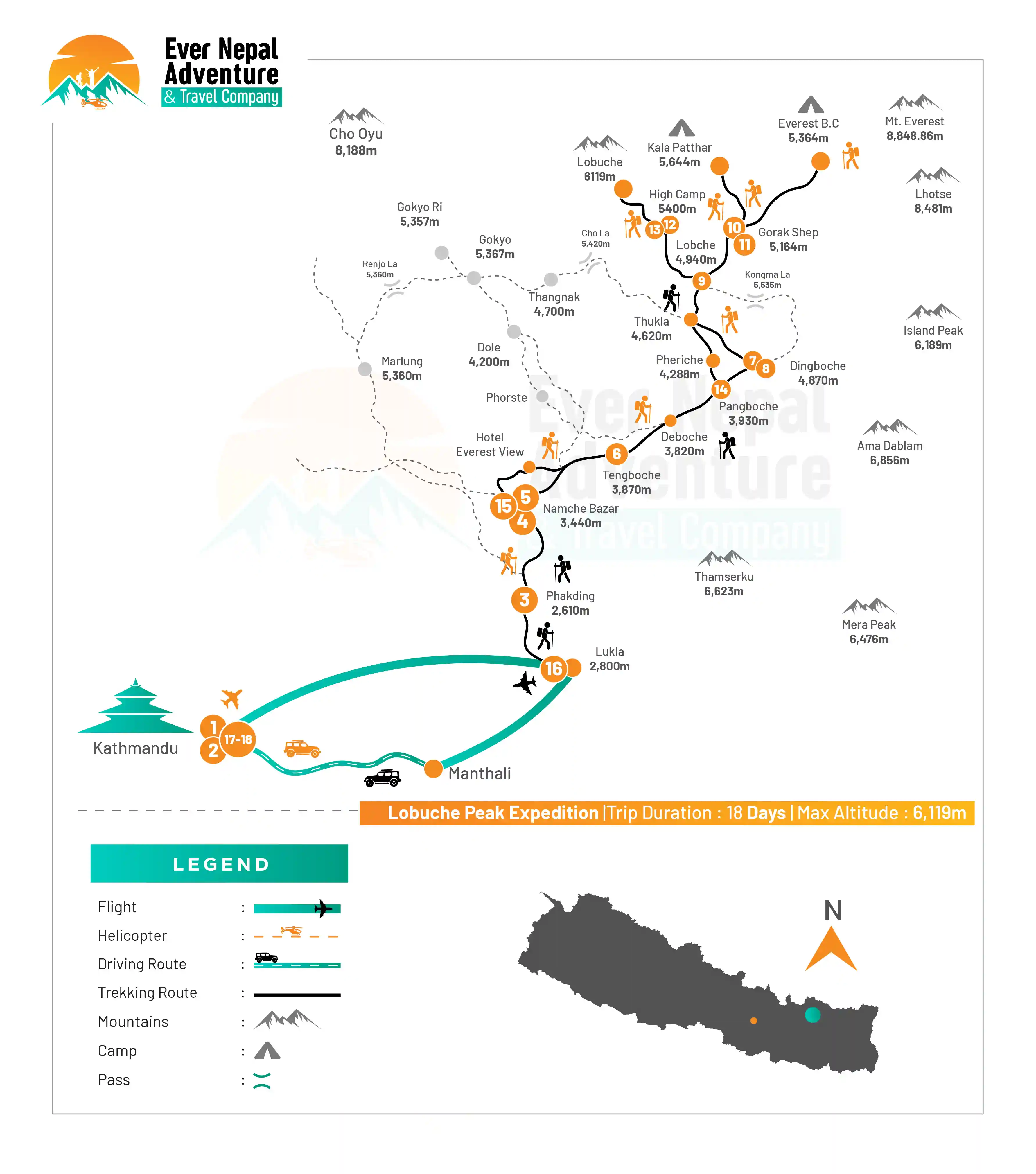
Day 10: Lobuche to Gorak Shep and Detour Everest Base Camp 5,364 meters/17,599ft

This day is one of the most exciting days of the trek as you move from Lobuche toward Gorak Shep and continue to Everest Base Camp. Trail first takes you gradually over rocky terrain and glacial moraines, with views of ice formations and the vast Khumbu Glacier below. The walk is challenging due to altitude and uneven ground, so slow and steady movement is important. After reaching Gorak Shep (5,180m), you take a short break before continuing toward Everest Base Camp. From Gorak Shep, the trail follows a rugged path along the glacier, passing rocky sections and icy landscapes. After a few hours of effort, you finally reach Everest Base Camp, where you can see the famous Khumbu Icefall and surrounding peaks. You return back to Gorak Shep for the night, feeling the achievement of reaching one of the world’s most iconic trekking destinations, after spending time enjoying the view and taking photos.

  • Max Elevation: 5,364 meters

  • Travel Distance: 10 to 11 kilometers (Lobuche to Gorak Shep to EBC to Gorak Shep)

  • Travel Hours: 6 to 7 hours

  • Accommodation: Teahouse in Gorak Shep

  • Meal: Breakfast, Lunch, and Dinner

Day 11: Gorak Shep to Kala Patthar to Lobuche

Early in the morning, you hike from Gorak Shep toward Kala Patthar, one of the best viewpoints in the Everest region. The climb is steep and challenging due to high altitude, but the effort is worth it. Kala Patthar (5,550m) is a rocky hill known for its amazing sunrise views over the Himalayas. From the top, you get a clear 360-degree view of major peaks including Mount Everest, Lhotse, Nuptse, Ama Dablam, Pumori, and surrounding peaks like Thamserku and Changtse. After spending time enjoying the view and taking photos, you descend back to Gorak Shep for breakfast. Later, you continue your descent back to Lobuche, walking slowly through the rocky trail. After reaching Lobuche, you rest and recover after a challenging but rewarding high-altitude day.

  • Max Elevation: 5,550 meters

  • Travel Distance: 8 to 9 kilometers (round trip + descent to Lobuche)

  • Travel Hours: 6 to 7 hours

  • Accommodation: Teahouse in Lobuche

  • Meal: Breakfast, Lunch, and Dinner

Day 12: Trek to High Camp 5400 meters/17,717ft

As you leave Lobuche today and start a short but steep climb toward High Camp, the trail is rocky and quiet, with fewer trekkers as you move higher into the alpine zone. The air becomes thinner, so you walk slowly and take regular breaks. Along the way, you can still enjoy wide views of the surrounding mountains and glaciers, including peaks like Lobuche Peak and nearby Himalayan ranges. The landscape becomes more rugged and exposed, showing the true high-mountain environment of the Everest region, as you gain altitude. You reach Lobuche High Camp (5,400m), after a few hours of steady climbing. This is a basic camping area set up for climbers preparing for the summit push. After arrival, you rest, have a warm meal, and get your equipment ready for the next day’s big climb. Proper hydration and rest are important here as the summit day approaches.

  • Max Elevation: 5400 meters

  • Travel Distance: 3 to 4 kilometers

  • Travel Hours: 3 to 4 hours

  • Accommodation: Tent camp at Lobuche High Camp

  • Meal: Breakfast, Lunch, and Dinner

Day 13: High camp to summit and back high camp 6119 meters/20, 076ft

You make the summit push today, so this is the most important and challenging day of the expedition as you attempt the summit of Lobuche Peak. The climb starts very early, around 1–2 AM, from High Camp. You begin in the dark with headlamps, moving slowly on a steep rocky trail. After a few hours, you reach the crampon point where you put on climbing gear. From here, the route continues over snow and ice using fixed ropes and ascenders for safety. As you climb higher, the terrain becomes more technical and demanding. After several hours of steady climbing, you finally reach the summit at 6,119m. From the top, you enjoy incredible views of giant peaks including Mount Everest, Lhotse, Makalu, Cho Oyu, Ama Dablam, and Nuptse. After spending some time at the summit, taking photos and enjoying the views, you carefully descend back to High Camp. The return journey is slow and controlled, but rewarding after a successful climb. You rest overnight at High Camp, feeling a strong sense of achievement.

  • Max Elevation: 6,119 meters

  • Travel Distance: 6 to 7 kilometers (round trip)

  • Travel Hours: 8 to 10 hours

  • Accommodation: Tent at Lobuche High Camp

  • Meal: Breakfast, Lunch, and Dinner

Day 14: Trek to Pheriche/Pangboche 3985 meters/13075ft

After successfully completing the climb at Lobuche Peak, today you begin your long descent. From High Camp, the trail goes down slowly through rocky and open terrain with wide mountain views. You retrace your steps past Lobuche and continue toward Thukla, where many trekkers stop for rest or lunch. From Thukla, the trail becomes easier as you descend into the wider Pheriche Valley. The air becomes richer in oxygen, making walking more comfortable after the summit push. You may also see familiar peaks like Ama Dablam and surrounding mountains from a different angle as you lose altitude. In the afternoon, the trail continues with gentle ups and downs toward Pangboche village, one of the oldest Sherpa settlements in the region. You stay overnight in a cozy teahouse, enjoying a warm meal and the peaceful mountain environment after a demanding climbing experience.

  • Max Elevation: 5,400 meters (start from High Camp)

  • Travel Distance: 10 to 12 kilometers

  • Travel Hours: 8 to 9 hours

  • Accommodation: Teahouse in Pheriche or Pangboche

  • Meal: Breakfast, Lunch, and Dinner

Day 15: Pheriche to Namche Bazaar 3,438 meters /11,280ft

You start your descent from Pheriche today and head back toward Namche Bazaar. The trail first moves through open, dry landscapes before slowly changing into greener surroundings with pine and juniper forests. As you lose altitude, breathing becomes easier and the air feels much more comfortable compared to the higher sections. Along the way, you pass through familiar villages like Pangboche and Tengboche, with beautiful views of mountains such as Ama Dablam and distant glimpses of Mount Everest. The route includes some steep downhill sections that can be tiring on the knees, so steady walking is important. After several hours of trekking, you arrive back at Namche Bazaar. Here you return to a comfortable teahouse, enjoy a warm shower, good food, and a relaxed evening after many days in higher altitude areas.

  • Max Elevation: 3,985 meters (start from Pheriche)

  • Travel Distance: 14 to 15 kilometers

  • Travel Hours: 6 to 7 hours

  • Accommodation: Teahouse in Namche Bazaar

  • Meal: Breakfast, Lunch, and Dinner

Day 16: Namche Bazaar to Lukla 2,800 meters/9,187ft

This is your final trekking day in the Everest region as you descend from Namche Bazaar back to Lukla. The trail begins with a steep downhill section and then follows the Dudh Koshi River for most of the journey. Walking through familiar villages, forests, and suspension bridges, you enjoy the last views of the Himalayan landscape. The route includes both descents and a few short uphill sections, making it a long but pleasant day of walking. You stop along the way for lunch and short breaks before making the final climb up to Lukla. As you arrive, there is a strong feeling of completion after days of trekking and climbing in the high mountains. In Lukla, you settle into a teahouse and spend the evening celebrating the successful journey with your guide and porters. It is a special moment to reflect on the adventure and the memories made during the Lobuche Peak expedition.

  • Max Elevation: 3,438 meters (start from Namche Bazaar)

  • Travel Distance: 19 to 20 kilometers

  • Travel Hours: 6 to 7 hours

  • Accommodation: Teahouse in Lukla

  • Meal: Breakfast, Lunch, and Dinner

Day 17: Fly to Kathmandu 1350 meters/4,429ft

You take an early morning flight from Lukla back to Kathmandu today. This short flight offers beautiful aerial views of the Everest region, including deep valleys, winding rivers, and snow-covered peaks one last time from above. It is a peaceful and scenic way to end your mountain journey. After landing in Kathmandu, you transfer to your hotel and have the rest of the day free. You can relax after the long trekking and climbing adventure, enjoy good food, or simply rest in the city. Many travelers also choose to explore local markets for souvenirs or visit cultural sites such as temples and stupas at their own pace. This day is mainly for rest, recovery, and enjoying the contrast between the quiet mountains and the busy city life of Kathmandu after your successful Lobuche Peak expedition.

  • Max Elevation: 2,860 meters (Lukla)

  • Travel Distance: Flight distance approximately 138 kilometers (Lukla to Kathmandu)

  • Travel Hours: 25 minutes (flight)

  • Accommodation: 3-star hotel

  • Meal: Breakfast

Day 18: Final departure 1350 meters/4,429ft

After an unforgettable adventure of trekking and climbing in the Everest region, it is time to return home. A team member will transfer you from your hotel in Kathmandu to the airport for your international flight. This marks the end of your Lobuche Peak expedition, where you experienced high mountains, local culture, and challenging trails. You will leave with strong memories of the Himalayas, new friendships, and a great sense of achievement. As you head into the airport, it is a final moment to reflect on the journey before boarding your flight home.

  • Max Elevation: 1,350 meters

  • Travel Distance: 6 to 8 kilometers (Hotel to airport transfer)

  • Travel Hours: 20 to 40 minutes

  • Accommodation:

  • Meal: Breakfast (depending on flight time)

What's included

  • Round-trip domestic flights between Kathmandu and Lukla

  • Three meals a day during the trek (breakfast, lunch, and dinner) with options like Nepali, Indian, Chinese, Italian, and simple European dishes

  • Teahouse accommodation on a twin-sharing basis throughout the trek as per the itinerary

  • Experienced, English-speaking, and government-licensed trekking guide

  • Porter service (1 porter for 2 to 3 trekkers and solo trekkers can hire an extra porter at additional cost)

  • Guide and porter expenses including meals, accommodation, salary, and insurance.

  • All necessary paperwork, government charges, and local taxes

  • Full camping setup during the climbing period including tents (sleeping, dining, kitchen, and toilet), along with tables, chairs, and mattresses

  • Base camp staff support and experienced climbing Sherpa for the summit attempt

  • Meals from base camp to base camp during the climbing period

  • Basic climbing gear provided such as crampons, harness, ice axe, carabiners, and screw gear

What's excluded

  • International flights to and from Nepal

  • Hotel accommodation and meals in Kathmandu before and after the trek

  • All drinks including tea, coffee, bottled water, soft drinks, and alcoholic beverages

  • Personal trekking or climbing gear such as climbing boots (can be rented if needed)

  • Travel insurance, including high-altitude trekking and climbing coverage (mandatory), along with emergency rescue and helicopter evacuation

  • Personal expenses like snacks, souvenirs, laundry, Wi-Fi, and battery charging

  • Tips for guides, porters, and drivers (optional but recommended)

  • Extra activities outside the itinerary such as cultural tours or additional hikes

  • Equipment rental for climbing if not included or if you prefer personal gear

  • Additional costs caused by delays due to weather, flight cancellations, landslides, or other natural events

  • Personal medical expenses not covered by the group first-aid kit

  • Any cost not specifically mentioned

Packing List for Lobuche Peak Expedition

If you are planning to climb Lobuche Peak, carrying proper mountaineering gear is extremely important for safety, warmth, and successful summit preparation. This expedition involves glacier walks, snowy sections, and extremely cold high altitude weather. Climbing with a smart packing list makes sure that you're comfortable, organized, and ready to handle the changing weather conditions of the mountain throughout the trip.

Head

  • Warm insulated beanie

  • Sun hat or cap

  • Balaclava or neck gaiter

  • UV-protected glacier sunglasses

  • Ski goggles for snowy conditions

  • High-SPF sunscreen

  • Lip balm with SPF

  • Headlamp with spare batteries

Hands

  • Light inner gloves

  • Warm insulated gloves

  • Waterproof outer gloves or mittens

Upper Body

  • Thermal base layers

  • Quick-dry trekking t-shirts

  • Full-sleeved trekking shirts

  • Warm fleece jacket

  • Heavy insulated down jacket

  • Waterproof and windproof shell jacket

  • Lightweight puffy jacket

  • Down vest (optional)

Lower Body

  • Thermal inner leggings

  • Trekking trousers

  • Softshell climbing pants

  • Waterproof outer pants

  • Fleece pants for camp use

  • Comfortable lower wear for teahouses

Footwear

  • Insulated mountaineering boots

  • Camp shoes or sandals

  • Gaiters for snow protection

  • Woolen socks (multiple pairs)

  • Moisture-wicking trekking socks

  • Microspikes or crampons

Climbing Equipment

  • Climbing harness

  • Ice axe

  • Helmet

  • Carabiners and safety cords

  • Ascender and descender devices

  • Climbing rope (usually provided by operator)

  • Crampons

  • Trekking poles

Toiletries

  • Toothbrush and toothpaste

  • Toilet paper

  • Wet wipes

  • Quick-dry towel

  • Soap or face wash

  • Small shampoo bottle

  • Hand sanitizer

  • Moisturizer for dry skin

Accessories

  • Sleeping bag (-15°C to -20°C recommended)

  • Duffel bag

  • Day backpack with rain cover

  • Water bottles or hydration bladder

  • Water purification tablets

  • Power bank

  • Travel adapter

  • Dry bags for electronics

First Aid Kit

  • Diamox for altitude sickness

  • Painkillers

  • Antiseptic cream or wipes

  • Bandages and blister care

  • Personal prescription medicines

  • Cold and cough tablets

  • ORS packets

  • Altitude medication if prescribed

Miscellaneous Items

  • Camera or mobile phone

  • Extra batteries

  • Snacks and energy bars

  • Notebook or journal

  • Binoculars

  • Extra memory cards

Specific Gears for Women

Female climbers may require some additional personal items for comfort and hygiene during the expedition due to cold temperatures and limited facilities at higher camps.

  • Undergarments

  • Sports bra

  • Sanitary pads or tampons

  • Travel-size shampoo

  • Moisturizer and sunscreen

  • Fleece headband

  • Thermal leggings

  • Intimate hygiene wipes

Documents

Climbing Lobuche East requires several permits and official documents since it is within the Everest region and involves peak climbing activities which are under the control of the Nepal government.

  • Valid Passport: Passport or any alternative document with 6 months validity must be used for any permit application, domestic flights, and expedition identification purposes. All official climbing records, travel records, must match passport details.

  • Nepal Tourist Visa: Foreign climbers have to get a Nepal tourist visa before or on arrival in Nepal. Expedition days and contingency days should be counted towards the validity of the visa.

  • Lobuche Peak Climbing Permit: For climbing Lobuche Peak; a special climbing permit from Nepal Mountaineering Association (NMA) is required. Depending on the season and whether it is spring, autumn, winter, or summer climbing, climber permit costs range from USD 70 to USD 250/person.

  • Sagarmatha National Park Permit: This permit is needed for entering into the Everest region and Sagarmatha National Park. Foreign nationals pay around NPR 3000 (USD 25) for this service.

  • Khumbu Pasang Lhamu Rural Municipality Permit: This is the permit that every trekker and climber has to get in the Khumbu area. Normally average NPR 2,000 to NPR 3,000, depending upon trekking duration and the checkpoint.

  • Passport-Sized Photographs: Carry at least 4 to 6 recent passport-size photographs for climbing permits, trekking permits, and official expedition paperwork.

  • Travel Insurance: Extensive travel insurance, including high altitude climbing insurance, helicopter evacuation, medical and rescue cover is recommended for the Lobuche Peak Expedition.

Frequently Asked Questions

Is Lobuche Peak harder than Island Peak?

For some trekkers, Lobuche East is a little more challenging than Island Peak, due to steeper sections and more fixed rope at the top. With good physical condition and a basic knowledge of mountaineering, climbers will be easier on the route.

How cold does it get during the Lobuche Peak Expedition?

Summit nights and early morning hours should be expected to be cold with temperatures falling below -15°C, particularly in the higher camps. The wind force is also often strong on the summit part, as well as in snow, so it is very important to be dressed in layers and in insulated climbing equipment during the expedition.

Do I need to carry my own climbing equipment?

The climbing equipment (ropes, helmets) is sometimes available for rent in some centers; personal gear (boots, crampons, harnesses, gloves) may be rented or purchased separately. Always check with the expedition company prior to departure for equipment information.

How long is the summit day on Lobuche Peak?

The hardest and longest day of the trip typically is summit day. The total time a climber may be on the trail is approximately 8 to 12 hours, determined by the weather, trail conditions and climbing speed. Summit pushes generally start very early in the morning to avoid strong afternoon winds.

Can I rent climbing gear in Kathmandu?

Yes, you can rent climbing equipment in Kathmandu or even before you head up to the Everest region. Mountain gear and other boots and down jackets, crampons and sleeping bags can be rented in the shops for a day.

Is helicopter rescue available during the expedition?

Yes, during an emergency helicopter rescue is available for altitude sickness and injury. But rescue flights require favorable weather conditions and full travel insurance to cover a high-altitude evacuation is advisable before embarking on the expedition.

What physical training is recommended before Lobuche Peak climbing?

Before the trip, it is extremely beneficial to do some cardio, go up and down the stairs, hike with a backpack, jog, and endurance training. Several weeks of regular training improves stamina and the ability to breathe in high altitude climbers' circumstances.

Are there charging facilities during the expedition?

Electricity can be used in most of the teahouses of the Everest trekking route but will be limited at higher camps. Some lodges expect to be paid for charging batteries, so it's preferable to have a battery pack with you or extra batteries.

What mountain views can be seen from Lobuche Peak?

The summit offers incredible views of famous Himalayan peaks including Mount Everest, Lhotse, Nuptse, and Ama Dablam. The panoramic scenery is one of the biggest highlights of the expedition.

Is Wi-Fi available during Lobuche Peak Expedition?

Wi-Fi is available in some lower teahouses of the Everest region, but connections are often slow and unreliable. Higher camps usually do not have internet access, so trekkers should be prepared for limited communication during the climbing section.

User Review