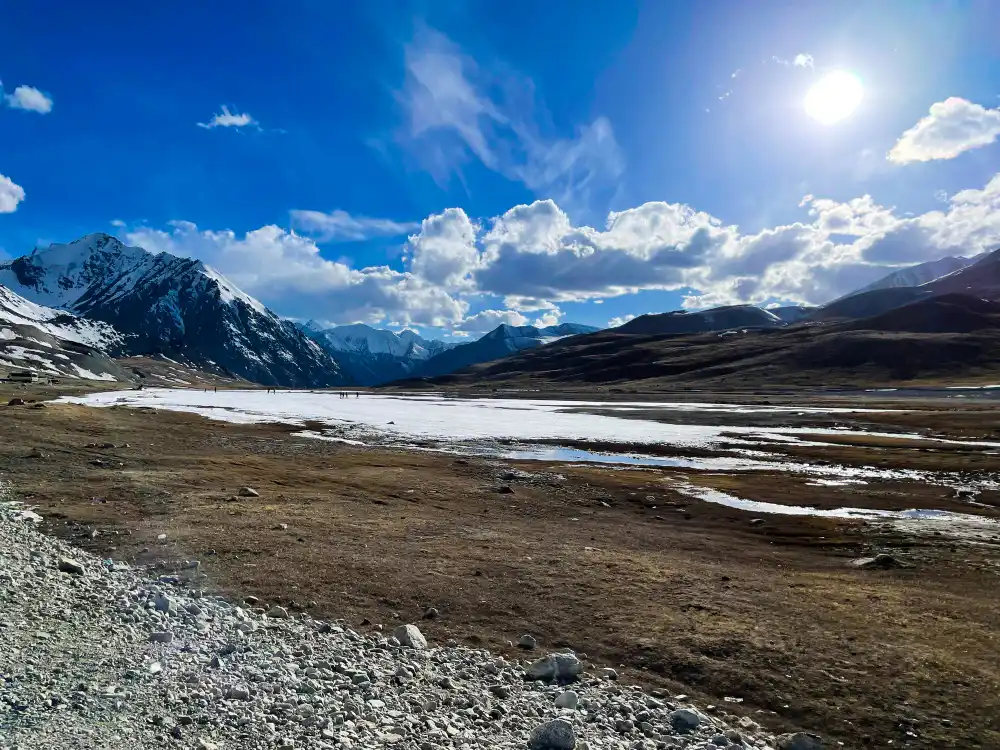
Lower Dolpa Trek For 19 Days

Tour Info

trip code

EN-036

Starting Point/ End Point

Kathmandu

Accommodations

Lodge/ Tea House

Max Altitude

5310m (Numa La Pass)

Duration

19 days

country

Nepal

Trip grade

Easy

Activities

Trekking

Best Season

April, May, June, September, October, November

Overview

Lower Dolpa trek, located in Karnali Province, is ideal for those who are seeking peaceful trails, unspoiled natural beauty, and traditional mountain life. Due to the isolation, this region has a pristine landscape and creates a strong connection with nature. Tibetan-influenced culture of this region shapes daily life, which is reflected in ancient monasteries, prayer flags, mani walls, and stone villages. Local communities continue age-old traditions, offering an authentic Himalayan experience. The lower Dolpa trek also features open valleys, and natural beauty often lies within the Shey Phoksundo National Park. 

Details

The lower Dolpa trek is a remarkable journey located in Karnali province, among the mid-western Himalayas of Nepal. This trek is best for those who want to enjoy peaceful trails, natural beauty, and traditional mountain life. Because the area is isolated, this region remains pristine and offers a strong sense of adventure and connection with nature.

As the region is deeply rooted in a strong Tibetan-influenced culture, you see daily life shaped by long-preserved traditions and customs. The ancient monasteries, prayer flags, mani walls, and stone-built villages found there reflect the long-preserved traditions and spiritual beliefs. Local communities follow age-old customs on special occasions, giving you a rare opportunity to witness an authentic Himalayan lifestyle. 

The lower Dolpa trek is also known for its diverse natural scenery, from open valleys to alpine meadows. Most of the places in the lower Dolpa trek lies inside the Shey Phoksundo National Park, which is a habitat for unique flora and fauna. The lower Dolpa trek is an enlightening experience for those who are in search of simplicity, cultural richness, and peaceful discovery in the Himalayas.
Highlights

  • Visit UNESCO World Heritage Sites, including Pashupatinath Temple, Patan Durbar Square, Syambhunath Stupa and Bhaktapur Durbar Square.

  • Visit Bon Gompas, Buddhist monasteries, and Tshowa Gompa around Shey Phoksundo Lake.

  • Witness the stunning aerial view of Langtang, Ganesh Himal, and Manaslu. 

  • Trek through terraced fields, deep gorges, river valleys and forests.

  • Explore Shey Phoksundo National Park.

  • Spot unique flora and fauna.

  • Cross multiple high mountain passes like Numa La Pass and Baga La Pass.

  • Trek through remote villages and yak-grazing pastures.

  • Witness flowing waterfalls, high suspension bridges, narrow gorges, and turquoise rivers along the trekking route.

  • Observe nomadic yak and sheep herds, mani walls, and local monasteries.

Itinerary

Day 1: Kathmandu (1,440 m / 4,593 feet) and transfer to the hotel

Your journey begins once you arrive at TIA (Tribhuvan International Airport). Upon reaching, you are welcomed by EverNepal's representatives. Then, you are transferred to your premium hotel, where you are again welcomed by the staff and helped check into your comfortable room. In the evening, we invite you for a delicious dinner. While eating dinner, we introduce all the representatives to you. After that, you spend the night in your premium room.  

  • Max Elevation: 1440 meters (Kathmandu)
  • Travel Distance: 5 to 6 kilometers
  • Travel Hours: 20 to 30 minutes   
  • Accommodation: 3-star hotel
  • Meals Included: Dinner

Day 2: Casual day, sightseeing, and trip preparation

On this day, you explore the vibrant streets of the Kathmandu Valley. After a leisurely breakfast, you begin your sightseeing tour with your guide. You visit UNESCO World Heritage sites in your private vehicle. While exploring the heritage, you can also purchase the trekking gear that you don't have and prepare yourself for the journey ahead. Below are some of the places you visit on day 2. 

A. Pashupatinath temple: Located at the bank of the Bagmati river, this holiest temple is dedicated to lord shiva. This temple is famous for its sacred cremation rituals. The Pashupatinath Temple is made of pagoda-style architecture with a gilded roof. 

B. Patan Durbar Square: This durbar square is the heart of Lalitpur. The Patan Durbar Square is famous for its fine Newari architecture and dense concentration of temples, palaces, and traditional artworks.

C. Syambhunath stupa: Situated at the top of the hill, this stupa offers a panoramic view of Kathmandu valley. This temple is also known as the Monkey Temple. It is one of the revered Buddhist stupas in Nepal. 

D. Bhaktapur Durbar Square: The Bhaktapur Durbar Square is famous for its well-preserved medieval culture, traditional temples, and vibrant local festivals. This durbar square reflects the rich cultural heritage of Bhaktapur. 

  • Max Elevation: 1,330 meters 
  • Travel Distance: 25 to 30 kilometers (total driving between sites)
  • Travel Hours: 5 to 6 hours 
  • Accommodation: 3-star standard hotel
  • Meals: Breakfast

Day 3: Flight from Kathmandu to Nepalgunj (150 m / 492 feet) – 50 minutes

Following the relaxed breakfast, you pack your belongings and be ready for the departure. Our driver comes to pick you up from the hotel to reach the TIA. You reach the TIA at least 3 hours before departure. After that, you take a flight to Nepalgunj. During the flight, you witness stunning views of mountains such as Langtang, Ganesh Himal, and Manaslu. Moreover, you also witness the view of flowing rivers, tributaries of the Ganges, and rural settlements. After around 50 minutes of flight, you arrive at Nepalgunj. Upon reaching, you can explore the attractive places. At night, you eat a warm dinner before going to sleep in a comfortable bed.  

  • Max Elevation: 150 m
  • Flight hours: 50 minutes
  • Accommodation: Hotel 
  • Meals: Breakfast, lunch and dinner

Day 4: Flight from Nepalgunj to Juphal and trek to Dunai (2,434 m / 7,985 feet)

Your trekking journey begins from this day. After a delicious breakfast in the early morning, you reach the airport with the help of your driver. Then, you take a flight which offers an aerial view of Kanjirolba mountain, valleys, rivers and remote terrain. After 35 minutes of flight, you arrive at Nepalgunj. From here, your trekking journey begins. You trek for about 4 hours, which is a distance of 10 km to reach Dunai. Along the trekking trail, you get to witness the terraced fields, the Thuli Bheri river, the landscape, and the village life. After a few hours of trekking, you arrive at Dunai, where you have a warm dinner and then go to your cozy room for the night.  

  • Max Elevation: 2,434 meters
  • Travel Distance: 10 km
  • Travel Hours: 4 hours 
  • Accommodation: Lodge
  • Meals: Breakfast, Lunch and Dinner

Day 5: Trek from Dunai to Tarakot (2,543 m / 8,343 feet)

Following the relaxed breakfast, you continue your trek towards Tarakot. You trek towards the east. The route passes through a small village where you observe the lifestyle of locals. Along the route, you trek through deep gorges, high suspension bridges, pine forests, and banks of the Bheri River, offering traditional terraced fields, rivers, and unique flora and fauna. After trekking for around 6 hours, covering a distance of 15 km, you arrive at Tarakot. Upon reaching the day 5 destination, you are offered breathtaking views of mountains and ancient monasteries. At night, you eat a delicious dinner before sleeping in a comfortable room. 

  • Max Elevation: 2,543 meters
  • Travel Distance: 15 km
  • Travel Hours: 6 hours 
  • Accommodation: Lodge
  • Meals: Breakfast, Lunch and Dinner

Day 6: Trek from Tarakot to Laini (3,160 m / 10,367 feet)

In the morning, you are provided with a leisurely breakfast. After that, you continue your trek towards Laini. To reach the day 6 destination, you cross the river through a high suspension bridge twice, pass through Sandul Gompa, rural villages, terraces and farms. While trekking through this route, you witness narrow gorges, the Tarap Chu river, the Putha Hiunchuli and the Churen Himal ranges. After around 6 hours of trekking, covering a distance of 16 km, you arrive at Laini, where you stay overnight after having a relaxed dinner. 

  • Max Elevation: 3,160 meters
  • Travel Distance: 16 km
  • Travel Hours: 6 hours 
  • Accommodation: Lodge
  • Meals: Breakfast, Lunch and Dinner

Day 7: Trek from Laini to Nawar Pani (3,475 m / 11,401 feet)

Following the early warm breakfast, you continue your trek towards Nawar pani, which takes around 5 hours, covering a distance of 10 km. During trekking, you observe the Tarap gorge, Chyugar Khola, a high suspension bridge, prayer flags, juniper forest and mountain scenery. After a few hours of trekking, you arrive at Nawar Pani, where you eat a delicious dinner before spending the night in a comfortable room.  

  • Max Elevation: 3,475 meters
  • Travel Distance: 16 km
  • Travel Hours: 6 hours 
  • Accommodation: Lodge
  • Meals: Breakfast, Lunch and Dinner

Day 8: Trek from Nawar Pani to Dho Tarap (4,080 m / 13,386 feet)

After a warm breakfast, you proceed with your trek to Dho Tarap. It takes approximately 7 hours to reach the destination of Day 8. You climb through Kamattarka and Ghyamghar to reach Dho Tarap. During your trek, you get to see Kanjiroba Himal, Taksi river, Tibetan-style stone house, mani walls, and the culture of the people. After a few hours of trekking, you reach Dho Tarap, where you are treated with a delicious dinner before going for the night in the warm lodge. 

  • Max Elevation: 4,080 meters
  • Travel Distance: 15 km
  • Travel Hours: 7 hours 
  • Accommodation: Lodge
  • Meals: Breakfast, Lunch and Dinner

Day 9: Acclimatization Day around Dho Tarap (4,080 m / 13,386 feet)

Day 9 is dedicated to adjusting your body to the high altitude. On this day, you fully explore the nearby villages and perform a hike around the Tarap Chu River valley after a relaxed breakfast. During the daytime, you experience the local lifestyle, hike to Bon Gompas and Buddhist monasteries, engage with the local community, and learn about their traditions. It takes around 3 hours to explore and experience the culture and surroundings. At night, you return to your comfortable lodge where you eat a warm dinner before staying overnight. 

  • Max Elevation: 4,090 meters
  • Travel Hours: 3 hours 
  • Accommodation: Lodge
  • Meals: Breakfast, Lunch and Dinner

Day 10: Trek from Dho Tarap to Numa La Base Camp (4,440 m / 14,566 feet)

After a leisurely breakfast at your cozy lodge, you continue your trek towards Numa La base camp. You trek in the northwest direction towards the Tarap Chu River to reach Day 10 destination. The trekking route passes through the upper Tarap valley, Tokyu village, before reaching the Numa La base camp. During the trek, you get to see the yak grazing grounds, Tibetan culture, Tarap Chu river, Numa La mountain range, and other snow-capped mountains. After about 6 hours of trekking, with a distance of 12 km, you reach the Numa La base camp, where you get to see the Dhaulagiri mountain range, Kanjirowa Himal, and the yak caravans. You have a warm dinner and stay overnight at a camp.

  • Max Elevation: 4,440 meters
  • Travel Distance: 12 km
  • Travel Hours: 6 hours 
  • Accommodation: camp
  • Meals: Breakfast, Lunch and Dinner

Day 11: Day 11: Trek from Numa La Base Camp to Danighar (4,510 m / 14,796 feet) via Numa La pass (5,310 m / 17,421 feet)

On day 11, you cross the highest pass in the Lower Dolpo journey. Following a hearty breakfast, you continue your trek towards Danighar. Before you reach the day 11 destination, you need to cross the Numa La pass - one of the highest passes in the Himalayas and Gyambo Khola. To traverse through Numa La pass, you need a steep ascent and a long, demanding descent, which tests your endurance. While trekking, you get a chance to see the nomadic yak, herds of sheep, and the breathtaking sights of the majestic mountains such as the Dhaulagiri range, and Churen Himal. After trekking for 7 hours, covering a distance of 17 km, you reach Danighar, where you are served a delicious dinner before staying overnight at a camping site.

  • Max Elevation: 5,310 meters
  • Travel Distance: 17 km
  • Travel Hours: 7 hours 
  • Accommodation: Camping site
  • Meals: Breakfast, Lunch and Dinner

Day 12: Trek from Danighar to Yak Kharka (4,020 m / 13,189 feet) via Baga La Pass (5170 m / 16,961 feet)

After a relaxed breakfast, you continue your trek towards Yak Kharka. To reach the destination of day 12, you cross the Baga La pass and the Temche village. While trekking through these trails, you get a chance to see the remote life, the variety of flora and fauna, the streams, the prayer flags, the chortens, and the Dhaulagiri peak. After trekking for 5 to 6 hours, covering a distance of 14 km, you reach Yak Kharkha, where you get a relaxed dinner before staying overnight at a camp.

  • Max Elevation: 5,170 meters
  • Travel Distance: 14 km
  • Travel Hours: 5 to 6 hours 
  • Accommodation: Camp
  • Meals: Breakfast, Lunch and Dinner

Day 13: Trek from Yak Kharka to Shey Phoksundo Lake (3,612m / 11,811 feet)

Following a tasty breakfast, you continue your trek towards Shey Phoksundo Lake, which takes around 4 to 5 hours, covering a distance of 10 km. To reach the destination on Day 13, you have to pass through Ringmo village, which is situated close to the shore of Phoksundo Lake. The trekking route includes descending from the yak pasture and then trekking through the forest to reach Phoksundo Lake. During trekking, you have a chance to enjoy the sight of waterfalls, rivers, streams, Tibetan villages, Shey Phoksundo Lake, and flora and fauna. After a few hours of trekking, you arrive at Shey Phoksundo Lake. At this place, you receive a warm dinner before spending the night in a comfortable lodge.

  • Max Elevation: 3,612 meters
  • Travel Distance: 10 km
  • Travel Hours: 4 to 5 hours 
  • Accommodation: Lodge
  • Meals: Breakfast, Lunch and Dinner

Day 14: Explore around Shey Phoksundo Lake (3,612m / 11,811 feet)

Day 14 is dedicated to exploring the areas around Shey Phoksundo Lake.After a warm breakfast, you, along with your guide, go on a sightseeing tour around the lake. You visit Ringmo village, ascend to Tshowa Gompa, and enjoy the view from the Shey Phoksundo Lake viewpoint. In addition to this, you can relax thoroughly in the vicinity of the lake, spot various species of flora and fauna, and experience the distinct way of life of the people residing there. While visiting these places, you take a relaxed lunch. After that, you further explore the places. In the evening, you return to your hotel, where you eat a delicious dinner before spending the night. 

  • Max Elevation: 3,600 meters
  • Accommodation: Lodge
  • Meals: Breakfast, Lunch and Dinner

Day 15: Trek from Shey Phoksundo Lake to Chhepka (2,670 m / 8,760 feet)

Following a warm breakfast, you continue your trek towards Chhepka, which takes around 5 to 6 hours, covering a distance of 25 km. The trail descends through alpine terrain into a lush river valley. You need to traverse through Ringmo Village, Phoksundo River valley, Rechi and Jharana hotel before you arrive at Chhepka. While trekking through this route, you can witness Phoksundo waterfall, ancient Ringmo village, narrow gorges and turquoise Suligad River. After a few hours of trekking, you arrive at Chhepka. At this place, you are served with a leisurely dinner before staying overnight at a comfortable lodge. 

  • Max Elevation: 2,670 meters
  • Travel Distance: 14 km
  • Travel Hours: 5 to 6 hours 
  • Accommodation: Lodge
  • Meals: Breakfast, Lunch and Dinner

Day 16: Trek from Chhepka to Shyanta village (2,520 m / 8,267 feet)

In the early morning, you are provided with a hearty breakfast. Once you eat breakfast, you continue your trek towards Shyanta village. It takes around 4 hours, covering a distance of 8 km, to reach the Day 16 destination. Before you reach Shyanta village, you descend through dense forest, pass near the Shey Phoksundo National Park exit point, and trek through Kageni village. During trekking, you witness the Phoksundo River, Tibetan-influenced culture, pine/oak forest, small waterfalls, and streams. After a few hours of trekking, you reach Shyanta village, where you eat a warm dinner before going to sleep at a cozy lodge. 

  • Max Elevation: 2,520 meters
  • Travel Distance: 8 km
  • Travel Hours: 4 hours 
  • Accommodation: Lodge
  • Meals: Breakfast, Lunch and Dinner

Day 17: Trek from Shyanta to Jhupal (2,475 m / 8,120 feet)

Once you wake up early in the morning, you are served a warm breakfast. After that, you continue your trek towards the Jhupal. You witness forests, the Suli Gaad river, high suspension bridges, traditional villages and agricultural landscape. To reach Jhupal from Shyanta village, you pass Kageni, Dunai and Kala Gaura village. After roughly 5 hours of trekking, covering a distance of 10 km, you arrive at Jhupal, where you eat a delicious dinner before going to sleep at a comfortable lodge. 

  • Max Elevation: 2,475 meters
  • Travel Distance: 10 km
  • Travel Hours: 5 hours 
  • Accommodation: Lodge
  • Meals: Breakfast, Lunch and Dinner

Day 18: Flight from Jhupal to Nepalgunj and Nepalgunj to Kathmandu (1,440 m / 4,593 feet)

On this day, you take a flight to return to the capital city of Nepal (Kathmandu). After a leisurely breakfast, your driver picks you up from the hotel and transfers you to the Dolpa airport. There, you take a scenic flight which offers beautiful views of the Thuli Bheri River, narrow gorges, Tibetan-style stone villages, and the Dhaulagiri massif and Kanjiroba Himalayan ranges. After around 35 minutes of flight, you arrive at Nepalgunj. From here, you again take the next flight from Nepalgunj airport on the same day. While having air transportation, you observe rivers, Ganesh Himal, Langtang and other mountain views. After around 45 minutes of flight, you finally reach Kathmandu. You can explore some attractive places like Narayanhiti Palace Museum, Ason Bazaar, Thamel, and Taleju Bhawani Temple. At night, you return to your 3-star hotel, where you eat a delightful dinner. 

  • Max Elevation: 1,440 meters
  • Flight Hours: 1 hour 20 minutes  
  • Accommodation: 3-star hotel 
  • Meals: Breakfast, Lunch and Dinner

Day 19: Transfer to the airport for an international flight

Following a pleasant breakfast, you pack your belongings and get ready to return to your home country. Your driver comes to pick you up at your hotel and transfer you to the TIA three hours before your flight. There, our representative helps you to complete the check-in and boarding formalities. After that, you take your flight and return to your home country. 

  • Meals: Breakfast

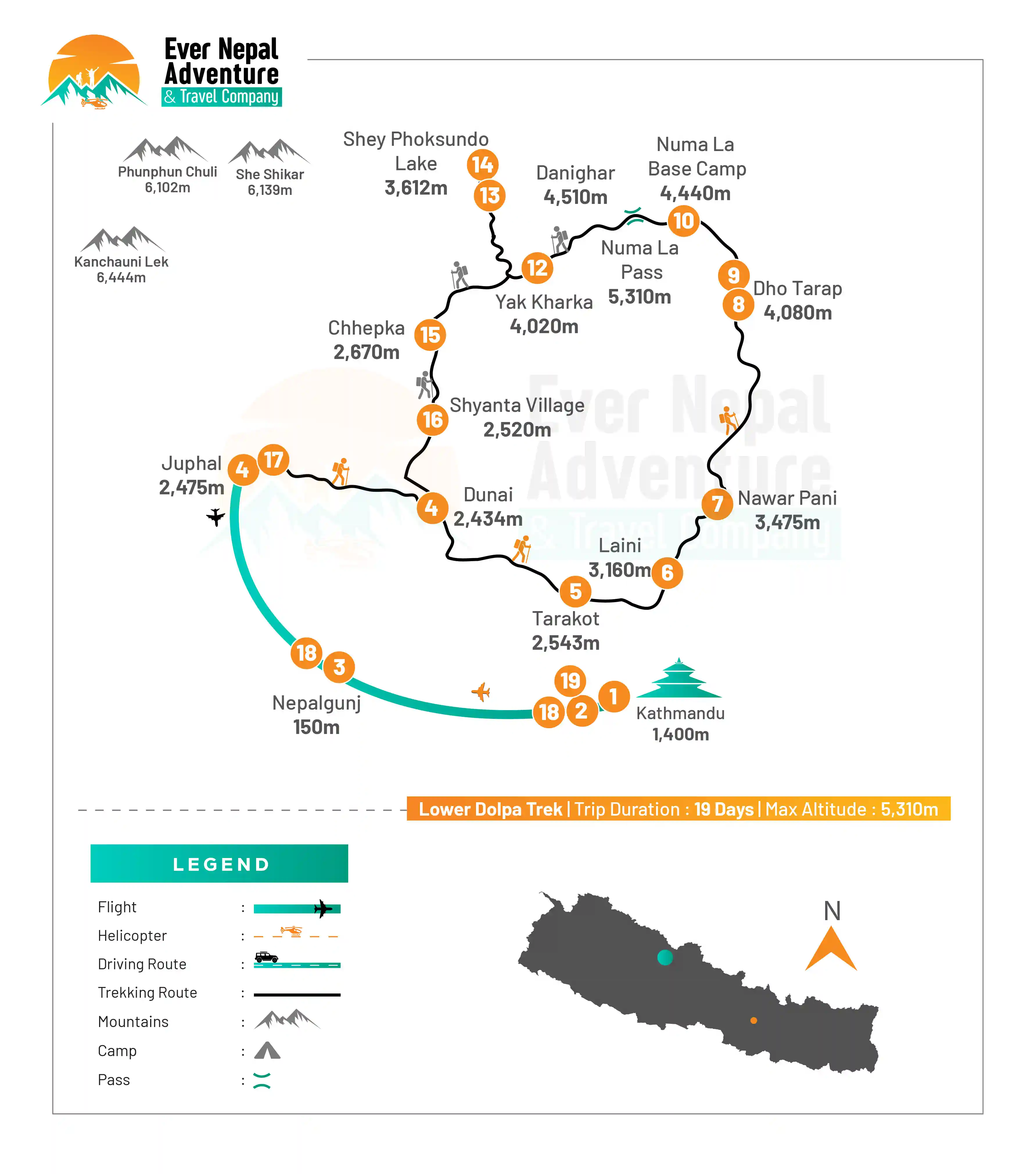
Trek Route

Lower Dolpa trek Route Map

Packing List for Lower Dolpa Trek

Lower Dolpa treks are among the most remote treks in western Nepal. It passes through dry regions, through the ancient Tibetan villages, in forests, high passes, and remote valleys within the scenic Shey Phoksundo National Park area. Weather is unpredictable and space is limited, so it's essential to have the right gear for a safe and comfortable hike.

Clothing for Head and Neck

  • Warm woolen cap
  • Sun hat
  • Neck buff or scarf
  • UV-protection sunglasses
  • Sunscreen cream
  • Lip care balm
  • Headlamp (extra batteries)
  • Dry particle mask (particle protection mask)

Upper Body Clothing

  • Moisture-wicking thermal layers
  • Trekking t-shirts
  • Long-sleeved hiking shirts
  • Fleece jacket
  • Insulated down jacket
  • Waterproof outer shell
  • Windproof jacket
  • Light rain poncho

Lower Body Clothing

  • Comfortable trekking pants
  • Waterproof trousers
  • Thermal innerwear
  • Warm fleece pants for night time
  • Quick-dry shorts
  • Relaxed camp wear

Gloves and Hand Protection

  • Lightweight inner gloves
  • Insulated warm gloves
  • Cold weather waterproof gloves

Footwear

  • High-ankle trekking boots
  • Sandals or slippers that are lightweight
  • Wool hiking socks
  • Extra quick-dry socks
  • Gaiters for dusty or muddy areas

Toiletries and Hygiene

  • Toothbrush and toothpaste
  • Soap or face wash
  • Hand sanitizer
  • Wet wipes
  • Toilet paper
  • Quick-dry towel
  • Shampoo sachets
  • Small moisturizer bottle

Trekking Equipment

  • Trekking poles
  • Sleeping bag
  • Duffel bag
  • Carry a backpack with a rain poncho
  • Refillable water bottles
  • Water purification tablets
  • Dry sacks or waterproof covers
  • In snowy season, wear lightweight crampons

Medicines and First Aid

  • Diamox tablets
  • Pain relief medicine
  • Bandage, blister pads
  • Antiseptic cream
  • Personal medications
  • ORS packets
  • Flu and cold reliever
  • Stomach upset medicine

Electronic and Extra Items

  • Mobile phone or camera
  • Power bank
  • Spare charging cables
  • Universal travel adapter
  • Snacks and protein bars
  • Notebook or diary
  • Binoculars

Extra Essentials for Female Trekkers

These are some of the essential items to have along with you during your Lower Dolpa Trek due to the remote villages and lack of facilities in between.

  • Comfortable sports bras
  • A sanitary pad or tampon
  • Intimate hygiene wipes
  • Moisturizer and Sunscreen
  • Warm leggings
  • Hairbands and clips
  • Personal skincare products

Documents

Lower Dolpa is a restricted trek area in Nepal, so it is important for the trekkers to have a few trek permits and other travel documents to go to Lower Dolpa.

  • Lower Dolpa Restricted Area Permit: This is a restricted permit required for those who are going to enter a restricted area in Lower Dolpa. The price of the permit begins at approximately USD 20.00 for each person per week, depending on the duration of the trek and the path taken.
  • Shey Phoksundo National Park Entry Permit: Trekkers are required to get Shey Phoksundo National Park Entry Permit for entering into the area of the national park. Can be issued from the office of Nepal Tourism Board Kathmandu or Nepalgunj. Typically, foreign nationals pay NPR 3000 for a permit.
  • TIMS Card: Trekking Information Management System Card enables to keep a record of trekking and enhances the tracking of safety in remote areas in case of emergencies.
  • Valid Passport: An original passport should have a minimum of 6 months of validity when time of applying for the trekking permits and domestic flights in Nepal.
  • Passport-Sized Photos: Bring at least 4 recent photo IDs (passports) for permits and official documents on the journey.
  • Nepal Tourist Visa: It is necessary for any tourist from other countries to obtain a Nepal tourist visa prior to their arrival in the area of trekking in Nepal. The duration of the visa should be sufficient to trek the whole program.
  • Travel Insurance: Travel insurance is highly recommended for the Lower Dolpa trek. High altitude trekking, emergency medical care and helicopter evacuation from remote areas of the mountains should be included in your coverage.

What's included

  • Complimentary airport transfers to and from your hotel.

  • Free introductory dinner.

  • Three nights of lodging in Kathmandu, with breakfast provided.

  • All lodging during the journey.

  • Three meals each day (Breakfast, lunch, and dinner) during the trek.

  • Overnight accommodation with numerous facilities in Nepalgunj. 

  • Free flight from Kathmandu to Nepalgunj, Jhupal to Nepalgunj and Nepalgunj to Kathmandu.

  • Seasoned, officially registered guide equipped with a first-aid kit.

  • Emergency preparedness kit.

  • Arrangements for rescue, if needed

What's excluded

  • Costs for international flights and visa fees for Nepal.

  • Porter services for transporting backpacks.

  • Personal insurance, individual expenses, asset damage and theft.

  • Expenses for visiting attractions in the city (temples, monasteries, etc.)

  • Each beverage, snack, and additional expenses such as laundry, warm showers, battery charging, wifi, etc.

  • Additional costs arising from natural calamities and unforeseen occurrences.

  • Tips for the guide and porter.

Frequently Asked Questions

How difficult is the Lower Dolpa Trek?

The Lower Dolpa Trek is considered difficult to moderate, due to the long days of hiking, long distance tracks, and the crossing of high mountain passes. Another drawback of the route is the limited facilities compared to other popular trekking areas; therefore, trekking requires a fair level of fitness and mental preparation.

What is the best time to do the Lower Dolpa Trek?

The Lower Dolpa Trek enjoys the ideal season of spring and autumn. March to May is nice with colourful landscapes and pleasant temperatures, while September to November is marked by stable weather, with clearer mountain views, a much safer and more enjoyable time for trekking.

Do I need a guide for Lower Dolpa Trek?

Yes, it is advisable and sometimes even mandatory to have a licensed guide for Lower Dolpa as it is a restricted area. Permits, route navigation, accommodation management, as well as communication with locals in remote villages, where the facilities are very basic, are provided by guides.

Is altitude sickness a concern during the trek?

Altitude sickness can become an issue when going higher and higher on the trek, and at higher altitudes. The risks of serious health problems caused by altitude are minimized by spending a little longer to get used to being at altitude, by drinking plenty of fluids, resting regularly and avoiding going up too quickly in the Dolpa region.

Are there tea houses in Lower Dolpa?

There are some basic tea houses in some villages but less facilities than the tea houses of Everest or Annapurna regions. Camps may still be needed in remote areas if on the planned treks and during the season of travelling.

How long does the Lower Dolpa Trek take?

Most Lower Dolpa Trek packages span 14 to 20 days, varying by route, acclimatization days, and side trips. Some trekkers also add on to Upper Dolpa from where one can come back for a longer and more adventurous trek to the Himalayas.

Is Lower Dolpa Trek suitable for beginners?

The trek may be done successfully by beginners who are physically fit and have experience of hiking, but the course is in a remote area and may be more difficult due to the longer hiking days. It's not that difficult to trek with proper preparation and training and experienced guides to show the way.

What kind of food is available during the trek?

In tea houses, they will typically offer basic dishes, such as dal bhat, noodles, potatoes, soup, fried rice, and Tibetan bread. At higher altitudes, there are fewer options for meals and snacks; but warm options such as food and basic snacks are generally available throughout the trekking route.

Can I charge my phone during the trek?

In some villages there are facilities for charging batteries, typically at an additional cost. On the other hand, in remote areas you might not always have access to electricity, so bringing a power bank or solar charger will be useful when on the Lower Dolpa Trek.

What makes the Lower Dolpa Trek special?

The Lower Dolpa Trek is famous for its untouched landscapes, Tibetan-influenced culture, ancient monasteries, high mountain passes, and peaceful villages. Many trekkers choose this region for its raw Himalayan beauty and quieter trails away from crowded trekking routes in Nepal.

User Review