Luxury Everest Panorama Trek For 6 Days

Tour Info

trip code

EN-010

Starting Point/ End Point

Kathmandu

Accommodations

Lodge/ Tea House ,

Max Altitude

5545m (Kala Patthar)

Duration

6 days

country

Nepal

Trip grade

Moderate

Activities

Trekking , City Tour , Helicopter Tour

Best Season

March, April, May, September, October, November

Overview

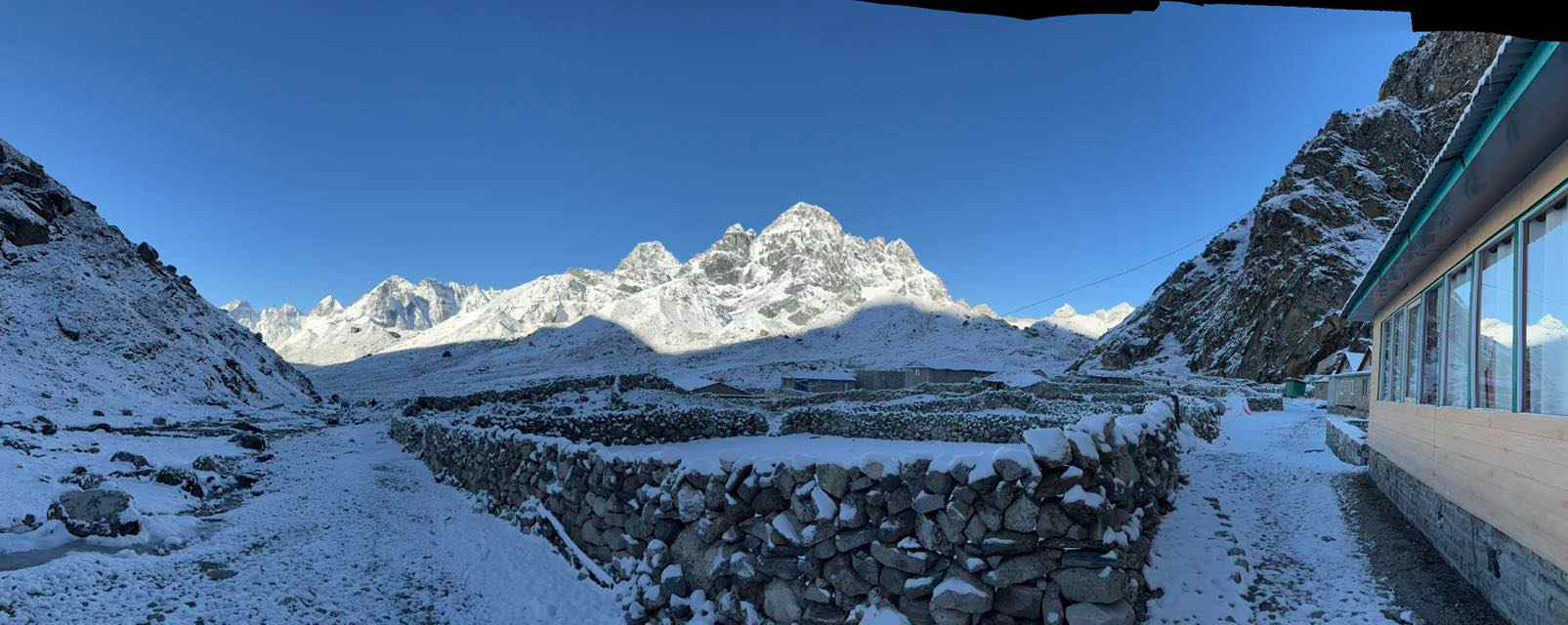
Everest Panorama Trek Via Helicopter is a relatively quick and accessible way to explore the Everest region by combining moderate trekking with a scenic helicopter flight.The journey gives you direct exposure to the alpine landscapes of Sagarmatha National Park, including pine forests, glacial rivers, and diverse mountain wildlife. During this trekking and helicopter tourism journey, you also pass through the Sherpa settlements, allowing you to gain insights into their culture. The helicopter segment provides fast, safer access to major viewpoints like Everest Base Camp and Kala Patthar, greatly reducing altitude risks. The trip also includes time at Everest View Hotel, one of the world’s highest luxury viewpoints. 

Details 

Everest Panorama Trek or Everest view Trek Via Helicopter offers an accessible path to the Everest region and combines both trekking and helicopter tourism. The trek will give you insights into the alpine zones of Sagarmatha National Park, which falls under the protected alpine zones. This park comprises areas such as pine forests and glaciers with glacial rivers and mountain fauna. This trip to do trekking and tourism will also take you to villages where the Sherpas live, getting to see their way of life firsthand.

Another key plus would be the helicopter part of your trip. This allows you to access key viewpoints such as Everest Base Camp and Kala Patthar. Also, since you would be reaching such heights through a helicopter service, the chances of altitude sickness are lower compared to full treks and expeditions.

Furthermore, this trek also offers a an opportunity to visit or overnight at the Everest View one of the highest luxury viewpoints in the world.
Highlights

  • Explore  ancient city and mesuem of temples in Nepal

  • Comprehensive guided tour of heritage site ,palace and temple

  • Explore a enchanting capital of Sherpa  and their rich culture

  • Overnight at Everest View hotel at 3880m
  • Crossing various suspension bridges, such as the Hillary Bridge.

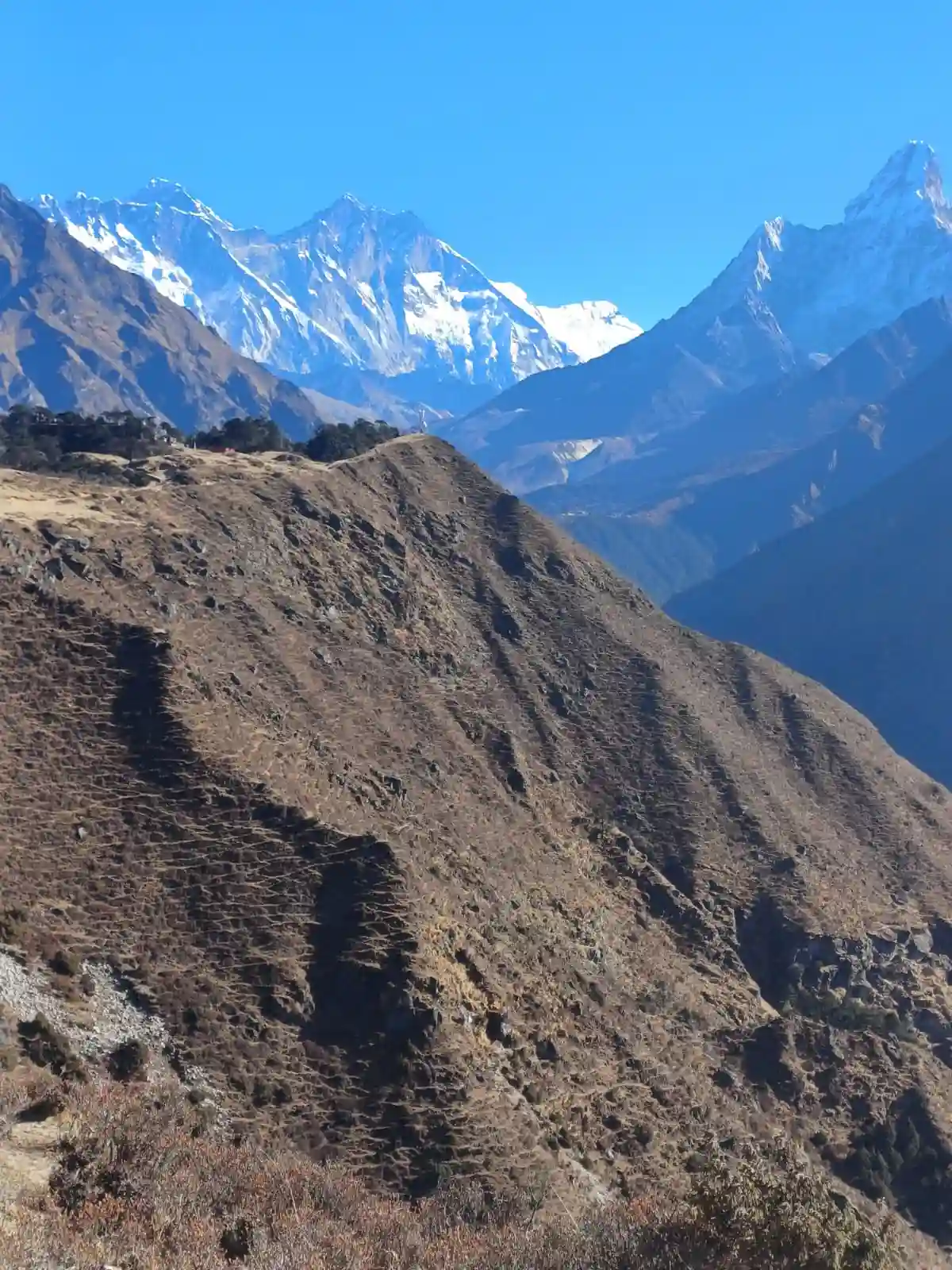
  • Enjoy a panoramic views of Everest, Lhotse, Ama Dablam, Thamserku, Kongde, Kusum Kanguru, and Nuptse.

  • Visit to the Sherpa Museum and National Park Museum in Namche.

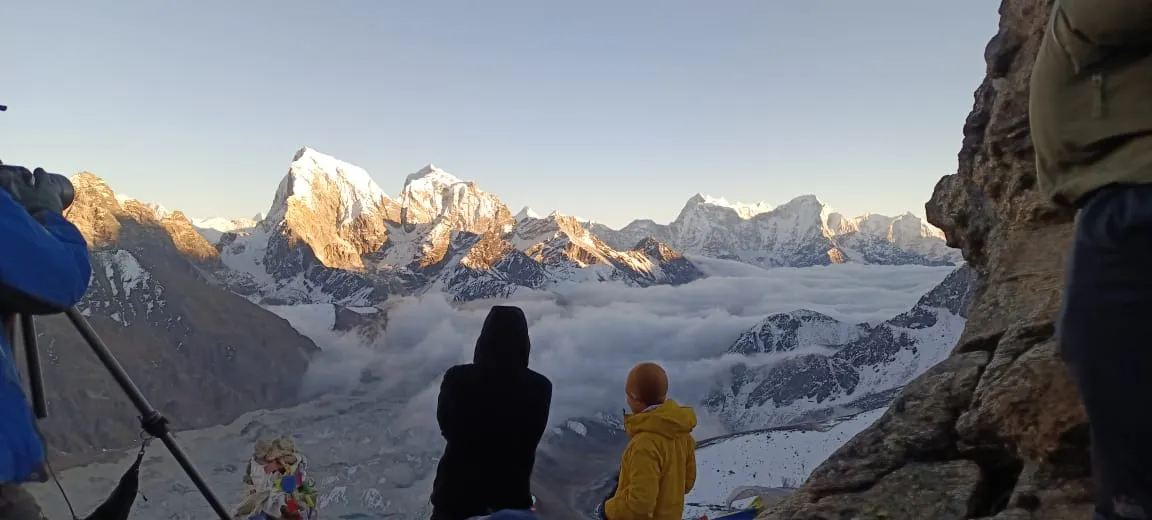
  • Land in Kalapather at 5450m and enjoy a aerial view of khumbu Glacier

Itinerary

Day 01: Arrival in Kathmandu and Pre-trip Meeting

Upon your arrival in Kathmandu at Tribhuvan International Airport, our representative from Ever Nepal Adventure receives you outside the terminal and transfers you to the designated hotel in a private tourist vehicle. Depending on your arrival time, we either hold a pre-trip meeting on this day or on the day after this. During this meeting, you meet your trekking guide, review the itinerary, and ask any questions you may have. Following this meeting, you head back to hotel for full recover of Jetlag.

Overnight in Hotel,Kathmandu

Max Elevation: 1,400 meters (Kathmandu)

Travel Distance: 5 to 6 kilometers.

Travel Hours: 20 to 30 minutes

Accommodation: 4-5 star standard Hotel 

Meal:  Dinner

Day 2: A full day guided sightseeing tour of Kathmandu valley.

After breakfast, if you did not have the pre-trip briefing on the day before, you will hold the briefing on this day. Following this, you start your sightseeing trip at around 8 am. The trip is done on a private comfortable vehicle and is conducted with the aid of a professional tour guide. During this sightseeing tourism trip, you shall visit the following heritage sites;

  • Pashupatinath Temple (UNESCO): Major Hindu temple dedicated to Lord Shiva, located on the banks of the Bagmati River. The temple is viewed from the eastern bank, as entry is restricted to Hindus. Boudhanath Stupa (UNESCO): One of the holiest Buddhist sites in Kathmandu, built in the 5th century. Known for its massive stupa, Buddha’s all-seeing eyes, and prayer wheel circumambulation.

  • Swayambhunath Stupa (Monkey Temple): Hilltop Buddhist stupa offering panoramic views of Kathmandu Valley. Popularly called Monkey Temple due to the resident monkeys.

  • Kathmandu Durbar Square (UNESCO): Historic palace complex of the Malla kings featuring temples, courtyards, museums, and a unique 17th-century inscription in 15 languages.Patan Durbar Square (UNESCO): Located in Lalitpur, known for refined Newari architecture from the Malla era and a rich artistic heritage. Following this tour, you head back to your hotel for an overnight stay.Overnight in Hotel,Kathmandu

Max Elevation: 1,450 meters (Swayambhunath Stupa)

Travel Distance: 25 to 30 kilometers (total driving between sites)

Travel Hours: 6 to 7 hours

Accommodation: 4-5 star standard Hotel 

Meal:  Breakfast

Day 3: Fly to Lukla from Kathmandu and Trek to Phakding / Manjo

Early in the morning, you either head to domestic airport, depending on the season. From here, you fly to Lukla with mountain views. Once you arrive at Lukla, you meet the trekking staff and receive a short briefing. You then take breakfast and start the trek. As a part of the trek, you descend through the Chaurikharka village, passing small settlements, suspension bridges, rhododendron forests, and grazing animals such as yaks and dzos. You then follow the Dudh Koshi River to Phakding before ending the day at Lodge or Resort 

Overnight in Phakding

Max Elevation: 2,652 meters (Phakding/Manjo)

Travel Distance:  8-10 kilometers

Flight Hour: 30 minute via Plane or 1:00 hour via Heli

Trek Hours: 3 to 4 hours

Accommodation: Lodge and Resort

Meal: Appetizer,Breakfast, Lunch, Dinner & Dessert

Drinks: Tea,coffee,Hot and Mineral water

Day 4: Trek to Namche Bazaar(3440m)

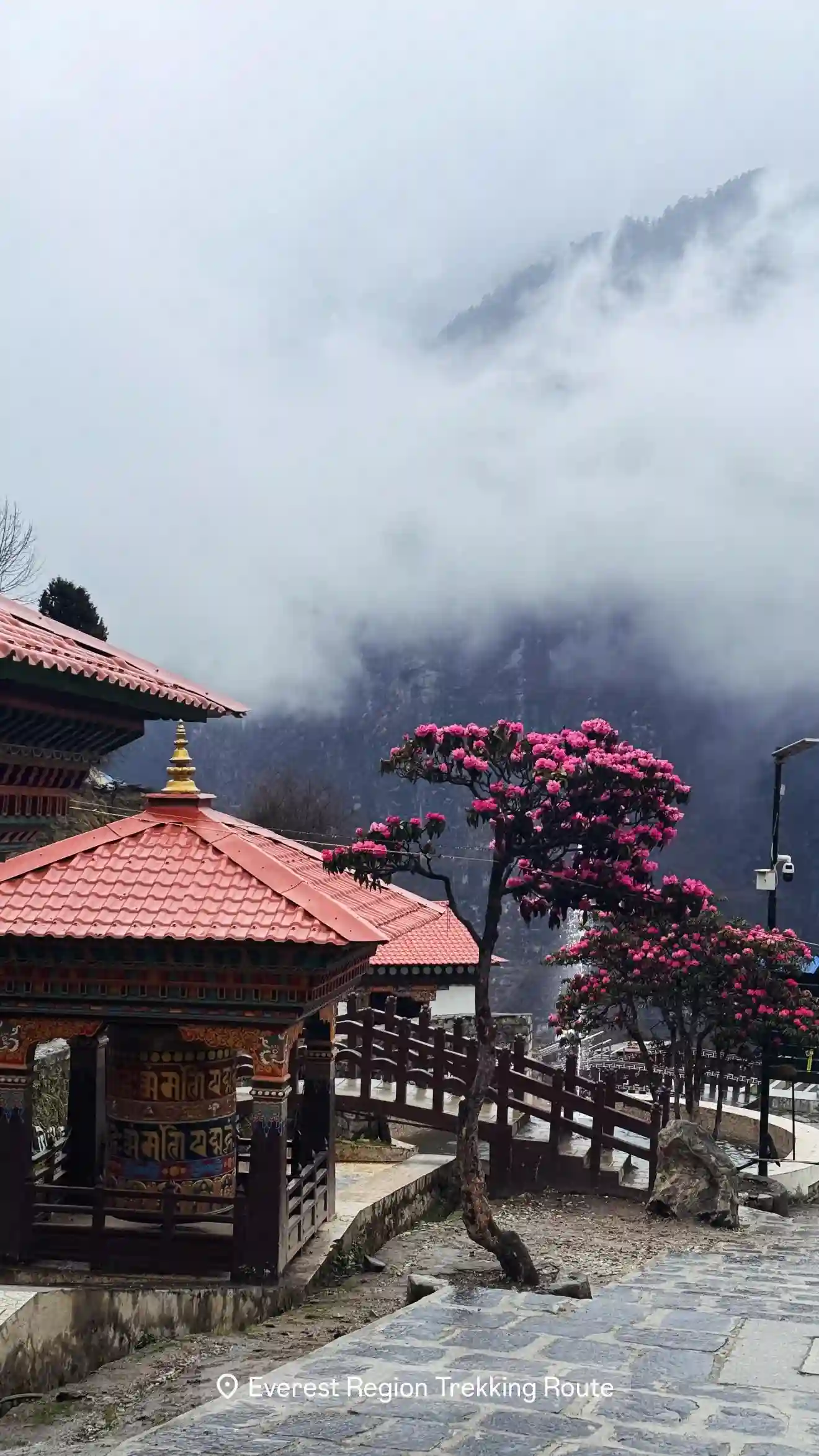
With the advent of a new day, you have your breakfast and then embark on your trek. The trek leads you along the Dudh Koshi River and through a few suspension bridges in pine forested regions or rhododendron and juniper woodlands. On your trekking journey, you pass through a few Sherpa settlements and a few Buddhist chortens and prayer wheels along the trekking trails. Upon reaching Monjo, you enter Sagarmatha National Park, as your entry will be checked there. After checks on your entry documents are over, your trek leads you to Jorsalle in search of lunch and then culminates in the Hillary Suspension Bridge. The next trek leads you to an uphill ascent to Namche Bazaar, where you stay overnight.

Overnight in Namache

Max Elevation: 3,440 meters (Namche Bazaar)

Travel Distance: 11 kilometers

Travel Hours: 5 to 6 hours

Accommodation: lodge/ Resort

Meal:  Appetizer,Breakfast, Lunch, Dinner & Breakfast

Drinks: Tea,coffee,hot and mineral water

Day 5: Acclimatisation Day in Namche Bazaar or Hike to Hotel Everest View

Today is reserved for acclimatisation to avoid altitude sickness or hike to Everest View hotel for overnight. After your breakfast, you will have to hike to the Everest View Point and Hotel Everest View at about 3,860 m. You can enjoy the sight of Everest itself, Lhotse, Ama Dablam, Thamserku, Nuptse, and other peaks from here. You will also get an opportunity to see Syangboche Airport on your hike. On your return journey, you can visit the Sherpa Culture Museum and the Sagarmatha National Park Museum to know more about Sherpa culture and the history of mountaineering in the Himalayas. After this, you can explore the shops of Namche Bazaar. You will spend the night at Hotel or Resort.

Overnight in Namache or Hotel Everest view 

Max Elevation: 3,880 meters (Hotel Everest View)

Travel Distance: 6 kilometers

Travel Hours: 3 to 4 hours

Accommodation: Lodge/ Tea house

Meal:  Appetizer,Breakfast, Lunch, Dinner & Dessert

Drinks: Tea,coffee,Hot and Mineral Water

Day 6: Fly to Kalapathar(5450m)/Everest Base Camp then return to Kathmandu

From Namche Bazaar or Hotel Everest View , there is a helicopter ride that flies over the Khumbu Valley. The helicopter ride takes you through the Sherpa settlements and glaciers and over the mountain ranges as you get to see the Khumbu Glacier, Everest Base Camp from distance and landing in Kala Patthar which is the best closet view of Everest.The helicopter flies to its maximum height of 5,545 m along the way while doing the flyover of the Everest region.The helicopter then touches down in Lukla upon completion of the flyover tour of the Everest region. This marks the end of the trekking then continuea flight to Kathmandu via Helicopter.

Overnight in Hotel,Kathmandu

  • Max Elevation: 5,450 meters (helicopter land in Everest region)

  • Travel Distance: 120 to 150 kilometers (Flight distance)

  • Travel Hours: 2  hours (total flight time including Lukla to Kathmandu)

  • Accommodation: 4-5 star standard Hotel 

  • Meal:  Breakfast and Lunch

Trek Route

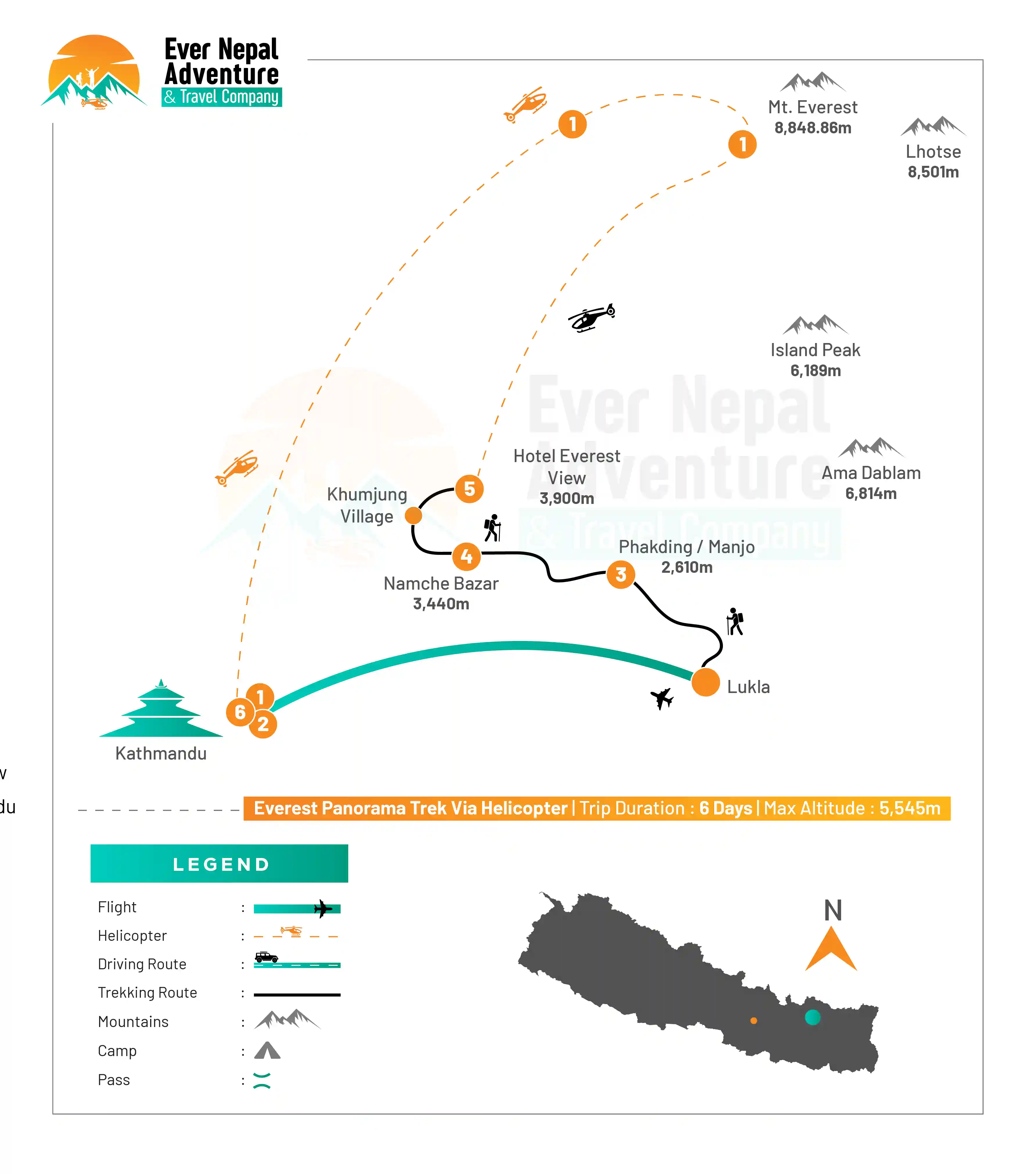
Ever Nepal | Everest Panoroma Trek via Helicopter Route Map

What's included

  • All kind of shuttle service on arrival and to depature

  • 3 night hotel 5-star hotel on twin or double sharing with breakfast

  • Guided Tour in Heritage site with professinal guide on your preferred language guide

  • All required ground comfortble transport i.e car or jeep during trip as per itinerary
  • Resort or Hotel (3-4 star)  and Everest View Hotel during trek

  • Meals ( Appetizer,Breakfast,Lunch ,Dinner and Dessert)
  • Tea,coffee,Hot and Mineral Water  during the trek

  • Domestic flights between Kathmandu-Lukla

  • Professional Licensed, English-speaking trek guide and assistant trek guide (avove 05 pax)

  • Porters provided at a ratio of one porter for every two trekkers (01 for 02)

  • All staff-related expenses, including salary, insurance, meals, accommodation, equipment, and domestic flights

  • Trekking duffel bag, sleeping bag, T-shirt, and trekking map from United Nepal Treks n Tours

  • Farewell dinner with a cultural program in Kathmandu

  • All trekking permits, entry fees, and necessary documentation

  • First-aid medical kit carried by the trek leade

  • Sharing helicopter flight to Kalapather and return to Kathmandu (03 pax or below 03 pax

What's excluded

  • International flights to and from Nepal

  • Nepal entry visa, available on arrival at Tribhuvan International Airport

  • Travel and rescue insurance

  • Personal expenses of any kind

  • Alcoholic and non-alcoholic beverages, including bottled water

  • Entrance fees for city sightseeing in Kathmandu

  • Lunch and dinner in Kathmandu and any additional hotel nights

  • Charges for excess luggage on flights

  • Tips for guides, porters, and drivers

  • Personal trekking gear and equipment

  • Any expenses not specifically mentioned in the inclusions.

Packing List For Everest Panorama Trek Via Helicopter

Trekking in the Everest region is a case where being warmly dressed without overburdening yourself is crucial. As you will be using the helicopter for the last stretch of your journey, it is not necessary to bring all your mountaineering equipment along. Following are some of the recommended packing lists for the Everest Panorama Trek.

Head: 

  • Warm woolen hat (beanie)
  • Sun hat with brim
  • Buff/neck gaiter,
  • Polarized sunglasses.

Hands: 

  • Lightweight liner gloves 
  • One pair of windproof/waterproof outer gloves.

Upper Body: 

  • Moisture-wicking base layers (thermal)
  • Fleece jacket or pullover
  • Down jacket (rated for -10°C to -15°C)
  • A wind/waterproof shell jacket.

Lower Body:

  • Thermal base layer bottoms
  • Trekking trousers
  • A pair of waterproof trekking pants.

Footwear: 

  • Sturdy, broken-in trekking boots with good ankle support 
  • At least four pairs of moisture-wicking trekking socks
  • A pair of lightweight sandals or sneakers for relaxing in the teahouse.

Toiletries: 

  • Biodegradable soap, 
  • Quick-dry towel, 
  • Toothbrush/paste,
  • Wet wipes (essential),
  • Hand sanitizer,
  • High-SPF sunscreen
  • lip balm.

Accessories: 

  • Trekking poles (recommended for descent), 
  • A headlamp with spare batteries, 
  • A reusable water bottle or hydration bladder (2L).

First Aid Kit: 

  • Blister plasters (moleskin)
  • ibuprofen/paracetamol, 
  • rehydration salts (ORS), 
  • personal prescription medications, 
  • altitude sickness tablets (Diamox—consult your doctor).

Miscellaneous Items: 

  • Passport copies, 
  • A small lock for your duffel bag,
  • Power bank 
  • A camera with extra memory cards.

Specific Gears for Women: 

Feminine hygiene products (bring extra, as they are hard to find on the trail), and a supportive sports bra designed for long-distance hiking.

Documents Required

In order to make your trip in Khumbu seamless and problem-free, you should have a number of important documents in place before and at the time of your visit to Nepal. Such documents are necessary to facilitate the issuance of trekking permits and other related purposes.

  • Passport: Must be valid for at least six months beyond your departure date from Nepal.
  • Passport Photos: Carry at least 4–6 spare passport-sized photos for permits and your visa application.
  • Sagarmatha National Park Entry Permit: This is mandatory for trekking in the Everest region. It is typically obtained in Monjo at the park entry checkpoint. (Approx. $30 USD).
  • Khumbu Pasang Lhamu Rural Municipality Permit: This replaces the old TIMS card for the Everest region. Your trekking agency usually handles this in Kathmandu or Lukla. (Approx. $20 USD).
  • Travel Insurance: It's not up for negotiation. Make sure your insurance covers high-altitude emergency medical evacuation (up to 6,000m) and helicopter evacuation. Always keep a digital and a hard copy of your travel insurance policy.
  • Nepal Visa: This is issued on arrival at Tribhuvan International Airport. Bring enough cash to pay the visa fee for 15 or 30 days.

Frequently Asked Questions

Is the Everest Panorama Trek considered difficult?

This is a moderate trek. While the daily walking hours are manageable (4–6 hours), you will be gaining significant altitude. Because you aren't trekking all the way to Base Camp, it is far less physically demanding than a standard Everest Base Camp trek, though you should still be in good cardiovascular health. 

Is altitude sickness a major concern on this trip?

Even with the moderate pace and helicopter support, altitude is something to respect. We follow a careful acclimatization schedule in Namche, and the helicopter flight at the end of the trip is at a high altitude, but because you are moving quickly via air, your body has less time to stress compared to a multi-day walk. Always drink plenty of water and listen to your guide's advice.

Do I need previous trekking experience?

Not necessarily, but it certainly helps to have done some regular hiking at home to prepare your legs and lungs. If you can handle 5–6 hours of walking on uneven, uphill terrain for a few days in a row, you are more than capable of completing this itinerary.

How safe is the helicopter portion of the trek?

Helicopter activity around the Mount Everest region is very controlled and done by expert pilots who know their way around the windy conditions around the mountain. Our flights only occur when conditions are favorable, and we put your safety first – no matter what, you will be safe.

What is the best time of year to go?

Spring, from March to May, is an ideal period to view the rhododendron blooms and pleasant weather, whereas autumn, from late September to November, is perfect for clear mountain scenery.

What is the culture like in the Sherpa settlements?

Khumbu Valley forms the core area for Sherpa culture, with a strong base of Tibetan Buddhism. Prayer wheels, mani walls, and monasteries abound in the area. It is a very reverent place, and one must always turn the prayer wheels in a clockwise manner. Please do not take pictures of locals without their consent.

What is tea house accommodation like in the Everest region?

Living in tea houses is what makes the Himalayan journey complete. Tea houses are basically small, family-owned guest houses in which you will have to share rooms with others. Though tea houses offer blankets, you should consider taking your sleeping bags along because they keep you extra cozy. The common area is the dining room, where you will get an opportunity to converse with other trekking partners over food, sitting by the fireplace.

Is there Wi-Fi and electricity available on the trail?

Absolutely, but most tea houses found in low-to-mid altitude towns such as Phakding and Namche have Wi-Fi services available, as well as electricity outlets to charge your gadgets for a fee. However, as you ascend, connections may not be that stable. In this case, it’s better to disconnect and enjoy the beautiful scenery surrounding you. It's always wise to carry a good power bank.

What should I do if my flight to Lukla is delayed due to weather?

Mountain weather in Lukla is notoriously unpredictable, and flight delays are a common part of the "adventure." If a flight is delayed or canceled, our team in Kathmandu will work immediately to reschedule you on the earliest possible flight. We always recommend building a "buffer day" or two into your international travel plans to ensure you aren't stressed by these inevitable mountain logistics.

How much extra money should I carry for personal expenses?

It is advisable to have between USD 20 to 30 per day for your own expenses like internet, hot showers, recharging your device, snacks, and beverages. It is always good to keep extra money for tipping your guide and porter.

User Review