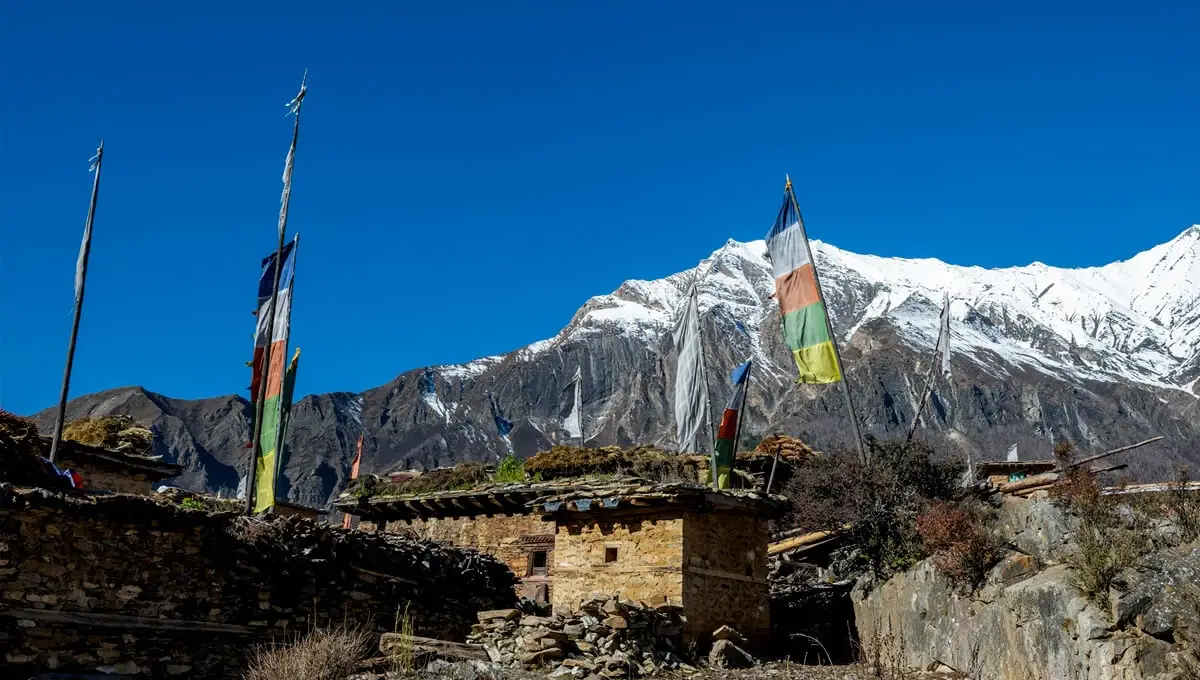
Upper Dolpo Trek For 26 Days

Tour Info

trip code

EN-032

Starting Point/ End Point

Kathmandu

Accommodations

Lodge/ Tea House

Max Altitude

5150m (Jeng La Pass)

Duration

26 days

country

Nepal

Trip grade

Challenging

Activities

Trekking

Best Season

March, April, May, September, October, November

Overview

As one of the most distant regions in Nepal, the Upper Dolpo Trek is a true Himalayan trekking adventure. From the capital of Kathmandu to Nepalgunj and Jhupal, the trip moves westwards before embarking on a trekking route that leads through Dunai, Ankhe, and Sulighat. Beyond these destinations lies one of the most memorable sights of this trekking adventure—the majestic Phoksundo Lake. Also of importance is the trekking stop at Shey Gompa. Crossing the challenging Jeng La Pass at 5,150 m is the trek’s highest point. Over 26 days, the trek blends solitude, high-altitude challenge, and timeless mountain culture.

Details

The Upper Dolpo Trek is one of the best trekking destinations in Nepal and is among the most isolated and diverse trekking journeys that can be undertaken within the territory of Nepal and is the only one that combines high mountainous, high-altitude treks, Tibetan culture, and Himalayan scenery. The trek starts from Kathmandu, where time is spent sightseeing around the city, and then a flight is taken to Nepalgunj and then to Jhupal, which is the entrance point for the Dolpo region. Further trekking leads the trekker through the villages of Dunai, Ankhe, and Sulighat, which lie along river gorges, pine forests, and Alpine regions.

It is a major highlight of the trek: arriving at the stunning Phoksundo Lake, its crystal-clear turquoise waters sitting beneath towering cliffs and snowcapped peaks. Acclimatization days spent at Phoksundo Lake and Shey Gompa afford altitude adaptation in gradual steps and provide ample time to explore sacred monasteries and ancient Bon and Tibetan Buddhist culture. The trek then proceeds through high-altitude settlements such as Namduna Gaon, Saldang, Yangze Gompa, and Sibu enclaves, where the old ways of life have been preserved.

Crossing through Jeng La Pass at an altitude of 5,150 meters brings the maximum effort to this trek, together with magical views of the Himalayas. The trekking trail then takes routes that lead back to Tokyu Gaon, Dho Tarap, and Tarap Khola, with a final descent to Dunai and then Jhupal, culminating with flights to Kathmandu. This 26-day Upper Dolpo trekking experience is not for the faint of heart, providing adventure-seekers an experience that is both rewarding, isolated, and connected to spirituality, in addition to its raw Himalayan landscapes. 

At Ever Nepal Adventure, one of the best travel and trekking company in Nepal, you can experience this remote and thrilling journey with luxury and comfort.
Highlights

  • Arrival in Kathmandu with guided sightseeing of cultural and historical heritage sites

  • Scenic flights from Kathmandu to Nepalgunj and Jhupal, showcasing Nepal’s diverse landscapes

  • Trekking through remote Dolpo villages such as Dunai, Ankhe, Saldang, Tokyu Gaon, and Dho Tarap

  • Exploration and acclimatization at the breathtaking Phoksundo Lake

  • Cultural immersion at Shey Gompa and Yangze Gompa, reflecting ancient Tibetan Buddhist traditions

  • Acclimatization days ensure safe and comfortable high-altitude trekking

  • Crossing the high Jeng La Pass (5,150 m), the highest point of the trek

  • Less-traveled trails offering isolation, tranquility, and untouched mountain scenery

  • Traditional teahouse stays with warm hospitality in remote Himalayan settlements

  • Return journey via Jhupal and Nepalgunj to Kathmandu, completing a rare and unforgettable Himalayan trek

Itinerary

Day 01: Arrival at Kathmandu with hotel transfer (1,400 m).

Upon arrival at Tribhuvan International Airport in Kathmandu, you will be welcomed warmly by one of our representative members and transported to one of the comfortable 3-star hotels in Kathmandu. After checking into the hotel, you get to unwind from your journey or take an ambient walk around town in the streets of Thamel. The evening ends with dinner at the hotel, where you get to enjoy an appetizing dinner that gives a pleasant taste of Nepalese cuisine in an aesthetic setting.

  • Max Elevation: 1,400 m
  • Travel Distance: 6–8 km
  • Travel Time: 20–30 min
  • Accommodation: 3-Star Hotel
  • Meals: Dinner

Day 02: Sightseeing of Kathmandu’s heritage sites and trekking briefing.

After breakfast, you continue on your explorations of Kathmandu’s cultural and historic treasures. The list of what you may want to visit includes Swayambhunath Stupa, Kathmandu Durbar Square, and Pashupatinath Temple, all of which are included in the list of UNESCO World Heritage sites. The afternoon is spent attending a detailed trek briefing. The day ends with a return to your hotel for a well-deserved rest before moving toward western Nepal.

  • Max Elevation: 1,400 m
  • Travel Distance: 5–10 km
  • Travel Time: 2–4 hours
  • Accommodation: 3-Star Hotel
  • Meals: Breakfast, Dinner

Day 03: Fly from Kathmandu to Nepalgunj (150 m) & transfer to the hotel

You fly to Nepalgunj early in the morning, from the Kathmandu hills to the warm lowlands of western Nepal. Arriving, you will be transferred to a comfortable hotel, where you can rest and make necessary preparations for mountain flights. The easy afternoon will let your body acclimatize with nice service and a quiet evening.

  • Max Elevation: 150 m
  • Travel Time: ~50 min flight + transfer
  • Accommodation: Hotel
  • Meals: Breakfast, Lunch, Dinner

Day 04: Fly from Nepalgunj to Jhupal (airstrip ~2,500 m) & trek to Dunai (2,850 m)

After a hearty breakfast, an early flight takes you to the remote airstrip of Jhupal, offering breathtaking views of rugged hills and deep valleys. From here, your trek officially begins as you walk toward Dunai on river trails and through traditional villages. This short trek starts off pretty easily and gives a gentle start while introducing the raw beauty of Dolpo. You'll stay overnight at a welcoming lodge in Dunai.

  • Max Elevation: 2,850 m
  • Travel Time: ~45 min flight + ~3 hours trek
  • Accommodation: Lodge
  • Meals: Breakfast, Lunch, Dinner

Day 05: Trek from Dunai to Ankhe (2,896 m)

The trek for the day follows the Thuli Bheri River and passes by cultivated fields, suspension bridges, and small settlements. Landscapes start to get rugged as you go deeper into the Dolpo region. You will find a simple yet comfortable teahouse at Ankhe, where warm meals and quiet surroundings greet you well after a steady trekking day.

  • Max Elevation: 2,896 m
  • Travel Time: ~6 hours
  • Accommodation: Teahouse
  • Meals: Breakfast, Lunch, Dinner

Day 06: Trek from Ankhe to Sulighat (3,180 m)

Today’s trek involves a continuous climb over narrow paths chiseled out of rocky slopes with mountain waterfalls and deep river valleys. Land gets increasingly inaccessible as trees thin and the climate cools. You come across some halting points that trekkers and pack animals use to rest. Arriving at Sulighat, you begin to enjoy a comfortable stay at a moderate and efficiently managed teahouse amidst adequate care and clean sleeping facilities, despite hard trekking activity throughout the day.

  • Max Elevation: 3,180 m
  • Travel Time: ~6 hours
  • Accommodation: Teahouse
  • Meals: Breakfast, Lunch, Dinner

Day 07: Trek from Sulighat to Phoksundo Lake (3,612 m)

You pass through evergreen pine forests and cliff sections before opening out to alpine scenery. Once you are nearing Phoksando National Park, the scenery becomes starkly barren but also very beautiful at the same time. It almost seems surreal once the lake at Phoksando comes into sight in all its turquoise colors amidst the rock cliffs. You camp by the lake in a comfortable lodge where the hospitality is warm and the evening by one of Nepal’s most famous natural features is very serene indeed.

  • Max Elevation: 3,612 m
  • Travel Time: ~6 hours
  • Accommodation: Lodge
  • Meals: Breakfast, Lunch, Dinner

Day 08: Acclimatization Day at Phoksundo Lake (3,612 m).

Today is a day for rest and acclimatization to the peaceful surroundings of Phoksundo Lake. Short treks to nearby viewpoints or monasteries will get your legs moving without overtaxing your body at high altitude. Your day is spent absorbing the peace that surrounds you and taking time to relax, rehydrate, and fuel your body by enjoying delicious meals. This is a day to feel comfortable in your surroundings while preparing your body for trekking into Dolpo.

  • Max Elevation: 3,612 m
  • Accommodation: Lodge
  • Meals: Breakfast, Lunch, Dinner

Day 09: Trek from Phoksundo Lake to Phoksundo Khola Camp (3,507 m).

The trail now leaves the lake behind and follows thin paths above steep gorges, which reveal dramatic views of the valley below. The country gets even more rugged and remote, the true entrance into Dolpo. You lose altitude down to Phoksundo Khola, where a simple but well-organized camp is waiting. Warm food and sheltered accommodations are almost a deluxe comfort in such a stark alpine environment. This is where you can rest and build your strength.

  • Max Elevation: 3,507 m
  • Travel Time: ~5 hours
  • Accommodation: Camp / Lodge
  • Meals: Breakfast, Lunch, Dinner

Day 10: Trek from Phoksundo Khola Camp to Phoksundo Bhanjyang (3,910 m)

The trek is gradual, as you pass over glacial and exposed routes, with spectacular views of nude mountains and upland valleys. The stillness of the scenery is broken only by the sounds of the wind and the distant water streams. As the trek gains elevation, the pace is steady and deliberate. After arriving at Phoksundo Bhanjyang, you establish a high camp where the staff is attentive to providing warm meals and sound rest for the next Phoksundo Lake trek phases.

  • Max Elevation: 3,910 m
  • Travel Time: ~6 hours
  • Accommodation: Camp / Lodge
  • Meals: Breakfast, Lunch, Dinner

Day 11: Trek from Phoksundo Bhanjyang to Shey Gompa (4,500 m).

Today’s trek takes you deep into the spiritual core of Upper Dolpo. You emerge into extensive high-altitude plains with the mountain ranges of the Himalayas in the background. You reach Shey Gompa after a gentle climb, and this monastery holds immense spiritual significance. This place is serene and full of Tibetan Buddhist traditions. You stay nearby in basic but comfortable accommodation with delicious meals and an evening at high altitude.

  • Max Elevation: 4,500 m
  • Travel Time: ~6 hours
  • Accommodation: Lodge
  • Meals: Breakfast, Lunch, Dinner

Day 12: Acclimatization Day at Shey Gompa (4,500 m).

Rest days help in acclimatization at the high altitude in which Shey Gompa is situated. The walks around the monastery and surrounding hills keep the body moving without much exertion. You get to see the local rituals being performed at the monastery, as well as the pace of life in the remote region where time passes so slowly. The warmth from the rooms in the lodge at Shey provides the best conditions for relaxation at the onset of acclimatization to the thinner air at the higher altitude.

  • Max Elevation: 4,500 m
  • Accommodation: Lodge
  • Meals: Breakfast, Lunch, Dinner

Day 13: Trek from Shey Gompa to Namduna Gaon (4,800 m).

The journey continues on topographic features characterized by broad valleys and extreme scenery. The region appears very distant and frozen in time, exhibiting few traces of modern civilization. The presence of Namduna Gaon can be noticed as a small settled place that has developed out of difficult environmental and cultural circumstances. You will spend the night in a basic but very hospitable tourist lodge.

  • Max Elevation: 4,800 m
  • Travel Time: ~6 hours
  • Accommodation: Lodge
  • Meals: Breakfast, Lunch, Dinner

Day 14: Trek from Namduna Gaon to Saldang (3,620 m).

The trail leads down gradually to one of the largest settlements in Upper Dolpo. Stone-walled houses, fields of barley, and prayer walls come to characterize the terrain around Saldang. Being at a lower altitude does bring some relief, and it seems like a livelier settlement compared to the preceding days. You stay in a chorten-like teahouse.

  • Max Elevation: 3,620 m
  • Travel Time: ~5 hours
  • Accommodation: Teahouse
  • Meals: Breakfast, Lunch, Dinner

Day 15: Trek from Saldang to Yangze Gompa (4,960 m).

On this day, a gradual ascent leads to the Yangze Gompa, which has religious significance and magnificent topographic landscapes. The trek involves an ascent, so it’s shorter but tougher. As you reach, the serene ambience and monastery offer an extremely peaceful experience. The facilities for accommodation are basic but take good care of you, with ample warmth in terms of meals, to help you take quality rest at one of the higher points of this trek.

  • Max Elevation: 4,960 m
  • Travel Time: ~4 hours
  • Accommodation: Lodge
  • Meals: Breakfast, Lunch, Dinner

Day 16: Trek from Yangze Gompa to Sibu (4,560 m).

Today’s route passes through valleys and highland areas with extensive views of the surrounding mountains. It feels very isolated, emphasizing the impression that you are far away from mainstream civilization. There is some descent towards Sibu, which is a small settlement that has basic sleeping facilities. The night passes quietly, with good accommodation that helps you to overcome exhaustion experienced during the day.

  • Max Elevation: 4,560 m
  • Travel Time: ~6 hours
  • Accommodation: Lodge
  • Meals: Breakfast, Lunch, Dinner

Day 17: Trek from Sibu to Jeng La Phedi (4,900 m).

The trek for the day begins with an ascent towards Jeng La Pass, with landscapes composed of wind and weather-carved open areas. The landscapes here appear raw and immense, with hardly any points of distinction other than the far-off ridges. Reaching Jeng La Phedi means camping at a higher spot, where planning, good food, and care guarantee sound sleep for reaching the final peak of this trek.

Max Elevation: 4,900 m
Travel Time: ~6 hours
Accommodation: Camp
Meals: Breakfast, Lunch, Dinner

Day 18: Trek from Jeng La Phedi to Tokyu Gaon via Jeng La Pass (5,150 m) and descend to Tokyu Gaon (4,209 m).

Today is one of the most challenging and rewarding days on your trekking journey. The day begins very early, climbing through to Jeng La Pass, and then opening into a huge wilderness area as you ascend to a height of 5,150m to get to Jeng La Pass, greeted by breathtaking sights of Dolpo’s massive ridges along with the Himalayas. You have a brief halt, followed by a lengthy descent to Tokyu Gaon through yak grazing grounds and a valley to finally wind up in an overnight lodge, savoring remarkably welcoming care.

  • Max Elevation: 5,150 m
  • Travel Time: ~7 hours
  • Accommodation: Lodge
  • Meals: Breakfast, Lunch, Dinner

Day 19: Trek from Tokyu Gaon to Dho Tarap (4,040 m).

The trail for this day is not as strenuous, giving a chance to enjoy the vast views of the valley and fields that encircle Tokyu Gaon. Along the trail, one encounters villages and grazing areas that echo the rich agricultural past of this region. Dho Tarap, one of the largest settlements in Upper Dolpo, is filled with a combination of Bon and Buddhist cultures. The town feels alive compared with what came prior, and the tea house accommodation provides a much-relieved environment for relaxation.

Max Elevation: 4,040 m
Travel Time: ~5 hours
Accommodation: Teahouse
Meals: Breakfast, Lunch, Dinner

Day 20: Trek from Dho Tarap to Tarap Khola (3,800 m).

After leaving Dho Tarap, you head towards the Tarap River as the route squeezes into deep gorges. The trail traverses under massive cliffs of rocks that form this harsh terrain. The terrain becomes relatively flat as it leads to Tarap Khola in the late afternoon. You find an organized camp or a lodge where you enjoy warmth, food, and safety despite finding yourself in such an inhospitable region.

  • Max Elevation: 3,800 m
  • Travel Time: ~6 hours
  • Accommodation: Camp / Lodge
  • Meals: Breakfast, Lunch, Dinner

Day 21: Trek from Tarap Khola to Khani Gaon (3,150 m).

The day begins with a descent into wooded trails and along rivers, with increasing greenery all along your route. Wooden bridges provide a welcome contrast in your walk, in addition to passage sections in canyons. Khani Gaon is a peaceful village, providing a serene place in which you can stay overnight. Your accommodations in this place involve a small tea house, where you have clean rooms and hearty food.

  • Max Elevation: 3,150 m
  • Travel Time: ~5 hours
  • Accommodation: Teahouse
  • Meals: Breakfast, Lunch, Dinner

Day 22: Trek from Khani Gaon to Tarakot (2,537 m).

As you continue trekking on well-marked paths that go past villages, slopes of forests, and village settlements, you realize the temperature seems warmer by the time you continue with your descent. Tarakot is a wonderful place with a history of being a prominent trading post. Your stay here gives you the opportunity to enjoy much-improved amenities. In actuality, your stay here allows you to enjoy a much-warm hospitality relative to the past weeks of tough trekking.

  • Max Elevation: 2,537 m
  • Travel Time: ~5 hours
  • Accommodation: Lodge
  • Meals: Breakfast, Lunch, Dinner

Day 23: Trek from Tarakot to Dunai (2,850 m).

The trail soon begins to wind its way back to Dunai, either along riverbanks or via familiar routes across agricultural areas. The hike is steady and meditative, allowing trekkers to reflect on their journey through Upper Dolpo. The return to Dunai is a sense of returning to luxury, as accommodations have improved, and access to services is easier to obtain. The day passes easily into the night, allowing trekkers to recover, enjoy a fine meal, and celebrate a successful trek through a very difficult region.

  • Max Elevation: 2,850 m
  • Travel Time: ~6 hours
  • Accommodation: Lodge
  • Meals: Breakfast, Lunch, Dinner

Day 24: Trek from Dunai to Jhupal (2,320 m).

Trekking to Phakding and then to Lukla will be the last hiking day. The path leads through some villages and hills, giving a nice and easy trekking experience for a day. Arriving in Jhupal by noon gives you the whole day to relax and prepare for further flights. A night in the lodge allows you to spend your last night in the mountains in a cozy and warm ambience.

  • Max Elevation: 2,320 m
  • Travel Time: ~3 hours
  • Accommodation: Lodge
  • Meals: Breakfast, Lunch, Dinner

Day 25: Fly from Jhupal to Nepalgunj & Nepalgunj to Kathmandu (1,300 m). Duration: ~1 hr 30 min flights + transfer.

Your day starts with a sightseeing flight from Jhupal to Nepalgunj. You get to witness the changeover from mountainous regions to lowland areas. You are then taken back to Kathmandu by a connecting flight. You are then checked into a hotel. You get to enjoy the comforts of a modern facility after spending considerable time in the wilderness. The rest of your day is free.

  • Max Elevation: 1,300 m
  • Travel Time: ~1 hr 30 min flights + transfer
  • Accommodation: 3-Star Hotel
  • Meals: Breakfast, Lunch

Day 26: Final departure from Kathmandu International Airport (1,300 m). Duration: Airport transfer.

After breakfast, you are transferred to the Tribhuvan International Airport for your onward flight. You bid farewell to the trek as it comes to an end, not only as an adventure but also as a deeply immersive experience in the Himalayas, carved out of isolation, culture, and the ever-present landscape of the Upper Dolpo region.

  • Max Elevation: 1,300 m
  • Travel Time: Airport transfer
  • Meals: Breakfast

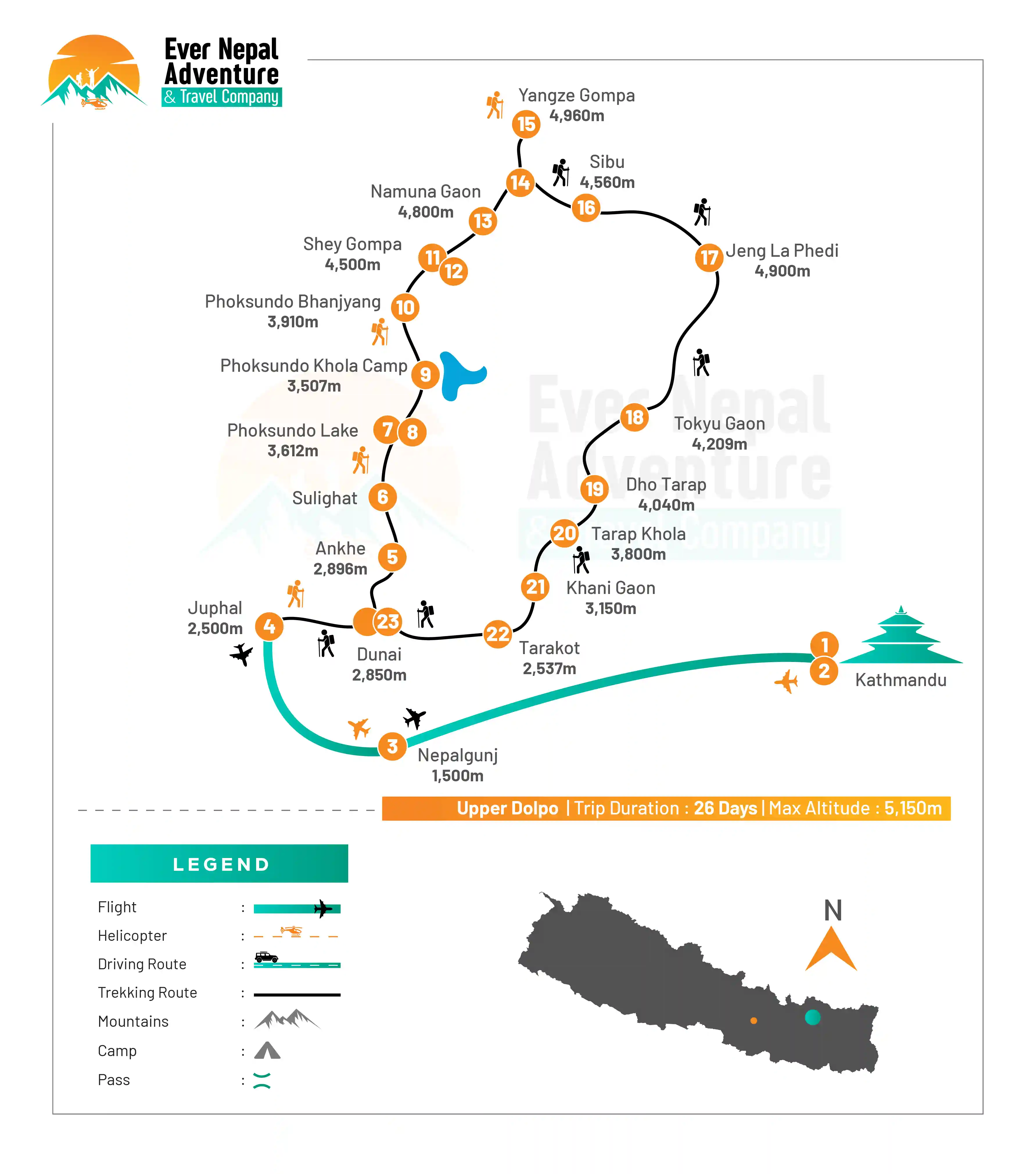
Trek Route

upper Dolpo trek route map

Packing List for Upper Dolpo Trek (26 Days)

The Dolpo region is a remote and high-altitude journey. Therefore, when going on this trek, you should pack smart. However, smart packing is not just about comfort but also survival and energy efficiency. Thus, your gears must be lightweight, layered, and reliable. Following is a complete packing list for Upper Dolpo Trek:

Head

  • Wide-brimmed sun hat
  • Warm beanie (wool or fleece)
  • Neck gaiter or buff
  • UV-protected sunglasses
  • High-SPF sunscreen
  • Lip balm with SPF
  • Lightweight headlamp with extra batteries
  • Facial wipes for hygiene on the trail

Hands

  • Waterproof outer gloves
  • Insulated inner gloves (for high altitude and cold mornings)

Upper Body

  • Moisture-wicking base layers (thermal tops)
  • Quick-drying trekking t-shirts
  • Breathable long-sleeved trekking shirts
  • Fleece jacket (mid-layer warmth)
  • Insulated down jacket (high altitude essential)
  • Waterproof and windproof outer shell jacket
  • Light, compressible, puffy jacket for layering
  • Raincoat or poncho for unexpected weather

Lower Body

  • Thermal innerwear (base layer bottoms)
  • Waterproof trekking pants
  • Two pairs of fleece or insulated trekking trousers
  • Lightweight cotton pants for lower altitude days
  • Windproof outer trousers
  • Comfortable trekking leggings for flexibility

Footwear

  • Durable waterproof trekking boots (well broken-in)
  • Lightweight sandals or camp shoes
  • Wool trekking socks (4–6 pairs moisture-wicking)
  • Gaiters (for snow, dust, and rocky terrain)

Toiletries

  • Toothbrush and toothpaste (travel size)
  • Biodegradable soap or body wash
  • Quick-dry towel
  • Toilet paper and wet wipes
  • Hand sanitizer
  • Small shampoo bottle
  • Moisturizer for dry high-altitude skin

Accessories

  • Trekking poles (highly recommended for Dolpo terrain)
  • Large duffle bag (for porters)
  • Daypack (20–30L for daily essentials)
  • Reusable water bottles or hydration bladders
  • Water purification tablets or a filter
  • Sleeping bag (rated for extreme cold -20°C or lower)
  • Dry bags or packing cubes for organization
  • Sunglasses strap and gear repair kit

First Aid Kit

  • Diamox (for altitude sickness prevention)
  • Painkillers (ibuprofen or paracetamol)
  • Antiseptic wipes and ointment
  • Bandages and gauze
  • Anti-diarrhea medication
  • Blister care kit (Compeed or similar)
  • Personal prescription medicines
  • Rehydration salts

Miscellaneous Items

  • Camera or smartphone with extra batteries
  • Power banks (high capacity recommended)
  • Solar charger (useful in remote areas)
  • Travel adapter
  • Binoculars for mountain and wildlife viewing
  • Notebook or journal
  • Lightweight snacks (energy bars, nuts, chocolates)
  • Cash in small denominations (no ATMs in Dolpo)

Specific Gears for Women

When it comes to gears, there are some gears that are specific to women. Having women specific gears ensures that any women on this trek get to go on this journey filled with confidence and comfort. The key gears specific to women for this trek include:

  • Sports bras (quick-dry and supportive)
  • Moisture-wicking undergarments
  • Sanitary pads or tampons (sufficient supply for entire trek)
  • Travel-size feminine hygiene products
  • Skincare essentials (moisturizer, cleanser, sunscreen)
  • Warm fleece headband or ear cover
  • Thermal leggings or fitted trekking tights
  • Lightweight long inner layers for comfort and warmth

Required Permits

Certain documents are required to successfully complete the Upper Dolpo Trek. These documents ensure you have a safe and hassle-free trekking experience. Documents that are compulsory for this trek are provided below:

  •  Permit for Restricted Area of Upper Dolpo Trekking: It is a compulsory permit needed for trekking into Upper Dolpo. This permit can be availed from the trekking agencies of Nepal along with the guide. This permit costs US$500 for the first 10 days and US$50 per day after that.
  • Shey Phoksundo National Park Permit: It is a mandatory permit for entering the Shey Phoksundo National Park area while trekking. It can be acquired from the Nepal Tourism Board, located in Kathmandu. The charges are NPR 3,000 ($23), NPR 1,500 ($12), and NPR 100 for foreigners, SAARC nations, and Nepalese citizens, respectively.
  • TIMS Card (Trekkers’ Information Management System): This is the permit that is required in the process of trekking management and trekker safety registration in Nepal. Usually, this permit is organized by the trekking agency prior to trekking. Its cost is NPR 2,000 ($15) for a foreign citizen.
  • Passport: An original passport with six months validity period after entry into the country is needed for the Upper Dolpo Trek.
  • Passport Size Photos: One needs to have 2 to 4 passport-size photographs for obtaining the necessary permits and for any official trekking documentation.
  • Nepal Entry Visa: A valid Nepal Tourist visa is needed for the traveler. Almost all tourists can get it while arriving at Nepal’s Tribhuvan International Airport.
  • Travel Insurance: Mandatory travel insurance for the Upper Dolpo Trek. 

What's included

  • Airport transfers in Kathmandu on arrival and departure by private vehicle
  • Domestic flights: Kathmandu–Nepalgunj–Jhupal and return Jhupal–Nepalgunj–Kathmandu (including airport taxes)

  • All trekking permits and fees, including Upper Dolpo Restricted Area Permit, Shey Phoksundo National Park Permit, and TIMS

  • Accommodation in Kathmandu at a 3-star hotel on a twin-sharing basis with breakfast

  • Hotel accommodation in Nepalgunj on a twin-sharing basis with meals as per the itinerary

  • All lodge and teahouse accommodation during the trek

  • Full-board meals during the trek (Breakfast, Lunch, and Dinner)

  • Professional government-licensed, English-speaking trekking guide with salary, meals, accommodation, insurance, and equipment

  • Experienced porters (one porter for two trekkers) with salary, meals, accommodation, insurance, and safety gear

  • Camping equipment where required (tents, kitchen tent, dining tent, sleeping mats, tables, chairs)

  • Cook and kitchen staff for camping sections, including food supplies and equipment.

  • A comprehensive first aid medical kit is carried by the guide

  • Trekking route logistics management and operational support

  • All government taxes, VAT, and official service charges

  • International airfare to and from Kathmandu

What's excluded

  • Nepal entry visa fees
  • Travel and rescue insurance (mandatory, including high-altitude helicopter evacuation)
  • Personal trekking equipment (sleeping bags, down jackets, trekking poles, etc.)

  • Meals in Kathmandu are not mentioned in the itinerary.

  • Alcoholic beverages, soft drinks, bottled water, and snacks during the trek

  • Personal expenses such as laundry, phone calls, Wi-Fi, hot showers, and battery charging

  • Tips for guide, porters, and trekking staff (customary but not mandatory)

  • Costs arising from itinerary changes due to weather, flight delays, natural disasters, or unforeseen circumstances

  • Any additional accommodation or meals caused by early arrival, late departure, or flight cancellation

  • Medical expenses and emergency treatment

  • Any services not explicitly mentioned under “Cost Includes.”

Frequently Asked Questions

How difficult is the Upper Dolpo Trek?

Upper Dolpo Trekking is a demanding and challenging trekking adventure in Nepal. The Upper Dolpo Trek is a challenging and demanding trekking adventure in Nepal. It involves long walking days on remote terrain with basic facilities. There are also high-altitude crossings like Jeng La Pass (5150 meters) at high altitude.

Do I need to have prior experience trekking for the Upper Dolpo Trek?

This trek is best done with previous experience. The route is a challenging trek through high-altitude, isolated regions. Trekkers must be physically fit and have experience in multi-day Himalayan hiking.

When is the best time of year to trek the Upper Dolpo?

The best seasons to trek Upper Dolpo are in the spring (March-May) and fall (September-November). The Dolpo region is best suited to these months because of the stable weather conditions, better mountain views and comfort trekking conditions.

Is altitude sickness possible concern on the trek?

Altitude sickness is a possibility because the trek reaches altitudes over 5,000 meters. The trekking route will feature acclimatization stops at Shey Gompa and Phoksundo Lake to allow you time to acclimatize to the higher altitude.

Are there teahouses on the Upper Dolpo Trek?

Yes, but only in certain settlements; otherwise, the journey will need you to camp in other sections. The accommodation facilities are basic compared to popular routes such as Everest and Annapurna.

What type of food can I expect on the trek?

In most teahouses and camps, you can expect to find simple, but nourishing meals like dal bhat (noodles), soup, potatoes and rice, tea and Tibetan bread. While there may not be much to choose from regarding food in faraway areas, the guides and kitchen staff always make sure meals are made available throughout the trekking period.

Travel insurance is mandatory for the Upper Dolpo Trek.

Travel insurance is mandatory for the Upper Dolpo Trek. Make sure that your insurance plan covers altitude trekking and evacuation and/or emergency helicopter service if required.

Is internet connectivity available during the trek and can we recharge our electronic gadgets?

Internet facilities are scarce in remote areas. Charging stations may be available for an extra fee at certain villages and teahouses. In Upper Dolpo, the coverage of mobile networks and the internet is not reliable.

Do I need to hire a guide on the Upper Dolpo Trek?

It is necessary to hire a guide because Upper Dolpo in Nepal is a restricted area for trekking. Independent trekking is prohibited, and permits are only issued by registered trekking agencies.

What makes the Upper Dolpo Trek unique compared to other trekking routes in Nepal?

Upper Dolpo Trek is unique because of the untouched Himalayan landscapes and ancient Tibetan Buddhist culture. It also offers a wilderness experience in a restricted region, as well as remote villages. Upper Dolpo is a quieter trekking route than the more popular routes. It offers a spiritual heritage and some of Nepal's most remote mountain scenery. 

User Review