Gosaikunda Lake Trek - 8 Days

Tour Info

trip code

EN-027

Starting Point/ End Point

Kathmandu

Accommodations

Lodge/ Tea House

Max Altitude

4610m/15120fts

Duration

8 days

country

Nepal

Trip grade

Moderate

Activities

Trekking

Best Season

Spring (March–May) and Autumn (September–November, Early December)

Overview

The Gosaikunda Lake Trek is a brief yet complete trekking adventure in the Langtang region of Nepal, combining mountain walking, cultural sites, and religious landmarks. It is a high-altitude trek that can be completed within a short period, and it is therefore a good trekking option that allows a trekker to have an experience of a Himalayan trek without committing much time. The path goes across traditional villages, forests of the Alps, and mountain passes. Lake of Gosaikunda is the greatest attraction. Expedition begins and finishes in Kathmandu and includes guided city sightseeing, road journeys, and well-established teahouse trekking.

Details

Gosaikunda Lake Trek is a suitable choice if you like to have a brief Himalayan trek, experience high altitude and cultural, religious, and natural elements. The hike quickly climbs through alpine towns reachable by road, where you can explore the forest trails, highland pastures, and glacier-fed lakes in a few days. Trek is interesting, the scenery is not static and does not require long-distance trekking per day. Pilgrims and trekkers usually use the route, and therefore, the trails are clear, and teahouse facilities can be found everywhere.

The trek is suitable for trekkers looking for a moderate challenge. Even though the increase in altitude is high, the itinerary allows for gradual climbing and adequate acclimatisation. Crossing Laurebina Pass is the main physical challenge, but it is not technical. This hike does not involve camping or any special equipment. It can be done with a basic level of trekking fitness.” It is a viable option among the people who desire a high-altitude experience in the Kathmandu area without having to go through a lengthy journey.
Highlights

  • High altitude trek to Gosaikunda Lake (4,385m) and Lauribinayak Pass (4,610m) in a short period of time.

  • Integration of trekking and cultural tourism with Kathmandu Valley heritage tourism.

  • Trekking route with frequent teahouses, which makes the trek not demanding in terms of camping.

  • Slow climb, which allows adequate acclimatization even though the elevation is high.

  • Possibility to traverse a high Himalayan pass without technical climbing.

  • Traditional Tamang village life and local mountain life experience.

  • Trekking equipment that is appropriate in case of moderate-level trekkers with simple trekking fitness.

  • The route begins and ends at Kathmandu, which minimizes long journeys.

  • Hikes through the forest and the Alps.

  • Hindu and Buddhist pilgrims attach religious importance to Gosaikunda Lake.

Itinerary

Day 01: Arrival in Kathmandu and Trek Preparation

Upon arrival at Tribhuvan International Airport, a transfer to the hotel in Kathmandu is arranged. The day is mainly used for rest after travel and for basic trek preparation. When you land at Tribhuvan International Airport, you are transferred to the Kathmandu hotel. The day is primarily spent on post-travel rest and simple preparation of the trek. A briefing is made short in order to revise the trek schedule, permits and checking of equipment. There is no long distance travelling on this day and the transfers are made in the form of hotel transfers within the city, which take around 20 to 30 minutes by vehicles, depending on the traffic, and covers a short distance within Kathmandu Valley. Kathmandu Overnight stay.

  • Max Elevation: 1,400 meters (Kathmandu)
  • Travel Distance: 5 to 6 kilometers
  • Travel Hours: 20 to 30 minutes
  • Accommodation: 3 to 4-star Hotel in Kathmandu
  • Meal: Dinner included

Day 02: Full Day Guided Tour

Your sightseeing tour is scheduled for 8 AM on the following day after breakfast at the hotel. This means that you will travel by way of a private car. This will make your travel easy and pleasurable. The guide who accompanies you will explain everything about your destinations. The itinerary has been designed to allow you enough time to visit each site without feeling rushed. Throughout the day, you will visit the most important UNESCO World Heritage Sites of Kathmandu Valley. Each site reflects the rich tradition, art, and spirituality of Nepal.

Swayambhunath (World Heritage Site).

Swayambhunath is an ancient religious shrine perched on top of a hill, overlooking Kathmandu Valley. It is also known as Monkey Temple because of the monkeys that live in the vicinity. This ancient Buddhist site in Nepal is considered to be one of the most sacred and oldest in Nepal. The stupa, which is decorated with prayer banners, shrines, and intricate carvings, offers a panoramic view of the valley.

Pashupatinath Temple:

Pashupatinath Temple, one of the most sacred Hindu temples dedicated to Lord Shiva and located on the banks of the Bagmati River, is one of Hinduism's holiest temples. The pagoda design of the temple serves as the focal point for Hindu pilgrims who visit it. People have the privilege to view the temple from special viewing spots on the other side of the river. The main temple is only meant for Hindus.

Boudhanath Stupa:

The Boudhanath Stupa, being one of the biggest Buddhist Stupas in Nepal and in the whole wide world, is the hub for Tibetan Buddhism. This stupa was constructed during the 5th Century AD and has the typical Buddha Eyes signifying wisdom in all directions.

Bhaktapur Durbar Square (World Heritage Site).

Bhaktapur Durbar Square is a beautiful medieval city center known for its Newari architecture. It includes temples, courtyards, and palaces. The 55-Window Palace and Nyatapola Temple are among the most important highlights of the Malla period. The square provides a unique insight into Nepal’s ancient city and cultural heritage.

You will return to Thamel late in the afternoon after completing your sightseeing tour. Here, you can explore the local markets and buy souvenirs. Overnight in Kathmandu concludes the day.

  • Max Elevation: 1,450 meters (Swayambhunath Stupa)
  • Travel Distance:  25 to 30 kilometers (total driving between sites)
  • Travel Hours: 4 to 5 hours
  • Accommodation: 3 to 4-star Hotel in Kathmandu
  • Meal: Breakfast included

Day 03: Drive from Kathmandu to Dhunche

The trip starts with a road trip to Kathmandu to Dhunche, the trailhead of the hike. The route takes you through mountainous roads, hills, crosses villages and valleys. The overall distance covered by the car is about 118 km, and the trip lasts about 5 to 6 hours, depending on the road and traffic conditions. Dhunche sits at an altitude of 2,030 m, where the overnight stay is arranged in preparation for the trek starting the following day.

  • Max Elevation: 2,030 meters (Dhunche)
  • Travel Distance: 118 kilometers
  • Travel Hours: 5 to 6 hours
  • Accommodation: Tea house/Lodge in Dhunche
  • Meal: Breakfast, Lunch, and Dinner included

Day 04: Trek from Dhunche to Sing Gompa/Chandabari(3330m)

On the fourth day, the hike begins in Dhunche and is traced along a trail through wooded lanes, small villages and along the banks of rivers. The trail slowly climbs to Sing Gompa/Chandabari, which is 3,330 m high. You will cover about 10 to 12 km in 4 to 5 hours, depending on your pace and rest breaks. An overnight accommodation is organized in a local teahouse in Sing Gompa.

  • Max Elevation: 3,330 meters (Sing Gompa/Chandabari)
  • Travel Distance: 10 to 12 kilometers
  • Travel Hours: 4 to 5 hours
  • Accommodation: Tea house/Lodge in Sing Gompa
  • Meal: Breakfast, Lunch, and Dinner included

Day 05: Trek from Sing gompa to Gosaikunda Lake(4385)

Your journey goes on further to Gosaikunda Lake, via the alpine routes and the highland tracts, between Sing Gompa and Gosaikunda Lake. The path leads slowly upwards to the holy lake, which is 4,385 m. You will trek about 8 to 10 km each day, which will take around 4–5 hours depending on your pace and rest breaks. A night stay is organised in a teahouse on the Gosaikunda lake.

  • Max Elevation: 4,385 meters (Gosaikunda Lake)
  • Travel Distance: 8 to 10 kilometers
  • Travel Hours: 4 to 5 hours
  • Accommodation: Tea house/Lodge near Gosaikunda Lake
  • Meal: Breakfast, Lunch, and Dinner included

Day 06: Trek to Gopte/Thadepati(3563m) via Lauribinayak Pass (4610m)

On this day, you will trek from Gosaikunda Lake to Gopte and Thadepati, crossing Lauribinayak Pass at 4,610 m. The path moves down the pass slightly past Gopte/Thadepati at 3,563 m, through alpine meadows and rocky terrain. You will cover about 12–14 km in 7–8 hours, depending on your pace and rest breaks. Overnight accommodation is arranged in a teahouse at Gopte or Thadepati.”

  • Max Elevation: 4,610 meters (Lauribinayak Pass)
  • Travel Distance: 12 to 14 kilometers
  • Travel Hours: 7 to 8 hours
  • Accommodation: Tea house/Lodge in Gopte/Thadepati
  • Meal: Breakfast, Lunch, and Dinner included

Day 07: Trek from Thadepati to Chipling village (2205m)

Your journey continues as you descend from Thadepati, leaving behind the exposed ridgelines and stepping into a quieter world of dense forests and scattered settlements. The trail winds gently through rhododendron and oak woods, with occasional clearings that reveal distant hills and terraced farmlands. As you move lower, the air grows warmer, and the path becomes more relaxed, leading you toward the peaceful surroundings of Chipling village.

You will trek approximately 7 to 9 kilometers today, which usually takes around 4 to 5 hours depending on your pace and rest stops. The descent is gradual for most parts, making it a comfortable walk compared to previous high-altitude days. A night stay is arranged in a local teahouse in Chipling, where you can unwind and enjoy the calm village atmosphere.

  • Max Elevation: 3,690 meters (Thadepati)
  • Travel Distance: 7 to 9 kilometers
  • Travel Hours: 4 to 5 hours
  • Accommodation: Tea house/Lodge in Chipling village
  • Meal: Breakfast, Lunch, and Dinner included

Day 08: Trek to Sundarijal and Drive to Kathmandu

On the last day, you will trek from Chipling Village to Sundarijal via forested paths and small villages. The day trekking distance is about 15 km and the walking time is about 7 to 8 hours. After reaching Sundarijal, a drive of 15.1 km (approximately 1 hour) returns to Kathmandu. An overnight stay is arranged at a hotel in Kathmandu.

  • Max Elevation: 1,300 meters (Sundarijal)
  • Travel Distance: 15 kilometers (trek) and 15.1 kilometers (drive)
  • Travel Hours: 7 to 8 hours (trek) and 1 hour (drive)
  • Accommodation: Tea house/Lodge or hotel in Kathmandu
  • Meal: Breakfast, Lunch, and Dinner included

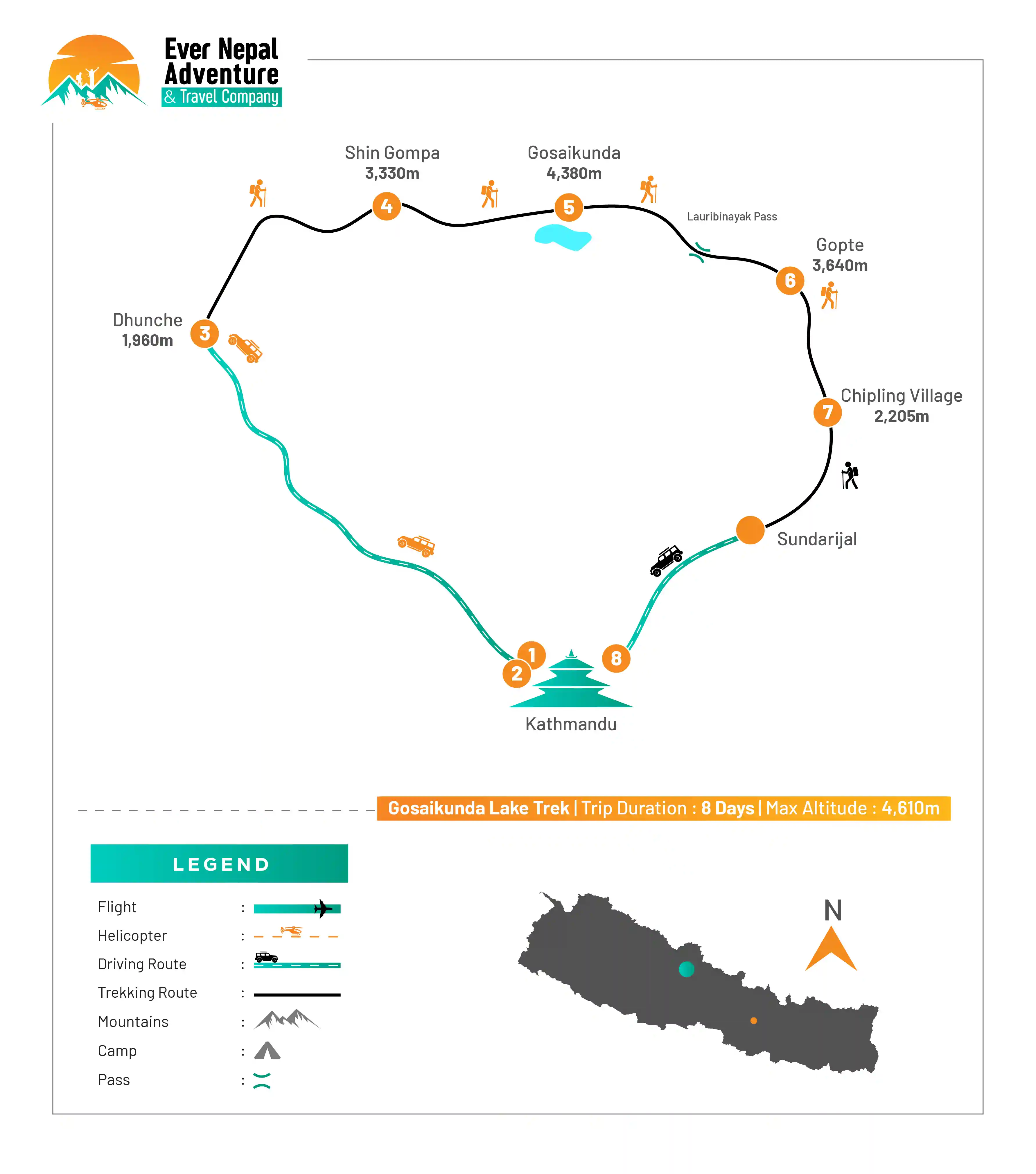
Trek Route

Gosaikunda-Lake-Trek-7-days-route

What's included

  • Kathmandu to Dhunche by private jeep, shared jeep or local bus.

  • Everything in the trek (Breakfast, Lunch, Dinner) and a cup of coffee/tea.

  • Jeep/car transport Sundararijal Kathmandu.

  • Certified English-speaking trekking guide throughout the trek.

  • Guide costs, such as meals, insurance, salary, accommodation and equipment.

  • The guide supplied hiking poles and a First Aid Medical Kit.

  • All the necessary permits (TIMS and trekking permits) and documents.

  • Included government and local taxes.

  • Good-bye dinner at the conclusion of the trek.

What's excluded

  • Airfare (in-country and overseas)

  • Visa fees

  • Travel insurance and medical insurance.

  • Personal costs, such as shopping, phone, laundry, bar bills, hot showers, snacks, and Internet.

  • Individual trekking equipment and clothing.

  • Additional Kathmandu accommodation outside the itinerary.

  • Helicopter evacuation in case of emergency.

  • In Kathmandu and Pokhara, there are tour or entrance fees.

  • Tips for guides and porters

  • Any other costs that are not indicated in the cost-inclusive section.

Packing List for Gosaikunda Lake Trek

With your climb from 2,000 meters to above 4,600 meters in such a short period of time, you must ensure that all your equipment is versatile. Using multiple clothing layers is essential, as you may feel hot while hiking in the sun but very cold once the sun drops behind the peaks at Gosaikunda. Here is a packing list for trekking to Gosaikunda Lake.

  • Head:

    • Warm beanie (wool or synthetic fleece).

    • Wide-brimmed sun hat or cap for lower altitude trekking.

    • Polarized sunglasses to prevent snow blindness near the pass.

  • Hands:

    • Lightweight inner thermal gloves.

    • Waterproof/windproof outer shells (crucial for Lauribinayak Pass).

  • Upper Body:

    • Moisture-wicking base layers (avoid cotton, it stays wet).

    • Mid-layer fleece jacket or thermal pullover.

    • Warm down jacket (rated for -10°C for the nights at the lake).

    • Waterproof/breathable hardshell jacket.

  • Lower Body:

    • Breathable trekking trousers (convertible ones are great).

    • Thermal leggings for high-altitude nights.

    • Waterproof over-trousers.

  • Footwear:

    • Mid-to-high-cut trekking boots (broken in before the trip).

    • 2-3 pairs of thick wool-blend trekking socks.

    • Comfortable sandals or Crocs for the teahouses.

  • Toiletries:

    • Quick-dry travel towel.

    • Biodegradable soap and toothbrush/paste.

    • High SPF sunscreen and lip balm.

    • Deodorant and wet wipes (showers are rare at high altitudes).

  • Accessories:

    • Headlamp with extra batteries (essential for early starts).

    • Trekking poles (highly recommended for the steep descent to Sundarijal).

    • Refillable water bottles or a hydration bladder (2L minimum).

  • First Aid Kit:

    • Diamox (for altitude), Ibuprofen, and throat lozenges.

    • Blister plasters (moleskin) and antiseptic cream.

    • Rehydration salts (ORS).

  • Miscellaneous Items:

    • 4-season sleeping bag (teahouse blankets aren't always enough).

    • Power bank for charging devices (charging costs extra at high altitudes).

  • Specific Gears for Women:

While on the trek, there are certain essentials that women must carry in order to complete the journey successfully. Having these gears ensures comfort, hygiene, and protection throughout the trek in changing weather and altitude conditions.

  • Moisture-wicking sports bras

  • Menstrual cup or sufficient biodegradable pads/tampons

  • Small bottle of dry shampoo

  • Trowel and waste bags for remote sections

Documents Required for Gosaikunda Lake Trek

Even though the Gosaikunda Lake trek is close to Kathmandu, it enters a protected National Park and requires specific permits. The following are the documents required while trekking to Gosaikunda Lake: 

  • Langtang National Park Entry Permit: This is required to enter the protected area where Gosaikunda is located. It can be obtained at the Nepal Tourism Board in Kathmandu or the park entrance at Dhunche. It costs around  3,000 NPR (approx. $23) for foreigners.

  • TIMS Card (Trekkers’ Information Management System): A mandatory registration card for all trekkers in Nepal to ensure safety and tracking. It is usually arranged by your trekking agency via the Nepal Tourism Board. Can Cost you around 2,000 NPR (approx. $15).

  • Copy of Passport & Photographs: You need at least 4 photographs in the passport format. You should always have an electronic and a hard copy of your passport. 

  • Travel Insurance: Your policy must cover trekking up to 5,000 meters and include emergency helicopter evacuation. Standard policies often exclude high-altitude trekking, so check your fine print.

Frequently Asked Questions

How difficult is the Gosaikunda trek for a beginner?

It is regarded as a moderate trek. Although it does not need technical skills to climb, the trek is steep, particularly from Dhunche to Sing Gompa. Stamina is essential on the trek.

Can I get altitude sickness on this route?

Yes. You go from Kathmandu (1,400m) to over 4,300m in just a few days. We’ve designed the itinerary with a stop at Sing Gompa to help you acclimatize, but it’s vital to stay hydrated and inform your guide if you feel a persistent headache.

Is there electricity and Wi-Fi on the trail?

Most teahouses up to Sing Gompa have electricity and some form of Wi-Fi (for a small fee). However, at Gosaikunda Lake, connections are unreliable and charging your phone can be expensive, so a power bank is a must.

What kind of food is available at the teahouses?

The "staple" is Dal Bhat (lentils, rice, and veg), which is the best fuel for trekking. You’ll also find pasta, pancakes, eggs, and Tibetan bread. We recommend sticking to vegetarian options at higher altitudes for better digestion.

Is the water safe to drink?

You should not drink tap or stream water directly. Use water purification tablets or a Steripen. Most teahouses sell boiled filtered water for a small charge, which is the safest and most eco-friendly option.

What is the best time to visit Gosaikunda?

The best windows are Spring (March to May) for rhododendron blooms and Autumn (September to November) for the clearest mountain views. Winter is beautiful, but the Lauribinayak Pass can be blocked by heavy snow.

Can I do this trek solo?

As of 2023, the Nepal government mandates that trekkers must be guided through most of its National Parks. This is simply because the weather conditions at these high altitudes may quickly change, which might confuse you about where you are going.

Are there hot showers available?

Lower down in Dhunche and Sing Gompa, you can find gas-heated showers. At Gosaikunda Lake, showers are usually just a bucket of hot water provided at a cost, though many trekkers skip washing for a day or two due to the cold.

How much extra cash should I carry?

Budget roughly $15–$25 per day for "extras" like hot showers, charging devices, Wi-Fi, snacks, and tips for your guide and porter. There are no ATMs once you leave Kathmandu/Dhunche.

What makes Gosaikunda Lake "holy"?

According to Hindu mythology, Lord Shiva created the lake by piercing a glacier with his trident (Trishul) to obtain water to cool his throat after swallowing poison. It is a major pilgrimage site during the Janai Purnima festival in August.

User Review