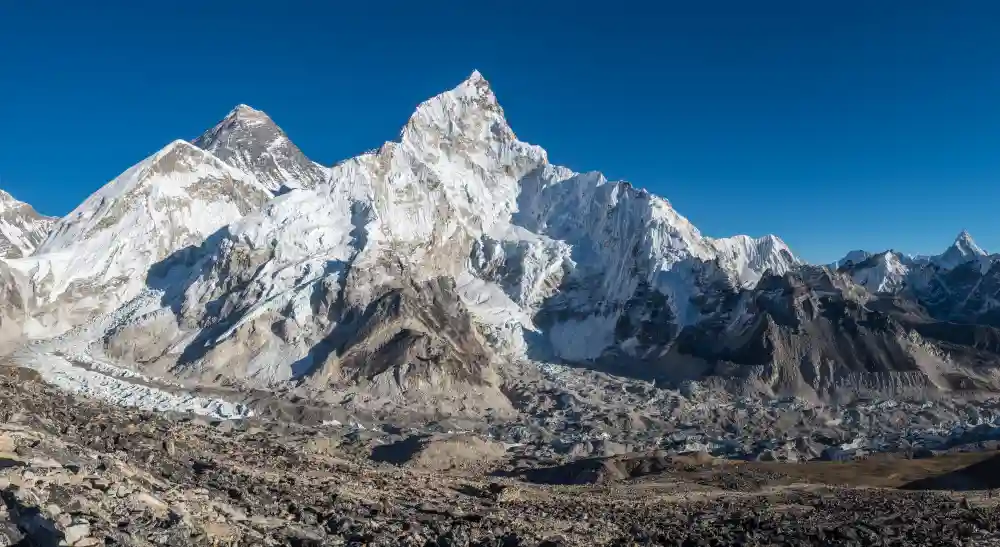
Dhaulagiri Circuit Trek - 17 Days

Tour Info

trip code

EN-035

Starting Point/ End Point

Kathmandu

Accommodations

Lodge/ Tea House

Max Altitude

5360m (French Pass)

Duration

17 days

country

Nepal

Trip grade

Challenging

Activities

Trekking

Best Season

February, March, April, May, June, September, October, November and December

Overview

The Dhaulagiri Circuit Trek is one of the toughest trekking routes in Nepal and is meant for people who want a true mountain adventure. This trek takes you around the world’s seventh-highest mountain, Mt. Dhaulagiri (8,167 m). You will walk through quiet villages, forests, river valleys, and high mountain areas. Along the way, you meet local people and see their simple mountain lifestyle. The trail is less crowded than popular treks, so you can enjoy peaceful walking and natural surroundings. The trek includes long days, high altitude, and rough paths, which makes it challenging but very rewarding.

Unlike the Everest and Annapurna regions, the Dhaulagiri Circuit does not have lodges everywhere. Some parts of the trek are very remote, and you must stay overnight in tents. This gives you a real camping experience in the Himalayas, close to glaciers, and snow-covered peaks. You will also cross high passes like French Pass and Dhampus Pass, which need good fitness and proper planning. This trek is best for experienced trekkers who are ready for a hard journey and want to explore a quiet and untouched part of Nepal.

Details

The Dhaulagiri Circuit Trek is a good choice for trekkers who want a quiet and challenging mountain journey in Nepal. This trail is far less crowded and is known for its natural beauty and peaceful surroundings. Walking across glaciers, rocky moraines, and snow-covered paths feels very different from regular teahouse treks. Along the route, you can enjoy clear views of Dhaulagiri I, Tukuche Peak, Nilgiri, and the Annapurna range. With fewer people on the trail, the trek offers a calm atmosphere where you can truly enjoy the mountains, nature, and the feeling of being in a remote Himalayan region.

One of the main reasons to choose this trek is the level of adventure it offers. The route crosses two high mountain passes, French Pass (5,360 m) and Dhampus Pass (5,200 m). These passes are demanding and require good physical fitness, but they are also some of the most exciting parts of the trek. You will also reach Dhaulagiri Base Camp (4,740 m), located close to glaciers and the huge south face of Mount Dhaulagiri, adding another memorable highlight to the journey.
Highlights

  • Complete a full circuit around the world’s 7th highest mountain, Mt. Dhaulagiri (8,167 m)

  • Cross challenging high passes including French Pass (5,360 m) and Dhampus Pass (5,244 m)

  • Walk through remote and untouched Himalayan landscapes far away from crowded trekking routes

  • Trek through traditional Magar villages, terraced farms, and quiet river valleys

  • Explore Italian Base Camp and Dhaulagiri Base Camp, surrounded by glaciers, icefalls, and massive mountain walls

  • Cross the Chhonbardan Glacier, one of the toughest glacier sections in Nepal trekking

  • Experience true camping-style trekking with full expedition support

  • Enjoy wide mountain views of Dhaulagiri, Nilgiri, Tukuche Peak, and the Annapurna range

  • Pass through changing landscapes, from forests and alpine meadows to high snow and ice zones

Itinerary

Day 01: Arrival in Kathmandu and Transfer to Hotel

After landing at Tribhuvan International Airport, you have to complete customs and collect your luggage. Our company representative welcomes you at the airport and transfers you to your hotel. You can rest for a while to recover from the long flight. Later, you join a briefing session with our guides, who will explain the trek, accommodations, meals, and important tips. In the evening, enjoy a welcome dinner at a traditional Nepalese restaurant with cultural performances, where you meet fellow trekkers and make new friends.

  • Accommodation: 3 star hotel
  • Travel Distance: 6 to 8 kilometers
  • Travel Hours: 20 to 30 minutes
  • Maximum Altitude: 1,350 meters (Kathmandu)
  • Meal: Dinner

Day 02: A Full Day Guided Tour

After having breakfast at the hotel, the full-day sightseeing tour begins around 8:00 AM. A private vehicle will be provided for the day, ensuring a comfortable and convenient trip. Our professional guide will accompany the tour to explain the history, culture, and significance of each site. The itinerary is relaxed, allowing ample time to explore each location without feeling rushed.

A. Pashupatinath (World Heritage Site)
Pashupatinath Temple is a major Hindu temple dedicated to Lord Shiva, located on the banks of the Bagmati River. Non-Hindus cannot enter the main temple, but the temple complex and rituals can be observed from the eastern side of the river. The temple features a two-tiered pagoda design and is internationally recognized for its spiritual and architectural importance.

B. Boudhanath (World Heritage Site)
Boudhanath is one of the most sacred Buddhist sites in Kathmandu. Constructed in the 5th century, this large stupa has four pairs of Buddha’s eyes facing every direction, representing awareness. Devotees can be seen circumambulating the stupa while spinning prayer wheels and offering prayers.

C. Patan Durbar Square (World Heritage Site)
Situated in the heart of Lalitpur, Patan Durbar Square is a prime example of Newari architecture. Most of the buildings were constructed during the Malla period, showcasing intricate wood carvings and detailed craftsmanship.

D. Swayambhu Stupa (Monkey Temple)
Swayambhu Stupa sits atop a hill and provides wide views of the Kathmandu Valley. It is often called the Monkey Temple due to the many monkeys living around the site. The stupa is an important spiritual place for both Buddhists and Hindus.

  • Accommodation: 3 star standard hotel
  • Travel Distance: 25 to 30 kilometers (total driving between sites)
  • Travel Hours: 5 to 6 hours (throughout sightseeing)
  • Maximum Altitude: 1,350 meters
  • Meal: Breakfast

Day 03: Fly to Pokhara and drive to Darbang (1,100m)

The journey moves closer to the mountains on this day and after breakfast, you head towards Kathmandu Airport for a 30-minute scenic flight to Pokhara. During the flight, if the weather is clear, you can enjoy views of the Himalayan range and green hills below. This trip continued by private vehicle toward Darbang, after landing in Pokhara. The drive takes around 6 hours, passing through Beni and following the Myagdi River. This drive can be long and bumpy in some sections, but it gives a good first look at rural western Nepal. Darbang is a small and quiet town and also it is the starting point of the Dhaulagiri Circuit Trek. After reaching Darbang, you can rest and prepare for the trekking days ahead.

  • Accommodation: Teahouse/Lodge
  • Travel Distance: 230 kilometers (flight + drive)
  • Travel Hours: 6 to7 hours
  • Maximum Altitude: 1,100 meters (Darbang)
  • Meal: Breakfast, Lunch, and Dinner

Day 04: Trek from Darbang to Sibang (1,770m)

Your official day of trekking starts from today. The route from Darbang to SIbang starts with a steady uphill climb along a ridge. Then the path slowly goes up toward Dharapani, a small village located on top of a hill with open views of the surrounding area. Climb is also gradual and comfortable, helping you adjust to the walking pace and higher elevation. After reaching Dharapani, you stop for lunch and take a short rest. From there, the trail continues above the river, passing through small villages and terraced farm fields. Along the way, you walk through Takam Village, where you can see traditional houses and local Magar culture. The trail includes some uphill and downhill sections, but the walk remains steady and manageable. After walking for about 6 to 7 hours in total, you arrive at Sibang, a quiet village surrounded by hills and farmland. This is your stop for the night, where you can rest and prepare for the next day of trekking.

  • Accommodation: Teahouse/Lodge
  • Travel Distance: 10 to 12 kilometers
  • Travel Hours: 6 to 7 hours
  • Maximum Altitude: 1,770 meters
  • Meal: Breakfast, Lunch, and Dinner

Day 05: Trek from Sibang to Naura Bhir (1,450m)

The walk from Sibang to Naura Bhir takes around five to six hours at a normal speed. You will pass local houses and farmland where people grow crops and keep livestock. After crossing a small river, the path climbs steadily toward Muri. This section is mostly uphill but manageable with short breaks along the way. From Muri, the trail becomes easier with gentle ups and downs. The route continues through quiet hillsides and scattered settlements. As you approach Naura Bhir, the surroundings become less crowded and more peaceful. You will stay overnight in a simple local teahouse where basic meals are provided.

  • Accommodation: Teahouse/Lodge
  • Travel Distance: 10 to 12 kilometers
  • Travel Hours: 5 to 6 hours
  • Maximum Altitude: 1,450 meters
  • Meal: Breakfast, Lunch, and Dinner

Day 06: Trek from Naura Bhir to Lapche Kharka (2,000m)

Route from Naura Bhir to Lapche Kharka follows the Myagdi Khola for most of the day. The trail starts with a gentle descent to the river and then gradually climbs through forested areas of oak, rhododendron, and pine trees, typical of the mid-hill region. Birds and small wildlife, such as langurs or pheasants, are often seen along the way. After a few hours, you reach Baghara Village, a small settlement with farmland and traditional stone houses. From here, the trail ascends steadily toward Lapche Kharka, a seasonal herder’s camp surrounded by open alpine pastures. This area offers views of Dhaulagiri and Nilgiri ranges in the distance. You may also see grazing yaks and domestic livestock. The night is spent in a simple lodge or herder’s shelter, providing a quiet place to rest and prepare for the higher altitude ahead.

  • Accommodation: Teahouse/Lodge
  • Travel Distance: 12 to 14 kilometers
  • Travel Hours: 7 to 8 hours
  • Maximum Altitude: 2000 meters
  • Meal: Breakfast, Lunch, and Dinner

Day 07: Trek from Lapche Kharka to Sallaghari (2,500m)

As you continue to trek from Lapche Kharka to Sallaghari, it is a gradual climb through a mix of forest and grazing lands. The trail passes through areas of rhododendron, pine, and oak trees, and you may spot birds such as Himalayan monals or pheasants along the way. Small streams and terraced fields are scattered along the path, showing the local farming lifestyle. You start to see mountains as you move ahead, including Dhaulagiri, Nilgiri, and Tukuche Peak, appearing in the distance. You reach Sallaghari, it is a quiet spot where you set up camp or stay in a local tea house. You can spend the evening resting and enjoying the calm surroundings before the trek continues to higher altitudes.

  • Accommodation: Teahouse / Camp
  • Travel Distance: 10 to 12 kilometers
  • Travel Hours: 6 to 7 hours
  • Maximum Altitude: 2,500 meters
  • Meal: Breakfast, Lunch, and Dinner

Day 08: Trek to Italian Base Camp (3,660m)

You can continue this day’s adventure on the ascending trail that passes through the forests and green landscapes. The trail from Sallaghari to Italian Base Camp moves through lush forests and green meadows, with streams and terraced fields along the way. As you gain altitude, you can spot the birds and small wildlife, such as Himalayan sparrows and mountain squirrels, and also grazing yaks are more common in this region. After a few hours, the path leads toward the Chhonbardan Glacier, marking the start of the high-altitude alpine environment. The climb here is steadier and requires more effort, but the views of Dhaulagiri I, Tukuche Peak, and surrounding mountains make the journey worthwhile. Following the glacier’s edge, you reach the Italian Base Camp, set against a backdrop of peaks including Dhaulagiri II, III, IV, and Tukuche. This is a good place to rest and prepare for the higher-altitude sections of the trek.

  • Accommodation: Tented Camp
  • Travel Distance: 10 to 12 kilometers
  • Travel Hours: 6 to 7 hours
  • Maximum Altitude:  3,660 meters
  • Meal: Breakfast, Lunch, and Dinner

Day 09: Trek from Italian Base Camp to Japanese Camp (4,200m)

The trek from Italian Base Camp to Japanese Camp begins with a steady move along the Myagdi Khola. Here, the trail passes through a narrow gorge with rocky cliffs on either side, so you need to be careful of loose rocks. After about 30 minutes in this area, you reach the moraine of Chhonbardan Glacier, marking the start of the higher alpine section. Then the route ascends gradually along the glacier edge, offering clear views of the surrounding Dhaulagiri peaks, including Dhaulagiri I, II, and III. The camp is set near Japanese Base Camp, providing a safe resting point for the night with stunning mountain views. This is an important acclimatization stop for you before the higher sections of the trek.

  • Accommodation: Tented Camp
  • Travel Distance: 8 to 10 kilometers
  • Travel Hours: 5 to 6 hours
  • Maximum Altitude: 4,200 meters
  • Meal: Breakfast, Lunch, and Dinner

Day 10: Trek from Japanese Camp to Dhaulagiri Base Camp (4,748m)

Route from Japanese Camp to Dhaulagiri Base Camp is a challenging section of the Dhaulagiri Circuit Trek. The trail passes through glacier terrain with some steep sections and crevasses, so careful footing is required. You need to walk slowly in this area due to the rocky and icy surfaces. After about five hours of walking, you reach Dhaulagiri Base Camp, located at the foot of the massive peaks. From here, you can enjoy 360-degree views of the surrounding mountains, including Dhaulagiri I, II, III, and IV. The nearby icefall adds to the dramatic landscape. This is a good spot to rest, take photos, and appreciate the scale of the high Himalayan environment before continuing on the circuit.

  • Accommodation: Tented Camp
  • Travel Distance: 8 to 10 kilometers
  • Travel Hours: 5 to 6 hours
  • Maximum Altitude: 4,748 meters
  • Meal: Breakfast, Lunch, and Dinner

Day 11: Rest and acclimatization at Dhaulagiri Base Camp

This day is dedicated to rest and acclimatization at Dhaulagiri Base Camp before crossing the highest pass on the trek. To help your body adjust to the high altitude, you can do a short hike of about 300 meters uphill from the base camp. The walk is steep in some places but provides excellent views of Mount Dhaulagiri and nearby peaks. Light walking around the camp and short excursions helps you to adapt to thinner air while you can also enjoy the surrounding environment. You can see glaciers, snow-covered ridges, and alpine vegetation typical of this high-altitude region. The rest of the day can be spent relaxing, taking photos, and enjoying the views of the massive mountains. Meals are prepared at the camp, and this day helps restore energy for the challenging passes ahead.

  • Accommodation: Tented Camp
  • Travel Distance: Short local hikes around base camp
  • Travel Hours: 2 to 3 hours of light walking
  • Maximum Altitude: 4,748 meters
  • Meal: Breakfast, Lunch, and Dinner

Day 12: Trek from Dhaulagiri Base Camp to Hidden Valley (5,120m) via French Pass (5,360m)

The route today takes you to Hidden Valley, crossing one of the highest points of the expedition, French Pass (5,360 m). This route leaves the glacier behind and winds across rolling hills, moraines, and mountain slopes. Here, the climb is steep in places, so walking slowly and taking regular breaks is important for you to adjust to the high altitude. From the top of French Pass, you get panoramic views of the surrounding peaks, including Dhaulagiri Massifs, Mukut Himal, Tukuche Peak, Thapa Peak, Sita Chuchura, and Tashi Kang. After spending time at the pass, the trail descends along snow, loose rocks, and gravel toward Hidden Valley. The valley is a wide, grassy meadow surrounded by high mountains. Camp is set up here for the night, providing a quiet place to rest and take in the high-altitude scenery.

Accommodation: Tented Camp
Travel Distance: 10 to 12 kilometers
Travel Hours: 6 to 7 hours
Maximum Altitude: 5,360 meters
Meal: Breakfast, Lunch, and Dinner

Day 13: Trek from French Pass to Yak Kharka (3,837m) via Dhampus Pass (5,280m)

It takes you around 7 to 8 hours to reach Yak Kharka from French Pass via  Dhampus Pass (5,280 m), another high Himalayan pass on the Dhaulagiri Circuit. The trail includes several uphill and downhill sections, so a steady pace with regular breaks is important. Climbing to Dhampus Pass is challenging due to its altitude, but the view from the top is rewarding. From here, you can see Tukuche Peak, Dhampus Peak, and the Annapurna Massifs clearly. After enjoying the views, the trail descends gradually along alpine pastures and moraine paths toward Yak Kharka, a wide grazing meadow surrounded by snow-covered peaks. You camp here for the night, resting in the peaceful high-altitude environment and preparing for the final sections of the trek.

  • Accommodation: Tented Camp
  • Travel Distance: 12 to 14 kilometers
  • Travel Hours: 7 to 8 hours
  • Maximum Altitude: 5,280 meters
  • Meal: Breakfast, Lunch, and Dinner

Day 14: Trek from Dhampus Pass to Jomsom (2,736m)

Continuing trekking from Dhampus Pass to Jomsom is mostly a gradual descent through alpine meadows and open pastures. You pass through Marpha Village (2,667 m), a charming settlement in the Annapurna region known for its apple orchards and traditional stone houses. After Marpha, the trail becomes relatively flat as it follows the Kaligandaki River, offering views of the river valley and surrounding peaks. The descent from the high alpine areas to the valley allows your legs to recover after the high passes. You arrive in Jomsom, a small town with lodges, guesthouses, and basic facilities, where you can spend the night. This section of the trek gives a mix of high mountain scenery and river valley landscapes, providing a gentle transition from the remote high-altitude areas back toward more populated regions.

  • Accommodation: Teahouse/Lodge
  • Travel Distance: 12 to 14 kilometers
  • Travel Hours: 5 to 6 hours
  • Maximum Altitude: 2,736 meters
  • Meal: Breakfast, Lunch, and Dinner

Day 15: Flight from Jomsom to Pokhara & transfer to hotel

After the trek, a scenic flight from Jomsom to Pokhara offers aerial views of the Kali Gandaki Valley, Annapurna, and Dhaulagiri ranges. Upon arrival in Pokhara, you are transferred to your hotel to rest and refresh. The afternoon can be spent relaxing at the hotel, taking a gentle walk around the lakeside area, or enjoying Phewa Lake. You can also admire the distant Annapurna and Machhapuchhre (Fishtail) peaks from the lakeside. Pokhara provides a calm and comfortable environment to recover from the high-altitude trek while enjoying the serene views and mild weather.

  • Accommodation: 3 star hotel
  • Travel Distance: 120 kilometers (by air and road)
  • Travel Hours: 30 minutes flight + 30 minutes transfer
  • Maximum Altitude: 827 meters (Pokhara)
  • Meal: Breakfast, Lunch, and Dinner

Day 16: Flight from Pokhara to Kathmandu

In the morning, you take a flight from Pokhara to Kathmandu, enjoying aerial views of the mountains, rivers, and valleys along the way. The short flight gives a final perspective of the Himalayan landscape before returning to the city. After arriving in Kathmandu, you are transferred to your hotel to rest and freshen up. In the evening, a farewell dinner is arranged, where you can enjoy traditional Nepalese food while watching cultural performances and dances. This is a great way to celebrate the completion of your Dhaulagiri Circuit Trek and reflect on the journey.

  • Accommodation: 3 star hotel
  • Travel Distance: 200 kilometers (by air)
  • Travel Hours: 30 to 35 minutes flight
  • Maximum Altitude: 1,400 meters (Kathmandu)
  • Meal: Breakfast, Lunch, and Dinner

Day 17: Transfer to Tribhuvan International Airport

The Dhaulagiri Circuit Trek comes to an end today. A company representative will transfer you to Tribhuvan International Airport about three hours before your scheduled flight. On the way, you can reflect on your trek and the incredible landscapes, mountains, and villages you experienced over the past 17 days. This is the time to say goodbye to Nepal and carry home lasting memories of high passes, glaciers, alpine meadows, and local culture. The journey may be over, but the experiences and photos from this trek will remain with you for a lifetime.

  • Travel Distance: 5 to 6 kilometers (to airport)
  • Travel Hours: 20 to 30 minutes
  • Maximum Altitude: 1,400 meters (Kathmandu)
  • Meal: Breakfast

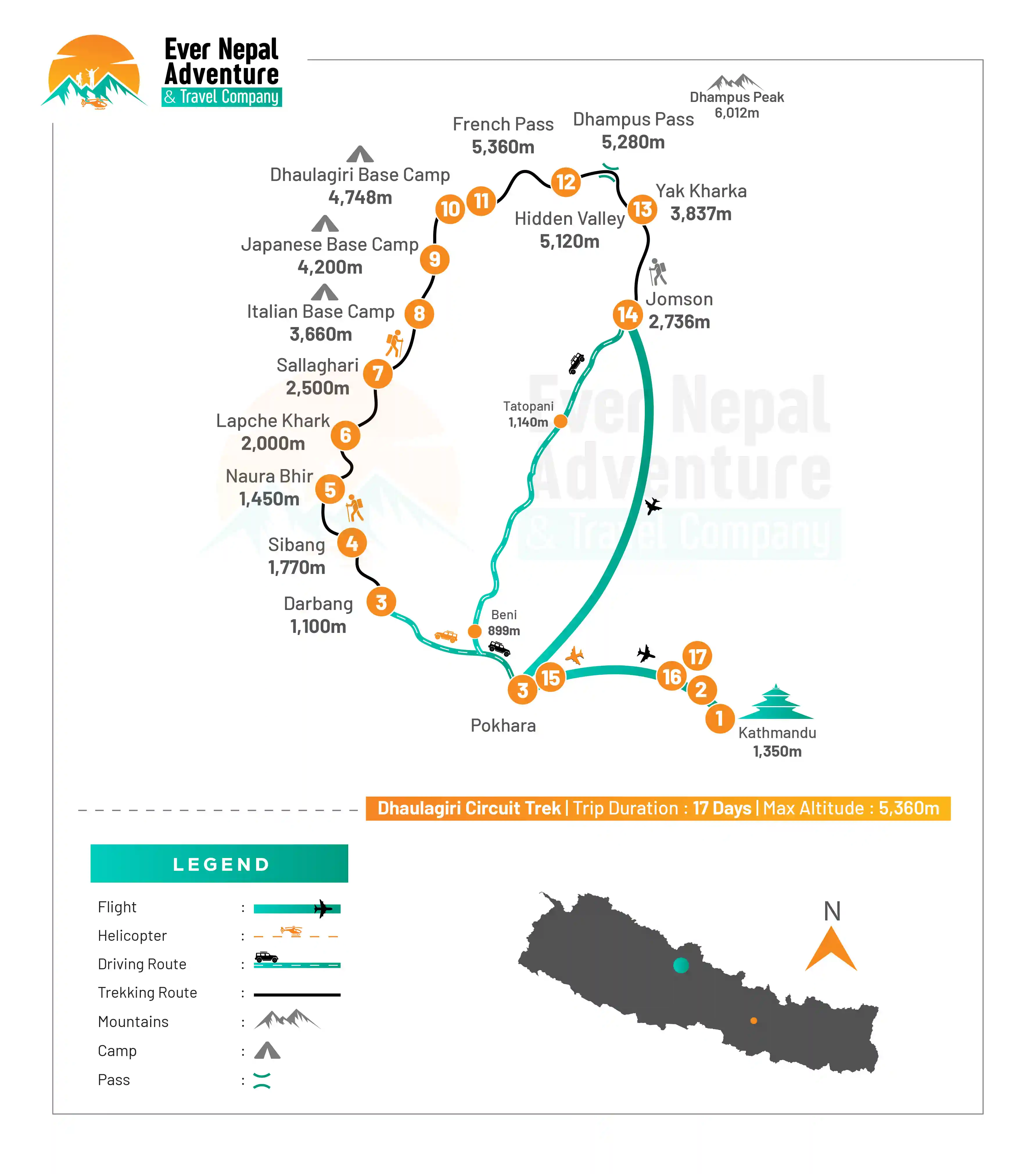
Trek Route

Dhaulagiri Circuit Trek Route

What's included

  • Airport pick-up and drop-off by a private, comfortable vehicle

  • 3 nights in a 3-star hotel in Kathmandu (twin/double room with breakfast)

  • Accommodation in local lodges or guesthouses during the trek as per the itinerary

  • All meals during the trek (breakfast, lunch, and dinner)

  • Farewell dinner with a traditional cultural show

  • All ground transportation by private vehicle as mentioned in the itinerary

  • Round-trip domestic flights between Kathmandu and Lukla

  • Experienced, English-speaking, government-licensed trek leader (assistant leader if required)

  • Porter support (1 porter for every 2 trekkers)

  • Safe drinking water throughout the trekking days

  • Tea, coffee, and light snacks during the trek

  • All staff costs including salary, insurance, food, accommodation, equipment, and domestic flight

  • Trekking gear support: duffel bag, sleeping bag, trekking map, and T-shirt

  • All necessary trekking permits and documents (TIMS and National Park permits)

  • First aid kit carried by the trek leader

  • All government taxes and official service charges

  • Guaranteed trip departure

  • Lifetime deposit

  • No booking or service fees

What's excluded

  • International airfare to and from Nepal

  • Nepal entry visa fee (available on arrival at Kathmandu airport)

  • Travel insurance (must cover high-altitude trekking and emergency evacuation)

  • Lunch and dinner in Kathmandu

  • Personal expenses such as drinks, snacks, laundry, and shopping

  • Extra hotel nights in Kathmandu due to early return or delayed flights

  • City sightseeing tours and entrance fees

  • Tips for guides, porters, and drivers (customary and expected)

  • Any other costs not clearly mentioned in the itinerary

Packing List for Dhaulagiri Circuit Trek

Dhaulagiri Circuit Trek is one of the most remote and challenging treks in Nepal. The path takes you through glaciers, high passes, and one of the few valleys in the high mountains, and through camping areas with only limited facilities. It is very important to wear the right equipment for trekking and mountaineering when going on the expedition, to ensure your safety and comfort.

Clothing

  • Thermal base layers
  • Warm trekking shirts
  • Heavy down jacket
  • Waterproof shell jacket
  • Windproof trekking pants
  • Fleece jacket or pullover
  • Thermal trousers
  • Extra inner wears and wool socks

Head & Face Protection

  • Warm woolen cap
  • Sun hat or trekking cap
  • UV sunglasses
  • Neck buff or scarf
  • Sunscreen and lip balm
  • Headlamp (extra batteries)

Hand & Foot Gear

  • Waterproof gloves
  • Warm fleece gloves
  • Waterproof trekking boots
  • Camp sandals or shoes
  • Thick wool socks
  • Gaiters for snow and glacier areas

Camping & Trekking Equipment

  • Duffel bag
  • Day backpack
  • Sleeping bag
  • Trekking poles
  • Water bottle / hydration bladder
  • Water purification tablets
  • Crampons or microspikes (as necessary)

Toiletries & Hygiene

  • Toothbrush and toothpaste
  • Soap and shampoo
  • Wet Wipes and tissues
  • Hand sanitizer
  • Apply moisturizer and cold cream
  • Quick-dry towel

Medical & Safety Supplies

  • Personal medications
  • Diamox
  • Basic first aid kit
  • Blister treatment
  • Painkillers
  • Antiseptic ointment and bandages

Extra Essentials

  • Power bank
  • Using a camera or a mobile phone
  • Cables/Adapter Charge
  • Dry snack bars and snacks
  • Rafting cover for backpackers
  • Notebook or journal

Specific Gears for Women

Women should take certain necessities on their Dhaulagiri Circuit trek, to keep them comfortable and prepared throughout the walk. These are items which can be useful while on trek, as the walk goes through remote villages in the Himalayas and into high elevations with lesser facilities.

  • Undergarments
  • Sanitary pads
  • Sports bra
  • Travel-size shampoo
  • Skin care products (cleanser, moisturizer and sunscreen)
  • Tampons
  • Fleece headband
  • Tight leggings

Documents

Before heading towards the Dhaulagiri Circuit, it is essential for you to have certain documents with you. It is important these documents are carried for permit checks, identification and safety management during the trek.

  • Annapurna Conservation Area Permit (ACAP): Since part of this route connects with Annapurna area which requires an Annapurna Conservation Area Permit (ACAP). It is available from Nepal Tourism Board (Nepal Travel Office) Kathmandu, Pokhara. Foreign nationals have to pay NPR 3,000 ($23), SAARC national citizens pay NPR 1,000 ($7) and Nepali trekkers pay NPR 100 ($1).
  • Dhaulagiri Restricted Area Permit: Depending on the route and itinerary, some of the sections in the Dhaulagiri Circuit require a special trekking permit, Dhaulagiri Restricted Area Permit. Normally, these permits are procured with the registered trekking agency in Nepal.
  • TIMS Card (Trekkers Information Management System): TIMS Card to register trekkers and for route monitoring, safety. It is available from the trekking companies or the tourism department.
  • Passport: Foreign trekkers must carry their original passport which should have a valid period of at least 6 months from the date of entry into Nepal.
  • Passport-Size Photos: 2 to 4 passport size pictures are required for permit applications and official documents on the trek.
  • Travel Insurance: As the region of Dhaulagiri Circuit is a remote mountain area, it is strongly recommended to travel with travel insurance covering high mountain trekking, medical treatment and emergency helicopter evacuation.

Frequently Asked Questions

How difficult is the Dhaulagiri Circuit Trek?

The Dhaulagiri Circuit Trek is considered very challenging, due to its glacier crossing and steep mountain tracks, plus remote camping areas and high passes above 5,000 meters. It is good for trekkers to be physically fit and to have a previous experience of high altitude trekking before they attempt this route.

Where is the Dhaulagiri Circuit located?

The Dhaulagiri Circuit is located in the western part of Nepal in the area of the Dhaulagiri mountain range. Defying the romantic mountains, the route goes through remote valleys, alpine forests, glaciers and passes of high Himal, the whole distance is full of beautiful scenery to observe.

What is the best season for the trek?

The best seasons are spring (March to May) and autumn (September to November) due to the more stability in the weather and the better visibility of mountains in those seasons. Often high passes are hard to navigate during winter, when heavy snow can also be dangerous.

Is camping required during the trek?

Yes, there are sections of Dhaulagiri Circuit where camping is required, as there are very few teahouses in the far remote high altitude areas. For these parts, trekking groups typically will carry camping gear and kitchen staff, along with tents.

How long does the Dhaulagiri Circuit Trek take?

It typically takes 16 to 21 days depending on the route, acclimatization days and weather conditions. Additional rest days or exploration days may extend the route times; during the trek.

Is altitude sickness a major concern?

Yes, altitude sickness is a serious concern due to passing altitudes of very high altitudes like French Pass and Dhampus Pass. Proper acclimatization, hydration, and smooth rise are very important during the trek.

What type of accommodation is available?

You can find basic teahouse accommodations in the villages at lower areas and further up the mountain one camps. At higher elevations, facilities are drastically reduced, and trekkers will need to be ready for more challenging trekking trips.

Is a guide necessary for this trek?

The Dhaulagiri Circuit is full of remote trails, glacier areas, and difficult mountain passes; so it is highly advised to hire a licensed guide. Guides help in navigating the route, safety, and logistics; throughout the journey.

What kind of food is available during the trek?

The mostly teahouses and camping cooking facilities offer meals such as dal bhat, noodles, soups, rice, potatoes, pasta and hot beverages. The food is cooked by the expedition's trekking crew during camping sections.

Why is the Dhaulagiri Circuit Trek special?

The trek is known for its untouched wilderness, glacier crossings, and the remote mountain landscapes, and less-traveled trail. It is one of the most adventurous himalayan experiences than many commercial trekking routes in Nepal.

User Review