Upper Mustang Jeep Tour - 10 Days

Tour Info

trip code

EN-037

Starting Point/ End Point

Kathmandu

Accommodations

Lodge/ Tea House

Max Altitude

3840m (Lo-Manthang)

Duration

10 days

country

Nepal

Trip grade

Easy

Activities

City Tour

Best Season

April, May, June, September, October, November

Overview

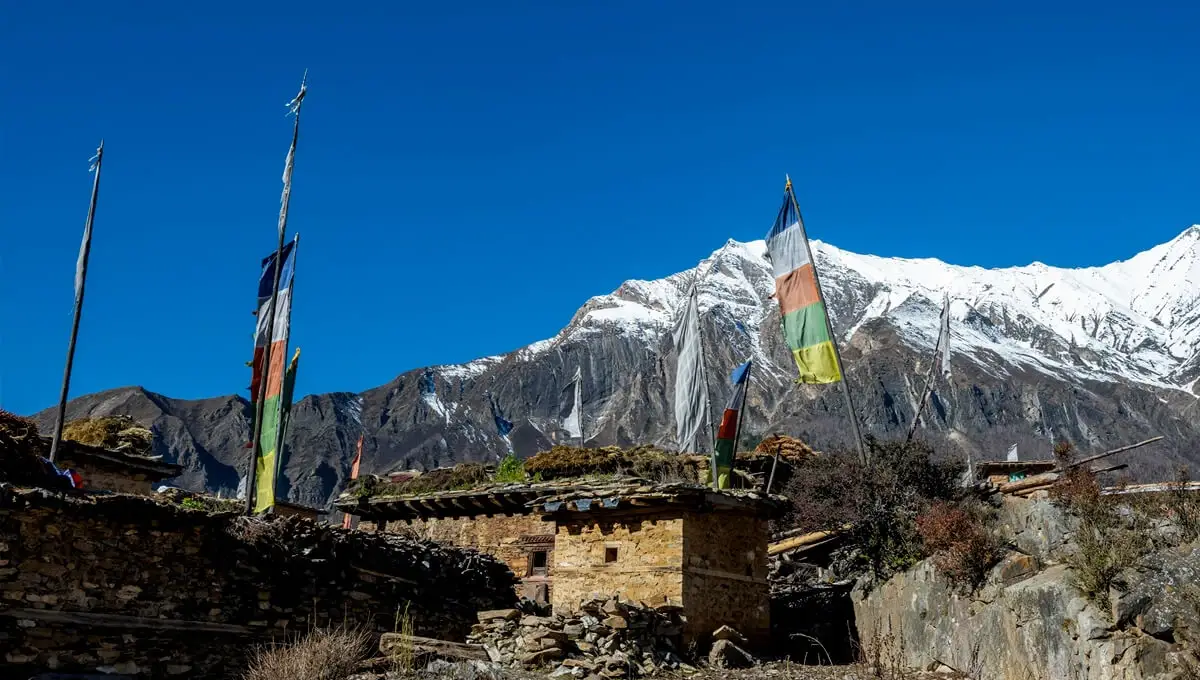
The Upper Mustang jeep tour is within the Gandaki province, offering a relaxed 10-day journey through one of Nepal's most unique regions. With a jeep journey, you see the valleys, cliffs, and plateaus with snow-capped mountains. You also see ancient monasteries, cave homes, and villages with a Tibetan influence. Since this area is very remote, the culture, architecture, and religion are all well-preserved. This area features prayer flags, chortens, and mud-brick houses, adding to the region's charm. With changing landscapes from river valleys to high-altitude deserts, the 10-day Upper Mustang jeep tour provides a peaceful and meaningful way to experience the natural beauty and cultural richness.

Overview

The upper Mustang jeep tour, located in the heart of himalayan region, offers a calm and comfortable way to explore one of Nepal's most unique regions. This Upper Mustang jeep tour is a 10-day journey that passes through valleys, cliffs, and open plateaus with stunning views of snowcapped mountains. Travelling the upper Mustang by jeep allows you to enjoy the natural surroundings more. 

During the Upper Mustang jeep tour, travelers can see ancient monasteries, old cave homes, and traditional villages shaped by Tibetan culture. As this region is remote, its customs, buildings, and spiritual traditions are well preserved. This valley contains prayer flags, chortens, and mud-brick houses. 

The scenery changes gently from river valleys to high-altitude deserts, adding variety without physical difficulty. A 10-day Upper Mustang Jeep Tour feels relaxed, offering a simple and meaningful way to experience the region's nature, culture, and quiet charm.

History

Upper Mustang, often called the “last Forbidden Kingdom,” was historically a part of the ancient Tibetan culture. Before the 14th century, the settlement in this region was fully scattered. It used to be the trade route between Tibet and the Indian subcontinent. Historically, it became an independent kingdom in 1380 AD when Ame Pal established the kingdom of Lo. He unified the region’s scattered territories and built a strong political and cultural foundation. Later on, the kingdom of Lo becomes an independent Buddhist kingdom with close religious and cultural ties to Tibet. 

One of the features of Upper Mustang is the ancient walled city of Lo Manthang. This walled city was built in the 15th century. The Lo Manthang is fully surrounded by massive mud-brick walls approximately 6 meters high in order to protect the city from invasions, safeguard trade wealth and defend against regional conflicts. In Lo Manthang, there are ancient monasteries, royal palaces, traditional mud-brick houses and narrow alleyways. 

Regarding the Monarch, the Upper Mustang was ruled by a royal lineage in 1380. The rulers held the title “Raja of Lo.” Even though Nepal was unified by Prithivi Narayan Shah in the 18th century, Mustang retained internal autonomy, and its royal system continued under Nepal’s sovereignty. The last recognized king was Jigme Dorje Palbar Bista, who ruled until the Nepalese monarchy was abolished in 2008. 

Spiritual and Natural beauty 

Upper Mustang is one of the most spiritually rich regions in the Himalayas. This region is deeply influenced by Tibetan Buddhism. Upper Mustang has several ancient monasteries, prayer flags, mani walls, and chortens that reflect centuries-old spiritual traditions. The sacred site around the Lo Manthang (heart of Upper Mustang) and other remote villages serves as an important center for meditation, rituals, and Buddhist festivals.

One of the features of Upper Mustang is an ancient sky cave which was carved into steep cliffs thousands of years ago. Most archaeologists have discovered that this place contains 10, 000 caves and it is believed that these caves have been used as meditation chambers, homes, and burial sites by early inhabitants. 

Like spirituality, the natural beauty found in this place is equally captivating. You can find desert-like terrain, deep valleys, and red-colored mountains formed by layers of ancient sedimentary rock. During sunrise and sunset, this red mountain glows, which is very spectacular.
 

Highlights

  • A complete day trip to explore the world heritage sites in Kathmandu.

  • Explore the Newari Culture and its distinctive traditions, crafts, and art involving wood.

  • Scenic mountain flight from Kathmandu to Pokhara. 

  • Full-day sightseeing in Pokhara, including Phewa Lake, Tal Barahi Temple, Davis Fall, and Gupteshwor Cave.

  • Witness an aerial view of rivers, valleys, and the Himalayan ranges.

  • Visit to the sacred pilgrimage site of Muktinath.

  • Drive through Kagbeni, Chhusang, and Ghami villages. 

  • Exploration of ancient monasteries, including Ghar Gompa and Tsarang Monastery. 

  • Discover Lo Manthang, the former capital of the Kingdom of Lo.

  • Explore Jampa Gompa, Thubchen Gompa, and the Royal Palace in Lo Manthang. 

  • Observe the beautiful views of mountain ranges such as the Annapurna, Dhaulagiri, Nilgiri, and Manaslu.

  • Stay at teahouses and lodges throughout the trek with warm hospitality.

  • Scenic return journey to Pokhara by flight or drive.

Itinerary

Day 1: Arrival in Kathmandu and pre-trekking preparation

Your trip to Upper Mustang commences when you arrive at TIA (Tribhuvan International Airport). There, you meet Ever Nepal's representatives, and they help you transfer to your hotel. At the hotel, you can take a few hours of rest. If you arrive in the morning, you can meet the trek guide who provides the key details of the trip. However, if you arrive at night time, you have the trek briefing session on the next day. In the evening, you are welcomed by our team for an elegant dinner. At dinner, you get a curated menu through which you can choose any dish you like. Once you eat dinner, you go to sleep in a premium room. 

  • Max Elevation: 1440 meters (Kathmandu)
  • Travel Distance: 5 to 6 kilometers
  • Travel Hours: 20 to 30 minutes   
  • Accommodation: 3-star hotel
  • Meals Included: Dinner

Day 2: A full day guided tour and sightseeing in Kathmandu valley

Your day 2 begins after having a relaxed breakfast. On this day, you have a trek briefing session if you arrive late on day 1. During the briefing session, our representatives ask for your passport, passport-sized photos, and international travel insurance to complete the necessary documentation and trekking arrangements. After that, your sightseeing tour begins, where your guide helps you visit the UNESCO World Heritage site in a private vehicle. 

A. Swayambhunath Stupa (The Monkey Temple): Located at the top of the hill, you witness the western side of the entire valley. This temple is also called Monkey Temple and Samhengu due to the countless monkeys found here. 

B. Pashupatinath Temple: Situated at the center of Kathmandu, alongside the bank of the Bagmati River, this site is the abode of lord shiva. The temple features pagoda-style architecture, with four main doors with a golden top known as 'Gajur'.

C. Bhaktapur Durbar Square: Perched in the Bhaktapur district, this place was once a royal palace of King Bhupatindra Malla. The durbar square is surrounded by pagoda and shikhara architecture temples. This place features 55 window palaces, the Nyatapole temple, the Golden Lion's Gate, and the Vatsala Temple.

D. Boudhanath Stupa: Built in the 5th century, this 2500-year-old Buddhist stupa has four pairs of eyes in four cardinal directions. These eyes watch the people and their doings. Many pilgrims from Tibet come here to worship. 

  • Max Elevation: 1440 meters (Kathmandu)
  • Accommodation: 3-star hotel
  • Meals Included: Breakfast, Lunch and Dinner

Day 3: Fly to Pokhara and full day sightseeing in Pokhara valley

Following a hearty breakfast, you get ready for the flight to Pokhara. Your driver picks you up from the hotel to catch the morning scenic flight to Pokhara. After around 25 minutes of flight, you arrive at Pokhara. Upon reaching there, your guide transfers to your 3-star hotel and helps you check into the room. You take some rest. Then, you, along with your guide, go on a sightseeing tour in Pokhara. You explore attractive places like: 

A. Bindhyabasini Temple: This temple lies in the heart of the old religious bazaar and is dedicated to Goddess Bhagwati. Around this temple, there is a ground which offers a picnic spot and relaxing areas.

B. Davis Fall: The Davis Fall is located on the southern side of Pokhara. In the fall, the streams from Phewa Lake crash and drop down into the deep gorge by jumping from numerous potholes. At this place, lots of tourists come to see. Davis fall is also referred to as Patale Chango. 

C. Phewa Lake and Tal Barahi Temple: Phewa Lake is the second-largest lake in Nepal, located at an elevation of 742 meters. In between this lake, the two-storied pagoda-style Tal Barahi temple is located, which is dedicated to the female force. 

D. Gupteshwor Cave: The Gupteshwor Cave is around 3 km long, containing a big hall-sized room. You need to crawl on your hands and knees to explore some of its narrower passages. Inside this place, the phallic symbol of Lord Shiva is preserved, which holds special value in Hindu traditions. 

  • Maximum Altitude: 827 meters
  • Flight Duration: 25 minutes
  • Travel Duration: 4 to 5 hours
  • Accommodation:  3-star hotel
  • Meals: Breakfast, Lunch and Dinner

Day 4: Fly to Jomsom (2,700m) and drive to Muktinath (3,700m / 12,1340 feet)

In the early morning, you are provided with a warm breakfast. After that, you are transferred to the Pokhara airport for a picturesque flight towards Jomsom. While you are in a scenic flight, you witness aerial views of Annapurna peak and Dhaulagiri range, the deep Kali Gandaki gorge, the river and the valleys. After roughly 20 minutes, you arrive at Jomsom. From here, you have a picturesque drive through Kagbeni and Ranipauwa before arriving at Muktinath - a holy temple, dedicated to lord Vishnu. During a scenic drive, you observe the Kali Gandaki river, Kagbeni village, apple orchards, Tibetan-influenced culture, and Mt Dhaulagiri to the west and Nilgiri to the east. After travelling for around 3 to 4 hours, covering a distance of 22.8 km, you arrive at Muktinath - a holy site where Hindus believe that bathing in the sacred water can cleanse one of sins. Here, you eat a delicious dinner before staying overnight. 

  • Maximum Altitude: 3,700 meters
  • Flight Duration: 20 minutes
  • Travel Duration: 3 to 4 hours
  • Travel distance: 22.8 km
  • Accommodation: Tea house/lodge
  • Meals: Breakfast, Lunch and Dinner

Day 5: Drive to Ghami (3,520m / 11,549 feet) via Chhusang –Syangboche-Nyi La)

After an early leisurely breakfast, you take a picturesque drive to cross several traditional Settlements such as Chhusang, Syangboche and Nyi La, arriving at the day 5 destination. While traversing through these villages, you get an opportunity to witness the Kali Gandaki river valley, the Tibetan-style villages of the Lo people, the Kagbeni villages, and the sky caves. Moreover, you also get breathtaking views of the Chungshi Rangjung cave, the red crag and Nilgiri, Dhaulagiri, and the Annapurna ranges. After around 5 to 6 hours of driving, covering a distance of 32 km, you arrive at Ghami, where you are served a delicious dinner before staying overnight in a comfortable room. 

  • Maximum Altitude: 3,932 meters 
  • Travel Duration: 5 to 6 hours
  • Travel distance: 32 km
  • Accommodation: Tea house/lodge
  • Meals: Breakfast, Lunch and Dinner

Day 6: Drive to Lo Manthang (3,840m / 12,599 feet) via Tsarang

On this day, you explore the heart of Upper Mustang (Lo Manthang). Following a relaxed breakfast, you take a drive towards the Day 6 destination. While having road transportation, you visit Ghar Gompa (Lo Gekar) - a monastery carrying the Lo people's culture and the creation history of the region and Charang (Tsarang) Monastery. After around 3 to 4 hours, covering a distance of 17km, you arrive at Lo Manthang - a walled city and the ancient capital of the former Kingdom of Lo. Upon reaching there, you take a short rest and explore the Jampa gompa - the oldest monastery in Lo Manthang, often known as the God house. Additionally, you also explore Thubchen Gompa and Chodey Gompa. In addition to that, you can also watch the breathtaking view of mountains, the king's palace, Buddhist schools, lifestyle and traditions. At Lo Manthang, you receive a warm dinner before spending the night. 

  • Maximum Altitude: 3,840 meters 
  • Travel Duration: 3 to 4 hours
  • Travel distance: 17 km
  • Accommodation: Tea house/lodge
  • Meals: Breakfast, Lunch and Dinner

Day 7: Exploration day in Lo-Manthang

This day is dedicated to sightseeing tours near the Lo Mangthang. After a delicious breakfast, you explore the major attractions of Lo Manthang such as Namygal Gompa, the sky caves of Chhoser and the Jhong cave. Additionally, you also explore numerous caves located near the Chhoser cave that are used for burial, and meditation. You also explore the 5-story royal palace, Tigkar village, immerse in the Tiji Festival with traditional dance and rituals, and explore the views of majestic mountains like Annapurna, Dhaulagiri, and Nilgiri ranges. After exploring all these places, you return to your lodge, where you are served with a warm dinner before spending the night. 

  • Maximum Altitude: 3,840 meters 
  • Travel Duration: 4 to 5 hours
  • Accommodation: Tea house/lodge
  • Meals: Breakfast, Lunch and Dinner

Day 8: Drive Back to Jomsom (2,700m / 8,859 feet)

In the morning, you get a warm breakfast. After that, you take a seat in the private vehicle for a picturesque drive towards Jomsom. While having a scenic drive, you witness different beautiful villages, lush landscape and traditional mud houses. In addition to that, you witness the stunning views of valleys, rugged cliffs and snow-capped mountains such as Annapurna Massif and Dhaulagiri ranges. After 6 to 7 hours, covering a distance of 50 km, you arrive at Jomsom. Upon arriving at the day 8 destination, you take a short rest and explore the local market. At night, you return to your hotel, where you eat a relaxed dinner before spending the night. 

  • Maximum Altitude: 2,700 meters 
  • Travel Duration: 6 to 7 hours
  • Travel distance: 50 km
  • Accommodation: Tea house/lodge
  • Meals: Breakfast, Lunch and Dinner

Day 9: Drive or Fly to Pokhara (837m / 2713 feet)

Following a hearty breakfast, you proceed on your journey towards Pokhara either by air or by road. If you prefer to travel by flight, it takes around 20 minutes, offering an aerial view of rivers, Gandaki gorges and Dhaulagiri and Nilgiri peaks. Alternatively, if you want to travel by private vehicle, you can observe stunning views of waterfalls, Tatopani, hills, villages and mountains. After a few hours of driving, you reach Pokhara, where you rest and explore the city that you didn't visit earlier. At night, you return to your hotel, where you eat a leisurely dinner and spend the night in a comfortable room. 

  • Maximum Altitude: 837 meters 
  • Travel Duration: 8 hours
  • Travel distance: 158 km
  • Accommodation: Tea house/lodge
  • Meals: Breakfast, Lunch and Dinner

Day 10: Flight to Kathmandu and Departure

After a leisurely breakfast, you take an early scenic flight towards Kathmandu. It takes around 25 minutes, offering river views, a glimpse of culture and sights of mountains such as the Annapurna Range and Manaslu. After that, you arrive at Kathmandu. Upon arriving, you take some rest until departure. During this time, you can recall your memories and reflect the breathtaking landscapes, cultural experience and unforgettable moments of your Upper Mustang journey. After that, you take a flight and return to your home country.

  • Meals: Breakfast

Trek Route

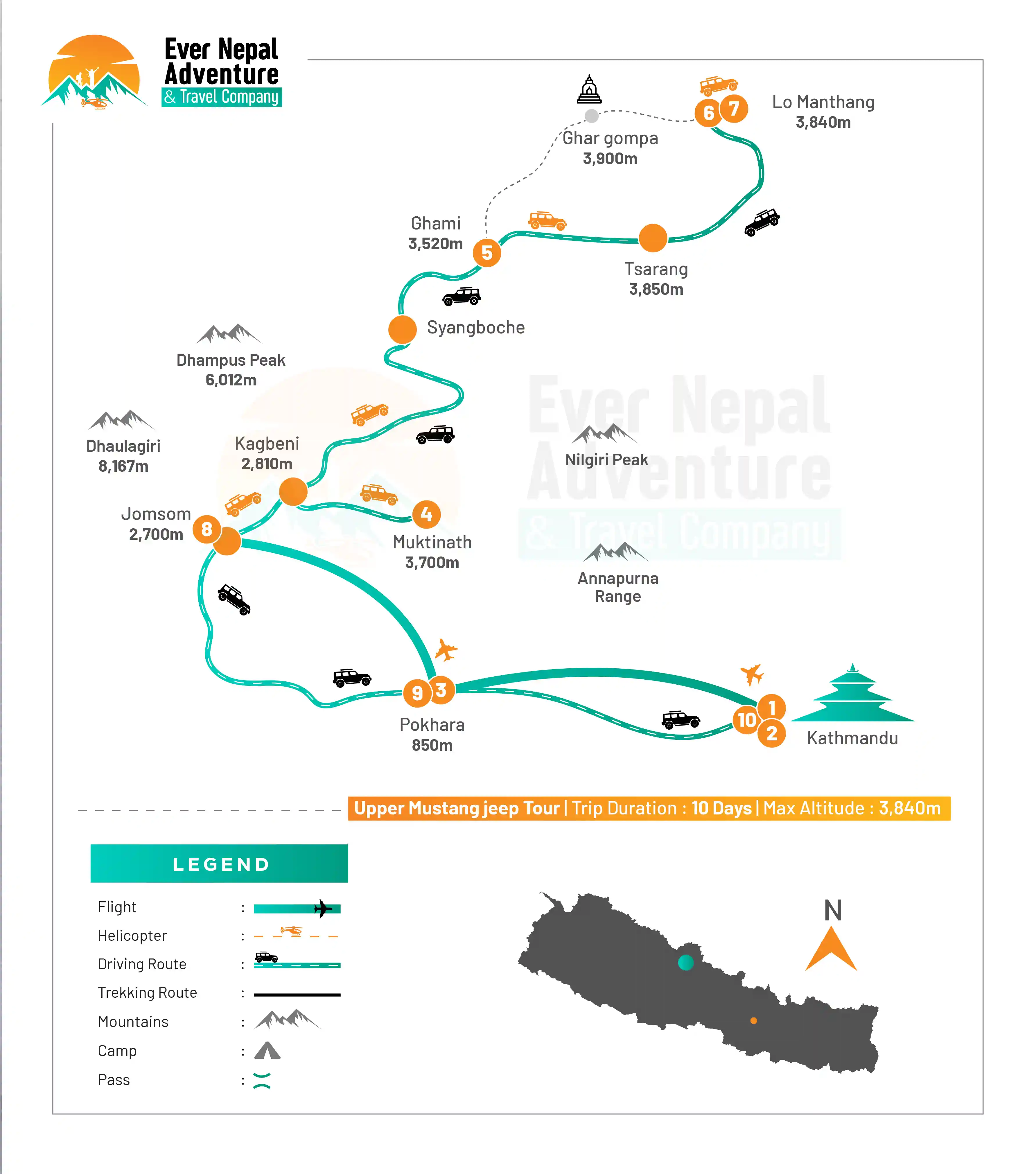
upper mustang jeep tour route map

What's included

  • Pick up and drop off at the Hotel in Pokhara and the airport in a private vehicle.

  • 2-night standard accommodation in Kathmandu with breakfast included.

  • All lodging in lodges/tea houses throughout the jeep tour, except Kathmandu and Pokhara, is based on twin/double sharing beds.

  • All regular meals (breakfast, lunch, and dinner) throughout the jeep excursion.

  • Airline ticket for Kathmandu to Pokhara, Pokhara to Kathmandu and Jomsom-Pokhara.

  • All required documents, Conservation entry permits, special permit for upper Mustang, and TIMS permit.

  • A knowledgeable, supportive, and approachable guide throughout the trek.

  • Comfortable jeep for Upper Mustang excursion from Jomsom.

  • Compensation, Meals, Beverages, Lodging, Travel, and Insurance for the Guide and Porter.

  • An evening Welcome dinner in Kathmandu at a traditional Nepali restaurant featuring a cultural dance performance.

  • First aid kit (carried by your trek leader).

  • All taxes imposed by the government and authorized expenditures.

  • Warm beverages (tea and coffee while on the jeep tour)

  • Clean drinking water.

  • 1-2 Night stay at a hotel in Pokhara with breakfast included.

What's excluded

  • International flight tickets.

  • Nepal entry visa.

  • Insurance for travel (in case of emergency).

  • Meals during your stay in Kathmandu and Pokhara include breakfast, lunch and dinner.

  • Drinks (cold beverages and alcoholic beverages).

  • Wireless internet, battery power, and a warm shower.

  • Your individual expenditures.

  • Sightseeing in the city and admission costs.

  • Tips for the guide, porter, and driver.

Packing List for Upper Mustang Jeep Tour

The Upper Mustang Jeep Tour goes up to the ancient kingdom of the Himalayas in Upper Mustang, an area that boasts rocky desert-like trails, dry, and windy conditions. Even though the journey is completed by jeep, the weather can still become cold and unpredictable, especially during mornings and evenings. Packing the essentials makes the trip more comfortable and enjoyable throughout the journey.

Head and Face Essentials

  • Sun hat or cap
  • Warm woolen beanie
  • UV-protected sunglasses
  • Neck scarf or buff
  • Sunscreen lotion
  • Dry weather lip balm
  • Face Wipes or Tissues
  • Small LED Flashlight or Headlamp

Clothing for Upper Body

  • Comfortable t-shirts
  • Warm thermal layers
  • Full-sleeved shirts
  • Fleece jacket
  • Down jacket for colder areas
  • Windproof outer jacket
  • Light rain jacket

Clothing for Lower Body

  • Hiking or travel pants
  • Warm thermal trousers
  • Comfortable casual pants
  • Quick-dry lower wear
  • Wear leggings

Footwear

  • Comfortable hiking shoes or sneakers
  • Warm socks
  • Light weight sandals or slippers
  • Additional pair of socks for dusty roadways

Toiletries and Personal Care

  • Toothbrush and toothpaste
  • Soap or face wash
  • Hand sanitizer
  • Wet wipes
  • Moisturizer
  • Shampoo sachets
  • Quick-dry towel
  • Toilet paper

Travel Accessories

  • Small backpack or day bag
  • Reusable water bottle
  • Power bank
  • Phone charger and cables
  • Camera or mobile phone
  • Universal adapter
  • Rubbery foods, snacks, and dry foods
  • A travel pillow or long drives

Health and First Aid Items

  • Basic first aid kit
  • Personal medications
  • Motion sickness medicine
  • Diamox for adjusting to the altitude
  • Pain relievers
  • Bandage and antiseptic cream
  • ORS packets for hydration

Useful Items for Women Travelers

It might be easier for women travellers to carry a couple of additional personal items, as conditions in the remote villages of mustang may be basic.

  • Sanitary pad or tampon
  • Comfortable innerwear
  • Moisturizer and sunscreen
  • Hair ties or clips
  • Intimate hygiene wipes
  • Warm trousers for the night


Documents

Upper Mustang, however, is an off-limits region in Nepal, and tourists must obtain special permits as well as personal documents in advance for the jeep tour.

  • Upper Mustang Restricted Area Permit: The upper Mustang Restricted Area Permit is the primary permit needed to visit Upper Mustang. Normally, a charge of USD 500 per person is required for the first 10 days and then extra days will cost more. Permits are granted by registered travel agencies in Nepal.
  • Annapurna Conservation Area Permit (ACAP): They must obtain the Annapurna Conservation Area Permit for travelling in this route as it is in the region of Annapurna Conservation Area. It is available at the tourism office in Kathmandu and Pokhara.
  • Valid Passport:  A passport with at least six months of validity; as it is required while applying for Upper Mustang permits and during domestic travel within Nepal.
  • Passport-Sized Photographs: Bring 3 to 4 recent passport-sized photographs for permits and paperwork for travel.
  • Nepal Tourist Visa: Foreign travelers must hold a valid Nepal tourist visa covering the complete tour duration; before entering the restricted Mustang region.
  • Travel Insurance: It is strongly recommended to take travel insurance for the Upper Mustang Jeep tour. Medical support, emergency evacuation and coverage for travel in high altitude remote areas should all be covered as part of your insurance.

Frequently Asked Questions

Is the Upper Mustang Jeep Tour difficult?

Compared to trekking it's much easier to go jeep tours as most of the journey is done by jeeps. But, even the most adventurous travellers still face long drives on bumpy mountain roads, dusty trails and high altitudes that can be challenging to navigate during the journey.


What is the best time for the Upper Mustang Jeep Tour?

Spring and Autumn are the best seasons to visit, as conditions remain clearer and the roads are better. Interestingly, the region of Upper Mustang is also accessible in this season as the area is located in a rain-shadow region with little rainfall.

Do I need trekking experience for this tour?

No, you do not need any trekking experience for the Upper Mustang Jeep Tour. Most travel occurs via jeep making it a family-friendly option and appropriate for older travelers or those looking for an alternative way to travel Mustang during a day if they don't want to trek into the mountains every day.

Can altitude sickness happen during the jeep tour?

Yes, altitude sickness is possible because Upper Mustang is located above 3,500 meters. It is recommended that travelers drink plenty of liquids, try not to drink alcohol, and take it easy during the trip to acclimatize to the higher altitudes.

Are roads safe in Upper Mustang?

All roads are being maintained and are generally safe but in many areas they are dusty, rough and bumpy. Most of the time, the terrain is well managed by experienced drivers who have a local expertise on local mountain tracks, which are often cut for off-road driving between Jomsom, Lo Manthang and other villages.

How many days does the Upper Mustang Jeep Tour take?

Most tour plans are 8 to 12 days long, depending on the route, sightseeing plans and acclimatisation stops. There are also some packages that include visits to the ancient monasteries, caves and nearby Mustang villages.

Is the internet available during the tour?

In the lower Mustang region internet connection is available and in remote villages mobile connection is weak. Many of the hotels provide wireless network access, but the speed is limited due to its mountain remote location.

What kind of accommodation is available in Upper Mustang?

Generally, you get to stay in the simple tea houses, lodges or small hotels. Rooms are typically very basic but are comfortable enough that families can stay for one night or more, and the local community feeds and treats you like a family member.

Why is Upper Mustang called the “Last Forbidden Kingdom”?

For many years in Upper Mustang, outsiders were not allowed to venture in, thus helping to maintain its ancient Tibetan culture, monasteries, language, and traditions. The region is still perceived as different from the rest of Nepal, thanks to its historical isolation.

Is the Upper Mustang Jeep Tour suitable for families?

Indeed, many families opt for this tour as it allows them to save a significant amount of trekking time without compromising on the enjoyment of the Himalayan landscape and its culture. It is still advisable for travelers to expect less than ideal road conditions and facilities in outlying villages in the mountains along the way.

User Review