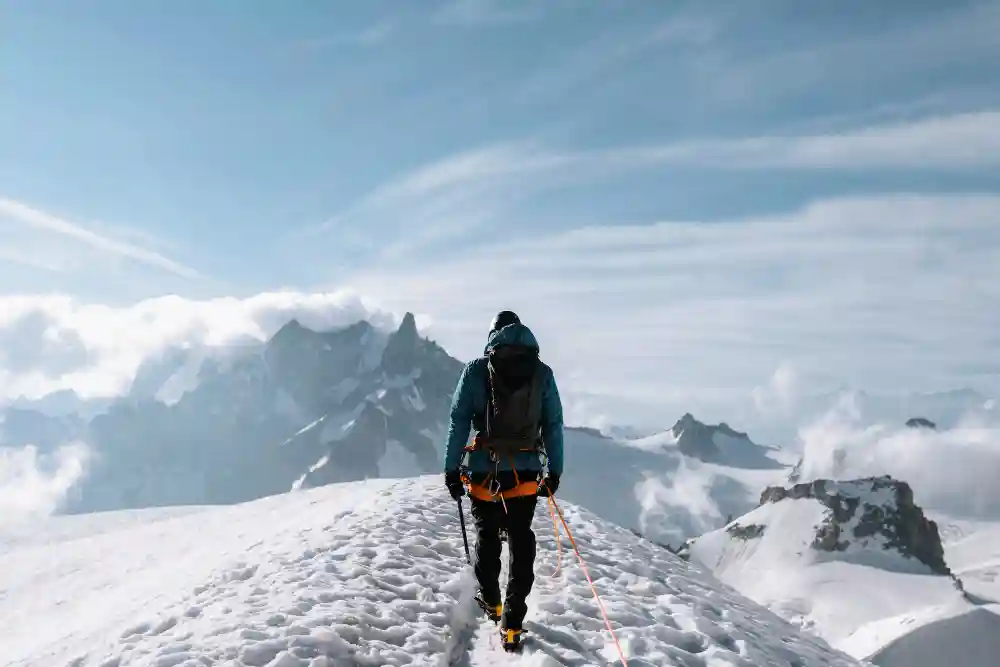
Himlung Expedition

Tour Info

trip code

EN-038

Starting Point/ End Point

Kathmandu

Accommodations

Lodge/ Tea House

Max Altitude

7126m (Himlung Himal Summit)

Duration

26 days

country

Nepal

Trip grade

Easy

Activities

Trekking , Climbing

Best Season

April, May, June, September, October

Overview

The Himlung Expedition takes you to one of Nepal's most remote Himalayan regions. Mount Himlung is a 7,126-meter mountain that offers a mix of high-altitude climbing and trekking. This 26-day trip takes you into the Nar-Phu Valley. The adventure combines raw landscapes with cultural depth and mountaineering.

This route starts from Kathmandu. It gradually moves out of the city, through villages, mountains, and finally to Himlung Base Camp. The climb is difficult but achievable. It's perfect for those looking to embark on a serious Himalayan journey without extreme technical difficulty.

Overview

The Himlung Expedition, a 26-day adventure at high altitude that includes remote trekking and a non-technical peak climbing of 7,000 meters, is an adventure for those who enjoy a challenge. Himlung Himal, located in the Nar-Phu area near the Tibetan Border, is a quieter option to the more crowded expedition peaks. This journey combines the excitement of mountaineering with the richness and diversity of cultural exploration.

Himlung expedition begins with a briefing and preparation session in Kathmandu before moving on to Koto by way of Besisahar. The trek is along the Nar-Phu Valley. It's a remote and less-traveled part of Tibet known for its dramatic scenery and preserved Tibetan cultural heritage. On the way, you will pass through settlements such as Meta and Phu village, where stone houses and monasteries are a reflection of a spiritual connection with the mountains.

As you ascend, the terrain becomes more glaciated and rugged. Base camp is a launching pad for the climbing phase. Multiple rotations between the camps will help with acclimatization. The summit push involves endurance, patience, favorable weather conditions and a lot of mental effort.

After the summit, the return journey follows the exact same route. It is a familiar but reflective experience. After returning to Kathmandu, the journey concludes with an evening of farewell and leisure.
Highlights

  • Discover the hidden Nar-Phu Valley - one of Nepal's most remote trekking regions
  • Visit the traditional Himalayan village of Meta and Phu
  • Explore the rich Tibetan Buddhist Culture, including monasteries and prayer walls.
  • The ascent is gradual and takes you through a variety of landscapes, including forests, alpine terrain and more.
  • Stay at Himlung Base Camp, located in the remote and high-altitude Himlung region (4900 m).
  • Climbing with proper acclimatization, high camp rotations and climbing period
  • Summit Himlung Himal (7,126 m), a rewarding non-technical expedition peak
  • Panoramic view of the Himalayan ranges on the Nepal-Tibet frontier
  • Return to the same scenic trail and take time for reflection.
  • Explore UNESCO World Heritage Sites in Kathmandu on a leisurely day.
  • Dinner to celebrate the successful conclusion of the expedition

Itinerary

Day 1: Arrival in Kathmandu. Pick up from the airport and transfer to the Hotel.

Your journey begins when you arrive at the Tribhuvan International Airport. Here, you will be greeted warmly and assisted with your hotel transfer. You will be able to see the vibrant blend of culture, traffic and temples with traditional architecture. You will get your first impression of Nepal's energy and mountain spirit.

You can rest and recuperate after your flight. Arriving early allows you to take a stroll outside or have a quiet cup of coffee and soak up the atmosphere. A welcome dinner is held in the evening, where you will meet your team of expedition leaders and learn about the journey that lies ahead.

  • Max Elevation: 1,350 meters (Kathmandu)

  • Travel Distance: 5 to 6 kilometers

  • Travel Hours: 20 to 30 minutes

  • Accommodation: 3-star hotel

  • Meals Included: Dinner

Day 2: Final preparation and expedition briefing in Kathmandu

After breakfast, you will be met by your guide at the hotel. He/she will take you in a private vehicle on a guided tour and preparation day of Kathmandu Valley. The morning is devoted to cultural exploration as well as final preparations for the Himlung expedition. Your guide will also provide you with information on the altitude progression and safety guidelines, as well as the overall expectations for the Himlung journey.

You will be visiting several cultural and religious sites in the Kathmandu Valley.

Swayambhunath Stupa

The Swayambhunath Stupa is situated at the top of a hill in the Kathmandu valley. It is among the oldest Buddhist stupas found in Nepal. The temple is nicknamed the Monkey Temple because of the many monkeys that dwell there. The Stupa features colorful prayer flags and shrines. Another unique feature of the Stupa is the Buddha’s eyes, which signify wisdom and knowledge. The site holds significant importance to Buddhists and Hindus.

Pashupatinath Temple

Pashupatinath, one of the holiest Hindu temples dedicated to Lord Shiva and located on the banks of the Bagmati River, is a sacred Hindu temple. The complex is characterized by pagoda architecture, shrines and open cremation grates where Hindu rituals take place. Non-Hindus are not allowed to enter the main temple, but the surrounding area provides a fascinating insight into Nepali spirituality and culture.

Bouddhanath

Bouddhanath is one of the biggest Stupas in Nepal and in the entire world. Bouddhanath is very significant to Buddhism because it is a holy place for Tibetan Buddhism. Bouddhanath can be easily identified by its huge dome and the all-seeing eyes of Buddha that are carved into it.

The focus shifts in the afternoon from sightseeing to preparation for the expedition. After a briefing about the Himlung route with your guide, you will be inspected by him to make sure that all of the clothing, equipment and essentials for trekking are in order. In Kathmandu, you can make any last-minute adjustments or purchases. The day is finished with an increasing sense of excitement for the Himalayan adventure.

  • Max Elevation: 1,350 meters (Kathmandu)

  • Accommodation: 3-star hotel

  • Meals Included: Breakfast, Lunch and Dinner


Day 3: Drive to Kodo (2,600 m) via Besisahar

An early breakfast is followed by an exciting drive through the beautiful region that lies ahead up to Koto via Besisahar. Driving through the lush green hills, terraces, river valleys, and rural settlements, leaving behind urban living, the drive continues through green hills, terraced farming, and river valleys.

The scenery gets more captivating and adventurous as the journey progresses. The trip takes us through rugged gorges, forests, and finally leads us to the gateway village of Koto, which is the gateway to the remote region of Nar-Phu.

  • Max Elevation: 2,600 meters (Koto)

  • Travel Distance: Approx. 230 to 250 kilometers

  • Travel Hours: 8 to 10 hours

  • Accommodation: Tea house/lodge

  • Meals Included: Breakfast, Lunch and Dinner

Day 4: Trek to Meta (3,560 m)

You enter the Nar-Phu Valley. The trail runs along a narrow river gorge, through dense forests of pine trees, rocky paths and suspension bridges. As you slowly gain altitude, the valley opens, and the landscape becomes more mountainous. Near Meta, a remote village surrounded by dramatic mountain views and dramatic cliffs, the air becomes cooler and thinner. You will experience your first taste of high altitude wilderness during this expedition.

  • Max Elevation: 3,560 meters (Meta)

  • Travel Distance: Approx. 10 to 12 kilometers

  • Travel Hours: 6 to 7 hours

  • Accommodation: Tea house/lodge

  • Meals Included: Breakfast, Lunch and Dinner

Day 5: Trek to Phu village (4,080 m)

This trail will take you to the deepest part of the Nar Phu region. You'll walk through vast valleys, ancient stone buildings, and Buddhist landmarks like chortens or mani walls. These are all examples of centuries-old spiritual traditions.

As you get closer to Phu village, it becomes more dramatic. The village, which is surrounded on all sides by arid cliffs and mountain ranges, gives a strong impression of isolation and cultural depth. Phu seems to be a place frozen back in time, where life continues harmoniously with the harsh Himalayan landscape.

  • Max Elevation: 4,080 meters (Phu Village)

  • Travel Distance: Approx. 8 to 10 kilometers

  • Travel Hours: 5 to 6 hours

  • Accommodation: Tea house/lodge

  • Meals Included: Breakfast, Lunch and Dinner

Day 6: Rest and acclimatization day in the Phu village

Today shall be our acclimatization day. It is vital for your body to adjust to the high elevation. Post breakfast, you can leisurely visit Phu village to explore its temples and learn about their way of living by interacting with them.

Some light hiking to some close-by vantage points will help your body to get accustomed to oxygen, at the same time giving you beautiful vistas of the surrounding landscape. This rest day is ideal for preparing for the more difficult sections of your journey.

  • Max Elevation: 4,080 meters (Phu Village)

  • Accommodation: Tea house/lodge

  • Meals Included: Breakfast, Lunch and Dinner

Day 7: Trek to Himlung base camp (4,900 m)

After leaving the cultural warmth behind in Phu, you start the journey towards Himlung Base Camp. The trail climbs steadily through rugged terrain and Himalayan landscapes.

As you progress higher in altitude, the scenery begins to change. Glaciers, rocky slopes and distant peaks become more prominent. Once you arrive at base camp, your new home is a high-altitude remote environment. This is the start of the true expedition.

  • Max Elevation: 4,900 meters (Base Camp)

  • Travel Distance: Approx. 8 to 10 kilometers

  • Travel Hours: 5 to 6 hours

  • Accommodation: Tented camp

  • Meals Included: Breakfast, Lunch and Dinner

Day 8 to 20: Climbing period from base camp to Himlung summit (7,126 m)

This prolonged period forms the heart of the expedition. This includes acclimatization, summit pushes, and training. As you move up to higher campsites and begin acclimatizing yourself to such high altitudes, you develop skills for dealing with the mountain through practice in the snow.

With each turn around, your body gets stronger. The weather, teamwork, patience, and the conditions of the mountain are all important factors during this phase. As soon as the window for the summit opens, you begin your final climb to Himlung Himal (7126 meters) and are rewarded with panoramic views across the Himalayan range. After reaching the summit, you descend safely back to base camp, marking an important achievement in your journey.

  • Max Elevation: 7,126 meters (Himlung Summit)

  • Accommodation: Tented camp

  • Meals Included: Breakfast, Lunch and Dinner

Day 21: Trek to Phu village (5,240 m)

After reaching the summit of Himlung Himal, you will begin the long descent in a state of relief and satisfaction. The trail follows familiar high altitude terrain but feels totally different. Instead of feeling the pressure from climbing, you feel calm and reflective. You will descend through open valleys, snow fields, rocky moraines and snowfields.

As you descend, the air becomes lighter and easier to breathe. The landscape gradually changes from harsh, glacial surroundings towards the sheltered valley of Phu. You will be welcomed by the warmth and simplicity of village life after a day at high altitude.

  • Max Elevation: 5,240 meters (Phu Village)

  • Travel Distance: Approx. 10 to 12 kilometers

  • Travel Hours: 5 to 6 hours

  • Accommodation: Tea house/lodge

  • Meals Included: Breakfast, Lunch and Dinner

Day 22: Trek from Phu Village To Meta

After leaving Phu behind, you continue your descent down the Nar-Phu Valley. The trail is familiar, with ancient stone walls and prayer flags as well as wide valleys that have been carved by glaciers and time. As you descend, the air is noticeably more oxygenated.

The landscape gradually changes from barren alpine terrain into more lush vegetation. Meta brings you back to a kinder world. The silence of the mountains gives way to gentler winds and a more friendly environment. The evening is relaxed and allows your body to recuperate.

  • Max Elevation: 3,560 meters (Meta)

  • Travel Distance: Approx. 10 to 12 kilometers

  • Travel Hours: 5 to 6 hours

  • Accommodation: Tea house/lodge

  • Meals Included: Breakfast, Lunch and Dinner

Day 23: Trek to Koto

The trail continues to descend through the narrow river valley and gorge, marking the final stretch in the Nar-Phu Region. The forest patches are denser, and you can hear the sound of rivers flowing as you walk through them.

Koto is reached via suspension bridges over rocky cliffs. It is symbolic to arrive here, stepping out of the restricted remote region and reconnecting with familiar trekking routes. The evening is quiet, allowing you to relax and reflect on your expedition. Max altitude: 2,600 meters (Koto)

  • Max Elevation: 2,600 meters (Koto)

  • Travel Distance: Approx. 12 to 14 kilometers

  • Travel Hours: 6 to 7 hours

  • Accommodation: Tea house/lodge

  • Meals Included: Breakfast, Lunch and Dinner

Day 24: Driving to Kathmandu from Koto

After having breakfast, start your journey towards Kathmandu through a scenic route. It includes passing hills, rivers, and farmland terraces.

On reaching Kathmandu, the energy, movements, and lights come back again in your life. After staying alone for days together, you find the comfort of a hotel and the luxury of a warm bath and a comfortable bed really comforting. The evening can be spent in relaxation.

  • Max Elevation: 1,350 meters (Kathmandu)

  • Travel Distance: Approx. 230 to 250 kilometers

  • Travel Hours: 8 to 10 hours

  • Accommodation: 3-star hotel

  • Meals Included: Breakfast, Lunch and Dinner

Day 25: Leisure day or explore World Heritage Sites of Kathmandu and farewell dinner

On the last day of this journey, you can either relax or spend some time exploring the culture of Kathmandu. Visit World Heritage sites or markets. Spend the evening with the team for a farewell meal after your Himlung expedition is over. Enjoy the evening by reflecting on your journey.

  • Max Elevation: 1,350 meters (Kathmandu)

  • Accommodation: 3-star hotel

  • Meals Included: Breakfast and Dinner

Day 26: Transfer back to the International Airport.

You will be transferred to Tribhuvan International Airport today for your flight. After spending weeks in the Himalayas, it's a relief to drive through Kathmandu. As you leave, you will take with you memories of high camps and glacier routes. You'll also carry with you the achievement of summiting the mountain, as well as the beauty of the Nar-Phu valley. The expedition may be over, but you will always remember the memories of high camps, glacier routes and summits.

  • Max Elevation: 1,350 meters (Kathmandu)

  • Travel Distance: 5 to 6 kilometers

  • Travel Hours: 20 to 30 minutes

  • Meals Included: Breakfast

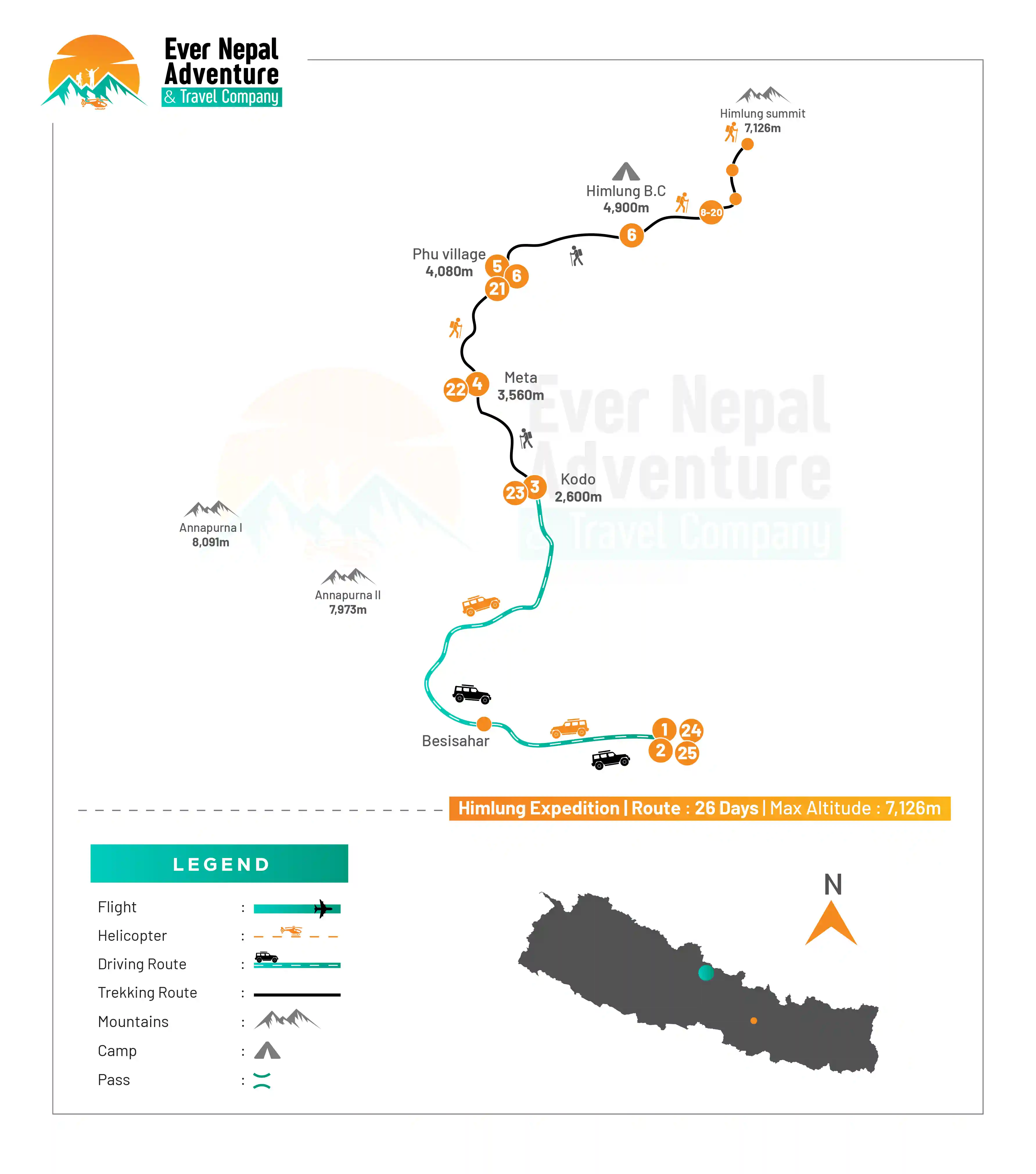
Trek Route

Himlung Himal Summit routemap

What's included

  • Airport pickup and drop off in Kathmandu
  • Three nights' hotel accommodation in Kathmandu (3-star category), including breakfast plan
  • Expedition briefings and support for pre-trip planning
  • All required trekking and climbing licenses, including restricted areas permits and expedition royalties
  • During the trekking period, you will be provided with full board meals (breakfast, lunch and dinner).
  • Tea house accommodation is available on the Koto to Base Camp trek.
  • Tented camping with all support provided during climbing (Base Camp, higher camps).
  • Team of experienced licensed climbing guides and trekking support staff
  • Porters/yaks for baggage transport (as per route requirement)
  • Base camp setup, including kitchen, dining equipment, and other camping gear
  • Climbing equipment (tents, ropes, cooking gear, etc.) for the base camp or higher camps.
  • Medical kit for base camp
  • During the expedition phase, a high-altitude chef and kitchen crew with experience in the field will be required.
  • Climbing Sherpa Support for Summit Push (as Per Group Size and Plan)
  • Surface transportation (Kathmandu to Besisahar, Koto and back by jeep or private vehicle)
  • Briefing on group climbing and safety orientation
  • Farewell Dinner in Kathmandu following expedition completion

What's excluded

  • Nepal International Flights
  • Nepal entry Visa Fee (available upon arrival at the airport).
  • Travel and rescue (must include high altitude evacuation up to 7,500m).
  • Personal climbing gear (boots and crampons; harnesses; helmets; down suits, etc.).
  • Personal trekking clothing and gear
  • Extra Nights in Kathmandu are not included in the Itinerary
  • Beverages, such as alcoholic beverages, soft drinks, bottled waters, snacks and personal food items
  • During trekking/climbing periods, you can expect to receive hot showers, Wi-Fi and other services.
  • Gratuities for guides, Sherpas, porters and staff
  • Medical expenses or treatments for personal health
  • In the event of an emergency, the insurance policy must cover helicopter rescue and evacuation.
  • Weather, landslides and other unforeseeable circumstances can cause itinerary changes.
  • Sherpas who summit (customary but optional, often expected) receive a bonus.
  • All services that are not mentioned specifically in the "Cost Included" section

Packing list for Himlung Expedition

A well-planned packing list is a must for a successful Himlung Expedition. As the route takes you towards the extremely high-altitude place, proper gear is crucial to ensure safety, comfort, and performance. Additionally, your gears must also be well-tested that can withstand extreme cold temperatures, strong winds, and unpredictable weather in the Himalayas. Some of the packing list for the Himlung Expedition are mentioned below: 

  • Personal Climbing Gears

    • Climbing Helmet

    • Ice Axe with a waist leash

    • Prusik Cords

    • Climbing Harness (Lightweight)

    • Carabiners

    • Ascending Device (Jumar / Ascender)

    • Summit Down Suit for above 7000m

    • Descending Device (Belay Device or Figure 8)

    • Mountaineering Crampons

  • Clothing

    • Balaclava

    • Warm beanie hat

    • Sun hat or cap

    • Ski Goggles

    • Headlamp with spare batteries

    • Desert cap

    • Sunscreen with a factor of 50+

    • Polarized Sunglasses with UV protection

  • Upper Body 

    • 3 Light and trekking weight thermal tops

    • 1 Down Jacket

    • 1 Waterproof shell jacket with hood 

    • 3 T-shirts or cool-max trekking shirts

    • 1 Down Vest

    • Weight-insulated down jacket with a hood

    • 1 Fleece Jacket or pullover

  • Lower Body

    • 2 Fleece Pants

    • 2 Thermal base layers

    • 1 Heavyweight hiking trousers

    • 1 Waterproof/ Rain pants

    • 2 Pairs of trekking pants,

    • Underwear

    • 2 Light Hiking shorts

  • Hands

    • Waterproof outer gloves

    • Lightweight gloves or liner gloves

    • Down Mittens

    • Pair of shell gloves

  • Foot Wear

    • Mountaineering boots

    • Gaiters

    • 3 Warm Trekking socks

    • 3 Pairs of liner socks

    • Hiking Shoes

    • Lightweight Rubber Shoes

  • Medical and First Aid Kit

    • Paracetamol Tablets

    • Diamox

    • Imodium

    • Personal Medication

    • Blister kit

    • Antibiotic Cream

    • Small, personal first-aid kit

    • Dressing Gauze

  • Accessories and Practical Items 

    • Small bottle of water purification tablets or a water filter

    • Camera

    • Large duffle bag

    • Small backpack or daypack

    • Smart Trekking Watch

    • Power banks

    • Trekking Pole

    • Binoculars

    • Travel adapter

  • Toiletries

    • Soap

    • Toothbrush and small toothpaste

    • Toilet paper

    • Hand sanitizer

    • Quick-dry towel

    • Small shampoo bottle

Specific Gears for Women

The specific gears for women on the Himlung expedition are designed to provide better fit, comfort, and performance in extremely high-altitude conditions. Since you need to climb the Himlung mountain, wearing and carrying the properly fitted clothing and equipment helps improve insulation, mobility, and safety. Some of the specific gears for women are listed below: 

  • Skincare items (moisturizer, skin cleanser, and sunscreen)

  • Travel-size shampoo

  • Sports bra

  • Undergarments

  • Tampons

  • Sanitary pads

  • Fleece Headband

  • Tight leggings


Documents required for Himlung Expedition

The documents required for the Himlung Expedition are essential for obtaining permits, ensuring legal compliance, and organizing logistics for the climb. These documents include valid passports, trekking permits, climbing permits, visa papers, and many others. The list of the necessary documentation for Himlung Expedition is as follows:

  1. Himlung Himal Climbing Permit: Himlung Himal climbing permit is a mandatory permit that allows you to climb the mountain which is 7,126 meters high. It is issued by the Department of Tourism under the Ministry of Culture, Tourism and Civil Aviation (MoCTCA). The cost of Himlung Himal climbing permits is $500 during spring, $250 during autumn, and approximately $125 during winter/summer per person.
  2. Nar-Phu Valley Restricted Area Permit: Nar-Phu Valley Restricted Area Permit is a mandatory document for completing the Himlung Expedition. It costs approximately $100 per week (during the peak season) or $75 (during off-season) per person. This permit can only be acquired via an official trekking agency in Nepal. 
  3. Annapurna Conservation Area Permit (ACAP): This is a compulsory permit which all foreign trekkers must get to enter into the Annapurna Protected Area located in Nepal. ACAP permit can be obtained at the Nepal Tourism Board Office, Bhrikutimandap, or Damside of Pokhara. It costs NPR 3,000 for foreigners ($22 - $25 approx.) and NPR 1,000 for SAARC nationals.
  4. TIMS Card: The TIMS card (Trekkers Information Management System) was issued for ensuring the safety and security of trekkers. This permit can be obtained either from the office of Nepal Tourism Board or from the Trekking Agencies’ Association of Nepal (TAAN). The price for a TIMS card is NPR 2,000 (approx. $15) for international tourists. 
  5. Travel Insurance: It must include emergency helicopter rescue, and medical expenses.
  6. Passport Size Photos: Bring at least 2 to 4 passport size photos for the purpose of obtaining permits and other formalities.
  7. Passport: You should have a valid passport for at least six months following your trip.

Frequently Asked Questions

Is prior experience necessary for the Himlung Expedition?

Yes, prior experience is a necessity to participate in Himlung Expedition. It involves climbing to the top of Mt. Himlung. Moreover, you need to traverse through steep snow or ice inclines, cross glaciers, and utilize ascenders (jumar) along with rappelling gear. 

Is the Himlung expedition technically difficult?

Yes, the Himlung Expedition is technically difficult as you need to ascend to the top of Mt. Himlung which requires excellent endurance, high-altitude experience, and basic mountaineering skills such as the use of ropes, crampons and ice-axes.

When are the best seasons for the Himlung Expedition?

The best seasons for the Himling expedition are Autumn (late September to November) and Spring (April to May). During these times, you can find skies are clear, the weather is stable, offering breathtaking views of mountains, and more favorable climbing conditions. 

Is oxygen required for completing the Himlung Expedition?

Supplemental oxygen is not absolutely required for completing the Himlung expedition. Nevertheless, carrying additional oxygen can be advantageous for you, especially when climbing the mountain where the air is thin and weather conditions can become more challenging.

What is the biggest challenge during the Himlung climb?

There are several biggest challenges during the Himlung climb.Some of the challenges that you may face include:

  • Health risks of extreme altitude

  • Mental strength and environmental aspects

  • Cold temperature

  • Long summit push duration

  • Wind exposure

How cold does it get on Himlung Himal?

The temperature at Himlung Himal can drop as low as -30degC, or even lower.In the autumn, the temperature ranges from -23°C to -26°C. So, the temperature is extremely cold at Himlung mountain throughout the year. 

Can beginners join if they are physically strong?

Yes, beginners can join the Himlung expedition if they are physically strong. Prior mountaineering and high-altitude trekking experience is required to successfully complete the technical challenges and Tashi Lapcha pass to Thame trek. 

Is altitude sickness a concern on the Himlung Expedition?

Yes, altitude sickness is definitely a concern on the Himlung expedition. You need to climb to the top of Mt. Himlung, having an altitude of 7,126 m. At this altitude, the oxygen level is too low, so you may experience symptoms such as headache, nausea, dizziness, and shortness of breath.

What are the signs that someone should descend immediately?

There are several signs that indicate you should descend immediately. Some of them are: 

  • Severe headache

  • Loss of coordination

  • Coughing with blood

  • Severe fatigue

  • Breathlessness at rest


User Review