Island Peak Climbing with Everest Base Camp

Tour Info

trip code

04

Starting Point/ End Point

Kathmandu

Accommodations

Lounge and tea house

Max Altitude

6,189

Duration

22 days

country

Nepal

Trip grade

Strenuous

Activities

Trekking

Best Season

March, April, May, September, October, November

Overview

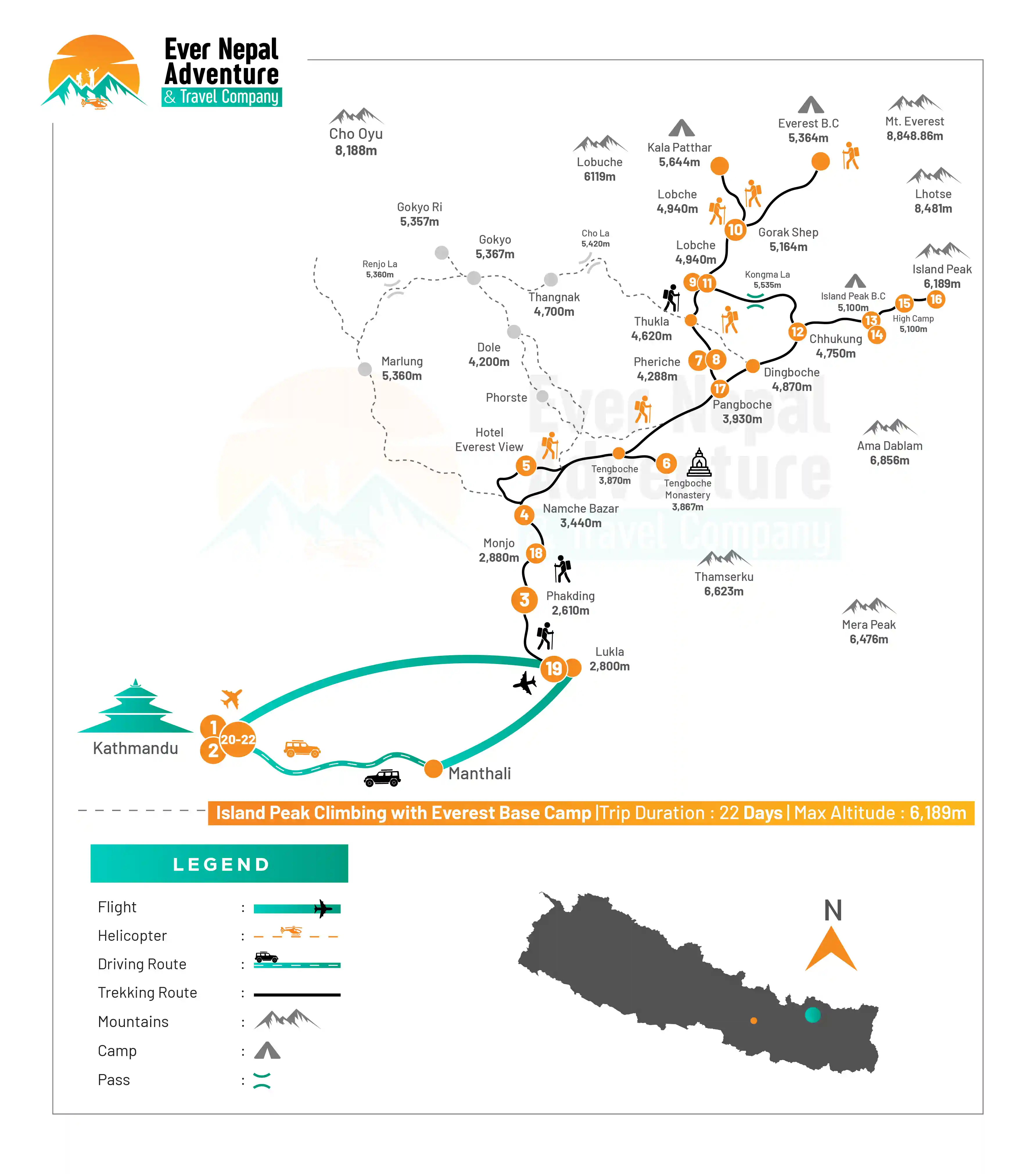
Island Peak Climbing with Everest Base Camp allows you to combine trekking and peak climbing within the Everest region. The classic Everest route follows the trail, which allows trekkers an opportunity to experience Sherpa cultures, dramatic landscapes, and high altitude adventure. The journey starts after a scenic flight from Kathmandu to Lukla. From here, the trail continues along the Dudh Koshi River to Phakding before climbing gradually towards Namche Bazaar.

As you continue your Island Peak Climbing with Everest Base Camp to Tengboche, views of Everest and Ama Dablam will open up. The trail moves on towards Pheriche and Lobuche. Here, there is a transition towards more alpine landscapes. The trek to Kalapatthar and the hike to Everest Base Camp give the most scenic view of the mountains. As you continue through the trek from the Kongma La Pass, you will find yourself in the less-explored area of the Imja Valley, preparing you for your upcoming climb. The more you progress towards Chhukung Base Camp, the more remote the area becomes.

The preparation for the climb is done at the Island Peak Base Camp, where you learn about basic mountaineering techniques. Once you reach the High Camp, your summit will be just ahead of you. Scaling up to the peak consists of glacier travel and rope climbing with a steady ascent. You will get a view of Everest, Lhotse, Makalu and other mountains that surround the area.

This would provide ample time for reflection during your descent via Pangboche and Namche Bazaar. The experience ends with a Lukla-Kathmandu flight.
Highlights

  • Island Peak climbers can enjoy the classic Everest Base Camp trek.
  • The iconic Namche Bazaar Trail will take you through Tengboche and Namche Bazaar.
  • Acclimatize gradually by taking scenic hikes and resting days
  • Kala Patthar and Everest Base Camp offer panoramic views
  • Crossing the high Kongma La Pass and entering the Imja Valley
  • Island Peak Base Camp provides basic mountaineering skills training
  • ummit Island Peak - one of Nepal's most popular trekking peaks
  • Everest, Lhotse, Makalu, and Ama Dablam are all visible from Ama Dablam.
  • Explore Sherpa culture and monasteries
  • A complete Himalayan experience that combines trekking and climbing

Itinerary

Day 1: Arrival in Kathmandu 1,338 m and transfer to hotel.

Kathmandu will welcome you with a mix of culture, chaos and warmth. Arriving at Tribhuvan International Airport, you will have to complete the arrival formalities. Then you can step into Nepal's vibrant atmosphere. Our representative will meet you outside the airport and help you get to your hotel. As you drive through the city, you will see bustling streets, temples and shops.

You can rest, recover and explore the streets around your accommodation at your own pace. This unique combination of traditional architecture, modern life and energy in the city creates an unforgettable first impression. You can get a feel for the area and prepare yourself mentally for your adventure in the Everest Region. This evening will be relaxed and allow you to prepare for your journey.

  • Max Elevation: 1,350 m
  • Travel Distance: 6 km
  • Travel Hours: 30 mins
  • Accommodation: Hotel
  • Meals Included: Dinner

Day 2: In Kathmandu trek preparation and sightseeing tour.

The day starts early with preparatory measures for the trek or climbing adventure. Your guide and the whole expedition group will come to meet you in your hotel room, where they will check all your gear and make sure everything is set up before heading out to start your journey. In the meantime, you would be driven around the valley on a personal transport to visit a number of tourist attractions.

This guided tour includes visits to some prominent cultural monuments in the area, and your guide will provide you with the necessary details about their significance, history, and culture. This way, you get a glimpse of Kathmandu's heritage and at the same time prepare yourself mentally for your adventure into the Himalayas.

  • Swayambhunath Stupa – Monkey Temple:

Swayambhunath is a Buddhist temple on a hill that is commonly known as Monkey Temple due to the presence of monkeys in the surrounding areas. It is a spiritually important place offering a magnificent view of the Kathmandu Valley. It has also been adorned with prayer flags, shrines, and a huge Buddha eye, which symbolizes wisdom and awareness. It is revered by both Buddhists and Hindus.

  • Pashupatinath Temple

Pashupatinath Temple is one of Nepal's most holy Hindu temples, dedicated to Lord Shiva. It lies on the banks of the Bagmati River. The complex includes traditional pagoda-style architecture, holy shrines, and riverside ghats that are used for Hindu rituals. Entrance to the main temple is denied to those who are not Hindus, but one can get spiritually uplifted from the ambience around it.

  • Boudhanath Stupa

Nepal's Boudhanath Stupa is a big Buddhist monument and a major place for Tibetan Buddhism. The huge white stupa constructed during the fifth century is well known for Buddha's all-seeing eye. Around the stupa are monasteries and prayer wheels. Monks and Pilgrims also chant prayers as they go clockwise around it.

Bhaktapur Durbar Square - A historic royal complex, it is one of the finest examples of Newari architectural style and medieval craftsmanship. The ancient seat of Malla kings is full of palaces, courtyards and temples. The 55-Window Palace is one of the most impressive. Nyatapola Temple and the Golden Gate are also noteworthy.

  • Thamel Area

Thamel, situated in Kathmandu, is a very popular tourist area because of the bustling streets filled with souvenir shops, cafes, restaurants and trekking gear shops. It is a perfect place to feel the atmosphere and get everything ready for your trek through the Himalayas.

The tour will come to an end by the end of the day, and you will go back to your hotel. The rest of the day is free.

  • Max Elevation: 1,350 m

  • Travel Distance: 20 km

  • Travel Hours: 5–6 hrs

  • Accommodation: Hotel

  • Meals Included: Breakfast

Day 3: Fly to Lukla 2, 860 m and trek to Phakding 2,645 m

The first part of the third day is full of excitement because of the fascinating scenery of mountains, rivers, and peaks from the air.  This trip also includes a landing in Lukla, which is not easy because the airstrip is built on a mountain slope. You will then meet your trekking group and start the trek to Phakding. The trail gradually descends through the forest and along the Dudh Koshi River. You'll walk along mani walls, prayer wheels and suspension bridges.

It is a relatively easy walk, which allows your body to adjust while you enjoy the beauty of the surrounding area. Peaceful trekking is created by the sound of the flowing river, the view of the pine forests, and the distant peaks. After reaching Phakding, you will settle into the teahouse to prepare for your trek.

  • Max Elevation: 2,860 m
  • Travel Distance: 8 km
  • Travel Hours: 4 hrs
  • Accommodation: Teahouse/Lodge
  • Meals Included: Breakfast, Lunch, Dinner

Day 4: Trek to Namche Bazaar 3,440 m / 11, 350 feet

The section from Phakding Bazaar to Namche Bazaar has some of the most thrilling sections. The day starts with a gentle walk along the Dudh Koshi River. You will cross several suspension bridges decorated with prayer flags. The route takes you through dense forests of rhododendron and pine.

The trail gets steeper as you continue, especially after crossing the Hillary Suspension Bridge. The final climb to Namche Bazaar can be challenging, but it is also rewarding. If the weather is good, you might catch your first view of Mount Everest and other nearby peaks.

After a steady ascent, you will arrive at Namche Bazaar. This vibrant Sherpa village is nestled within a natural amphitheater. This is the hub for the Everest region. It has cafes, bakeries, and breathtaking mountain views. This is a lively place, surrounded by the raw beauty of the Himalayas. Here you can begin to feel the essence of high-altitude hiking.

  • Max Elevation: 3,440 m
  • Travel Distance: 11 km
  • Travel Hours: 6 hrs
  • Accommodation: Teahouse/Lodge
  • Meals Included: Breakfast, Lunch, Dinner

Day 5: At Namche for acclimatization and short scenic hike to Everest View hotel(3880 m)

Namche Bazaar has set aside this day for acclimatization. You will not rest completely, but instead take a short walk to help your body adapt to the altitude. After breakfast, you will begin your gradual ascent towards the Everest View Hotel. This is one of the highest hotels in the entire world. The trail provides stunning views of surrounding peaks, including Everest, Lhotse and Ama Dablam.

Slow and steady hiking allows you to gain altitude without exerting yourself. You will pass through small villages and viewpoints with incredible views of the Himalayas. You can stop at the top to take in the view and enjoy it before returning to Namche.

You can explore the rest of your day. Visit local bakeries, markets or just relax in the mountains. This day is crucial in preparing you for the higher altitudes to come. It also offers some of the most beautiful views of Everest.

  • Max Elevation: 3,880 m

  • Travel Distance: 5 km

  • Travel Hours: 3–4 hrs

  • Accommodation: Everest View Hotel 

  • Meals Included: Breakfast, Lunch, Dinner

Day 6: Trek to Tengboche Monastery 3,867 m

From Namche, you will begin the trail with a gentle walk on a ridge. You'll enjoy spectacular views. The trail offers clear views of Everest, Ama Dablam and Thamserku. The trail then descends to the Dudh Koshi River. It crosses a suspended bridge before continuing up a forested slope.

Tengboche Monastery (the largest monastery in Khumbu) is the destination after several hours of trekking. This spiritual site provides a scenic and peaceful atmosphere surrounded by towering summits. Ama Dablam towers above the monastery in a spectacular setting.

You can tour the monastery or, if the timing is right, watch the prayer rituals. The serene and spiritual surroundings add a unique cultural aspect to the journey. As you settle into the lodge, enjoy the views of the mountains at sunset.

  • Max Elevation: 3,867 m
  • Travel Distance: 10 km
  • Travel Hours: 5 hrs
  • Accommodation: Teahouse/Lodge
  • Meals Included: Breakfast, Lunch, Dinner

Day 7: Trek to Pheriche 4,200 m / 13,780 fee

The day begins as you descend through a forested trail before crossing over a river to continue down an open valley. As you go higher, the scenery changes. It becomes more rugged and less vegetated. The trail gives you a spectacular view of the surrounding peaks.

Pheriche is reached after passing through Pangboche. As you climb, the air is thinner and cooler. The atmosphere is more remote here, with fewer tree species and more open terrain dominated mostly by mountains and glacial features.

Your walking pace is manageable and steady, so you can keep a comfortable speed. When you arrive in Pheriche, settle into the lodge and relax. This village can be used to acclimatize, and the effects will be more noticeable. The peaceful surroundings and surrounding views make this a relaxing place to prepare for the following phase of your trek.

  • Max Elevation: 4,200 m
  • Travel Distance: 9 km
  • Travel Hours: 5 hrs
  • Accommodation: Teahouse/Lodge
  • Meals Included: Breakfast, Lunch, Dinner

Day 8: At Pheriche rest day for acclimatization and hike to Nangkartshang Peak

Pheriche has another important acclimatization. After breakfast, you begin a gradual hike towards Nangkartshang Peak. The trail is a steady climb that offers amazing views as it increases in elevation. The altitude makes this hike challenging but rewarding.

The viewpoint provides a great view of many Himalayan peaks, such as Makalu and Ama Dablam. The landscape looks vast and dramatic. Glaciers and rocky terrain dominate the horizon. After a few hours at the top of the mountain, you can return to Pheriche.

The rest of your day is for relaxing. You can spend time exploring the village. Be sure to hydrate properly and prepare your body for the high elevations that lie ahead. This day provides a chance to adjust your body and also offers some of the best views.

  • Max Elevation: 5,080 m
  • Distance to travel: 6 km
  • Travel Hours: (4-5 hrs)
  • Accommodation: Teahouse/Lodge
  • Included meals: Breakfast and Lunch

Day 9: Trek to Lobuche 4,960 m

The trail is open and has gradual climbs. You walk beside the Khumbu Glacier and enjoy views of surrounding peaks, icy mountains, and ridges. As you progress, the air becomes thinner and the environment more extreme. After passing memorials to climbers lost on Everest, it becomes more reflective. The trail continues toward Lobuche. A small settlement set in dramatic mountain scenery, it is the next stop on this journey.

The altitude makes it necessary to maintain a careful pace. On arrival, you can rest and prepare your body for the following day's journey up to Everest Base Camp. The Himalayan surroundings are powerful and raw, giving you an authentic sense of Himalayan life.

  • Max Elevation: 4,960 m
  • Distance to travel: 8 km
  • Travel Hours (Travel Time): 5 hrs
  • Accommodation: Teahouse/Lodge
  • Meals Included in the Price: Breakfast, Lunch, Dinner

Day 10: Trek to Everest Base Camp 5,364 m and back to Gorakshep

This is one day you are looking forward to the most. Begin your journey by trekking to Gorakshep. After a short break, you continue on to Everest Base Camp. The trail follows the edge of the Khumbu Glacier. You will encounter rocky terrain with icy formations. Everest Base Camp is an amazing achievement. The feeling of being surrounded by towering peaks is incredible. You will then retrace your footsteps back to Gorakshep, where you will spend the night. Returning to Gorakshep is an exhausting but rewarding walk, which marks a major milestone on the trek.

  • Max Elevation: 5,364 m
  • Travel Distance: 12 km
  • Travel Hours: 7 hrs
  • Accommodation: Teahouse/Lodge
  • Meals Included: Breakfast, Lunch, Dinner

Day 11: Climb Kalapathar 5,545 m, and trek to Lobuche

Kala Patthar provides one of Everest's best viewpoints. The climb can be challenging and steep, especially if it's cold. But the reward is incredible.

From the summit, you can enjoy a breathtaking sunrise view over Everest. The golden light that hits the mountains creates a stunning scene. After spending time up top, descend to Gorakshep.

Later, you will trek back towards Lobuche. The descent will feel easier. This allows you to recover and still enjoy the dramatic scenery.

  • Max Elevation: 5,545 m
  • Travel Distance: 10 km
  • Travel Hours: 6 hrs
  • Accommodation: Teahouse/Lodge
  • Meals Included: Breakfast, Lunch, Dinner

Day 12 : Trek to Chhukung via Kongma La pass

This is the hardest and most rewarding day of the trip as you traverse the high and remote Kongma La Pass. A good start begins from the early hours of the day, when slowly climbing through rugged terrain. Along the way, the journey becomes increasingly difficult as the climb becomes more rugged. You must be vigilant in moving cautiously at a slow pace. While the thin air may slow down your progress, the breathtaking scenery around you will motivate you.

Reaching the summit of Kongma La Pass is indeed a wonderful experience. At this point, one will be surrounded by beautiful vistas of the snowcapped mountains of the Himalayan range. You will descend towards Chhukung after spending some time on the pass.

The descent can be equally challenging, with slippery rocks and glacial trails that need to be watched. You will feel more isolated and quieter as you descend to the Imja Valley compared with the main Everest trek. As you reach Chhukung lodge, relax and enjoy the view. As you begin to climb Island Peak, the focus shifts from the trekking phase.

  • Max Elevation: 5,535 m
  • Travel Distance: 11 km
  • Travel Hours: 7 hrs
  • Accommodation: Teahouse/Lodge
  • Meals Included: Breakfast, Lunch, Dinner

Day 13: Trek to Island Peak Base Camp 5,100 m / 16, 732 feet

The trek for this day starts after leaving Chhukung behind. The path gradually climbs towards the Island Peak Base Camp. It is an off-the-beaten-path trekking route in the upper Imja Valley. One can get an experience of isolation in the wildness of the Himalayas. There is an increasing difficulty of the terrain where rocky paths, glacial moraines, and scanty vegetation prevail.

As one moves forward, the Island Peak will come into view. The peak stands out prominently above the valley, providing you with a sense of the difficulties that lie ahead. There will be irregular terrain and increasing height, and for this reason, concentration is required.

At base camp, there will be a welcome sight of mountainous terrain characterized by mountains and glaciers.  The campsite has been set up in a large open area with stunning views in all directions. While the climbing team is preparing equipment, you can relax in your campsite and enjoy the view. This is where the atmosphere changes from trekking to expedition mode and builds anticipation for your days ahead.

  • Max Elevation: 5,100 m
  • Travel Distance: 6 km
  • Travel Hours: 4 hrs
  • Accommodation: Camp
  • Meals Included: Breakfast, Lunch, Dinner

Day 14: Rest day at Island Peak base camp(5,100 m) for climbing training

This day is devoted to acclimatization. After breakfast, you will be trained by your guide in basic mountaineering techniques. Learn how to use gear such as ascenders, ice axes, crampons, and harnesses. Training includes techniques for walking on snow and ice as well as rope handling and safety procedures.

This hands-on session will help you gain confidence, particularly if you have little climbing experience. The controlled environment allows you to practice these skills and understand the techniques needed for the summit push. The guides will ensure everyone is comfortable before they move forward.

You can explore the surroundings, hydrate well and mentally prepare for the climb. You can take a walk around the area, hydrate yourself and mentally prepare for your climb. This combination of a high-altitude, quiet, and isolated environment creates a strong feeling of anticipation. This day is critical to ensuring that the ascent will be safe and successful.

  • Max Elevation: 5,100 m
  • Accommodation: Camp
  • Meals Included: Breakfast, Lunch, Dinner

Day 15: Trek and climb to high camp 5,500 m / 18,044 feet

The climb to High Camp begins on a gradual ascent through rocky and ice-covered terrain. As you gain altitude, the trail gets narrower and more technical. This part is quite a challenge since it consists of loose rocks or ice, which sometimes can be very slippery.

However, as one ascends higher, the scenery gets more magnificent. The mountains and the glaciers are what stand out. With thin air and challenging steps, one must be careful not to move too quickly. This is not an arduous trek, but rather an intense one.

High Camp marks a major milestone. The campsite has a spectacular location with incredible views of the Himalayan ranges. After you arrive, rest, hydrate yourself and prepare for the summit push. After a quick dinner, your guide gives a briefing outlining the summit plan. You have a short sleep as you prepare for a dark, early start.

  • Max Elevation: 5,500 m

  • Travel Distance: 4 km

  • Travel Hours: 4 hrs

  • Accommodation: Camp

  • Meals Included: Breakfast, Lunch, Dinner

Day 16: Climb the summit of Island Peak 6,189 meters (20,305 feet)

Summit day is a rewarding and challenging experience. You start the climb in the early morning, usually before dawn. Use headlamps to navigate. The first part of the trail is on rocky terrain, before it transitions to glacier travel.

You will use safety gear and ascenders to make your way up the fixed-rope sections. The final push towards the summit requires a steep ascent that will test both mental and physical strength. Your team and you will continue to move forward, despite the challenges.

Island Peak's summit is a truly unforgettable experience. The views from the summit are breathtaking. Everest and its surrounding peaks, Lhotse or Makalu, can be seen in all their glory. After spending time at the top, you start a slow descent back to the base camp.

The return journey can be physically demanding, but it is also rewarding. When you reach the Camp, it feels like a long day, but it is also deeply rewarding. It's the highlight of the whole expedition.

  • Max Elevation: 6,189 m
  • Travel Distance: 8 km
  • Travel Hours: 8 hrs
  • Accommodation: Camp
  • Meals Included: Breakfast, Lunch, Dinner

Day 17: Trek to Pangboche 3, 900 m

The descent is a relief after the intense summit. The trail continues to Pangboche after returning through Chhukung. As you drop in altitude, the air becomes thicker. Breathing is easier. The landscape changes from the rugged terrain of the Alps to a greener environment with more vegetation. The walk feels relaxed in comparison to the previous days. This allows you to take your time and enjoy the scenery.

Pangboche village is known for its tranquility and picturesque scenery. After arriving, you can relax in your lodge. The evening is quiet, giving you time to relax and reflect on how far you've come.

  • Max Elevation: 3,900 m
  • Travel Distance: 10 km
  • Travel Hours: 6 hrs
  • Accommodation: Teahouse/Lodge\
  • Meals Included: Breakfast, Lunch, Dinner

Day 18: Trek to Monjo 2,880 via Namche Bazaar 3,440 m

The trail descends steadily through familiar trails. You will pass Namche Bazaar, where you can enjoy a quick break and the vibrant atmosphere. From Namche, the route continues down through forests, along the river and towards Monjo. As you descend in altitude, your oxygen levels will improve.

The day is filled with beautiful scenery, a feeling of accomplishment and changing landscapes. After reaching Monjo, you will settle into the lodge to spend the night. This marks the end of your journey.

  • Max Elevation: 3,440 m
  • Travel Distance: 15 km
  • Travel Hours: 7 hrs
  • Accommodation: Teahouse/Lodge
  • Meals Included: Breakfast, Lunch, Dinner

Day 19: Trek to Lukla(2,860 m) and transfer to a lodge

The final trek begins with an overwhelming sense of accomplishment, as you leave Monjo. Follow the familiar Dudh Koshi River path. The path passes through suspension bridges in forests and past small settlements you've seen before. However, this time it feels different. There is no pressure from altitude, and you can now walk at a slower pace.

As you proceed, you pass Phakding on your way to Lukla. The trail has a mix of gentle ascents, descents and a steady upward climb to Lukla. Enjoy the last views along the way of the mountains, rivers, and distant peaks.

Lukla is where the trek and the climbing phase end. After you have arrived, relax and settle into your lodge. The evening is filled with celebrations alongside your guides, team and reflecting on all the challenges overcome and the summit that was achieved. It's a moment to reflect on the summit and be grateful for all that you have accomplished.

  • Max Elevation: 2,860 m
  • Travel Distance: 14 km
  • Travel Hours: 6–7 hrs
  • Accommodation: Teahouse/Lodge
  • Meals Included: Breakfast, Lunch, Dinner

Day 20: Fly from Lukla to Kathmandu with afternoon free at leisure

The day begins with a return flight to Kathmandu. Your flight is short, but it offers an incredible aerial view of the Himalayas. As you take off from the mountain runway, the last thing you see is the rugged terrain of the Himalayas. Upon your arrival in Kathmandu, you will be transferred to the hotel. The contrast is striking between the calm mountains and the bustling city. After days of exploring remote high-altitude regions in the mountains, the comforts offered by the city feel well deserved.

The rest is up to you. Relax or explore at leisure. You can either choose to relax, enjoy a meal, or walk through the nearby streets. This day will allow you to return to a comfortable environment and reflect on the journey that you just finished.

  • Max Elevation: 1,350 m
  • Travel Hours: 30 mins
  • Accommodation: Hotel
  • Meals Included: Breakfast

Day 21: Free day as contingency and for individual activities.

It is important to keep this day flexible, in case of any delays. If all has gone well, the day can be used to explore, relax, or engage in personal activities. You may spend this period shopping for souvenirs or exploring some culture-specific sites, or just go back to visit some of the most visited places, such as Thamel. In addition, trekking and climbing also offer ample time for relaxation, including tasting some of the native foods, relaxing at your hotel or sitting at a café.

Such a buffering day is meant to guarantee an easy process of international travel. The mountain memories, the people you met and the journey are all consolidated, making the final days of your trip a memorable one.

  • Max Elevation: 1,350 m
  • Accommodation: Hotel
  • Meals Included: Breakfast

Day 22: International departure for homeward bound

Your journey in Nepal has come to an end. After breakfast, transfer to Tribhuvan International Airport. Kathmandu is one of the most vibrant cities in the world. The streets, temples, daily life and the vibrant street life are all visible on the drive.

As you are preparing to leave, your experience trekking to Everest Base Camp & summiting Island Peak remains with you. This journey has combined physical challenge with cultural discovery and breathtaking mountain scenery. Every moment of the journey, from the bustling cityscapes to the remote Himalayan terrains, has added to an unforgettable adventure.

After packing your bags and recollecting your experiences, you board the flight home. Though you have returned from the Himalayas now, the experience is still fresh and can inspire future mountaineering trips.

  • Max Elevation: 1,350 m
  • Travel Distance: 6 km
  • Travel Hours: 30 mins
  • Meals Included: Breakfast

What's included

  • Private vehicle for airport pick-up in Kathmandu and drop-off at the same time
  • Hotel accommodation at Kathmandu, 3 stars with breakfast (upgrade options are available)

  • Round-trip domestic flights: Kathmandu - Lukla - Kathmandu

  • All necessary trekking permits as well as entry fees for the Sagarmatha National Park.

  • Full board meals are included (Breakfasts, Lunches, and Dinners) during the trek period.

  • Island Peak Base Camp High Camp offers teahouse/lodge accommodation for trekking and camping arrangements.

  • Professional English-speaking trekking guide

  • Included in the number of porters needed (1 porter per two trekkers) is their food and accommodation as well as their wages, insurance, and salary.

  • Island Peak climbing license and all necessary mountaineering gear

  • Climbing equipment includes fixed ropes (fixed, ice screws and group climbing gear), ice screws, and group climbing gear.

  • Island Peak Base Camp provides basic mountaineering training.

  • First-aid medical kit carried by the guide

  • All taxes, service fees and official expenses

What's excluded

  • Nepal: International flight to and from Nepal

  • Nepal entry visa fees

  • Travel insurance that includes high-altitude trekking (and emergency evacuation)

  • Personal climbing equipment includes boots, crampons, harnesses, sleeping bags and down jackets.

  • Personal expenses

  • Breakfast, lunch and dinner

  • Kathmandu extra night due to flight delays or early returns from Lukla

  • Tipping guides, porters and climbing personnel

  • Expenses for medical evacuation, rescue or any other expenses

  • Spending on alcoholic and soft beverages, bar bills during the trek

  • The cost of unforeseen events (weather conditions, flight cancellations and strikes, natural calamities)

Packing List for climbing Island Peak and Everest Base Camp

Having appropriate equipment when you decide to climb Island Peak and Everest Base Camp is very important for ensuring that you are safe, comfortable, and flexible. The trip involves some hiking at high altitudes, traveling on glaciers, and mountaineering activities. Packing wisely will also help you to stay organized and ready for the rapidly changing weather conditions of the Everest region. Here is a packing list that you should consider for Island Peak Climbing and Everest Base Camp.

  • Head

    • Wide-brimmed sun hat

    • Neck gaiter, or buff

    • Warm insulated beanie

    • Balaclavas for Summit Push

    • Glacier sunglasses with UV protection

    • Ski goggles with wind and snow protection

    • High-SPF sunscreen

    • Lip Balm with SPF

    • Extra batteries included in lightweight headlamp

    • Facial wipes

  • Hands

    • Inner liner gloves

    • Insulated waterproof gloves

    • Gloves or mitts for heavy summits

    • Hand Warmers

  • Upper Body

    • Thermal base layers that wick away moisture

    • T-shirts for trekking that dry quickly

    • Long-sleeved hiking shirts that are breathable

    • Fleece jacket

    • Insulated down jacket

    • Heavy down jacket for summit Climbing

    • Shell jacket that is waterproof and windproof

    • Raincoat or Poncho

    • Lightweight puffy Jacket

    • Sportswear for layering

  • Lower Body

    • Thermal innerwear

    • Softshell trekking pants

    • Waterproof shell trousers

    • Insulated climbing pants

    • Fleece trekking trousers

    • Comfortable camp pants

    • Warm leggings and compression layers

  • Footwear

    • Waterproof trekking boots that are durable

    • Mountaineering Boots Compatible with Crampons

    • Lightweight sandals and camp shoes

    • Gaiters for Snow Protection

    • Wool trekking socks

    • Thermal Summit Socks

    • Microspikes and crampons

  • Climbing Gear

    • Climbing harness

    • Helmet

    • Ice axe

    • Safety cords and carabiners

    • Ascenders and descenders devices

    • Crampons

    • Trekking poles

    • Mountaineering backpack

  • Duffel bag

    • Sleeping bag suitable for extreme cold

    • Sleeping bag liner

  • Toiletries

    • Toothbrushes and toothpaste

    • Biodegradable soap

    • Quick-dry towel

    • Small shampoo bottle

    • Hand sanitizer

    • Wet wipes

    • Toilet paper

    • Moisturizing cream for dry skin

    • Nail clipper

  • Accessories

    • Hydration bladders or water bottles

    • Filters or tablets for water purification

    • Power banks

    • Travel adapter

    • Camera or phone

    • Memory cards and Batteries Extra

    • Dry bags or waterproof stuff sacks

    • Snacks, energy bars and snacks

    • Journal or notebook

    • Binoculars

  • First Aid Kit

    • Diamox is used to treat altitude sickness

    • Prescription medications for personal use

    • Painkillers: Ibuprofen and paracetamol

    • Bandages and gauze

    • Blister Treatment Kit

    • Antiseptic creams and wipes

    • Anti-diarrhea medication

    • Electrolyte packets

    • Altitude sickness medication

    • Pulse Oximeter (optional).

  • Miscellaneous Items

    • Passports and travel documents

    • Passport-sized Photos

    • Spending money on personal expenses

    • Insurance documents

    • Maps and trekking notes

    • Book or other entertainment items that are lightweight

  • Special Gears for Women

Women should bring certain essentials to the Island Peak Climbing and Everest Base Camp trip in order for them to be comfortable, prepared, and protected during both the trekking and the climbing sections. The right gear can make this experience more enjoyable and safer, especially since the adventure includes high altitudes, cold weather and physically demanding climb days. Here are some specific gears designed for women.

  • Sports Bra

  • Tactical Leggings

  • Fleece Headband

  • Sanitary Napkins and Tampons

  • Hygiene Products

  • Beauty Products (Moisturizers, Sunscreens, Cleansers)

  • Padded Trekking Tights

  • Portable Personal Hygiene Products

  • Hair Care and Extra Hair Bands

Documents and Permits

For undertaking Island Peak Climbing and Everest Base Camp Trek, there are certain documents that are required to be obtained. These documents will make sure that you have an easy and legal expedition in the area of Everest. Some of the documents required for this trek are listed below:

  • Sagarmatha National Park Permit: It is the mandatory permit required for entering Sagarmatha National Park that covers the region of Everest.  The Nepal Tourism Board in Kathmandu, or the Monjo park entrance point can issue this permit. For foreigners, the charges are around NPR 3,000 ($23), NPR 1,500 for SAARC nationals and NPR 100 if you're a Nepali citizen.

  • Khumbu Pasang Lhamu rural Municipality Entrance permit: This permit is needed for entry into the Khumbu area. You can get it at either the Lukla or Monjo Checkpoints. For foreign trekkers, the fee ranges from NPR 2,000 up to NPR 3,500 ($15-$23).

  • Island Peak Climbing License: As Island Peak is managed by the Nepal Mountaineering Association as a trekking peak, climbers are required to obtain an official climbing license. The price varies according to the season. It is approximately USD 250 for spring, USD 120 in autumn and USD 70 during winter/summer.

  • TIMS Card: In some situations, one may require the TIMS card for safety purposes as far as registration is concerned. It can be acquired from registered trekking agencies and tourist offices in Kathmandu.

  • Valid Passport: The trekking and climbing journey demands the possession of a passport which is original and has validity of not less than 6 months after entry into Nepal.

  • Passport Size Photos: You need to bring 6 passport sized photos as they are required for official registration and documentation purposes.

  • Entry visa to Nepal: All foreigners visiting Nepal should acquire an entry visa. This visa is available at Tribhuvan International airport and other Nepalese Embassies abroad.

  • Travel insurance: For Island peak climbing and Everest Base camp visit, it is compulsory to have travel insurance which covers high altitude climb and trekking, emergency rescue by helicopters and evacuation services, trip cancellations and medical bills, and all other accidents.

  • Medical certificate regarding climbing fitness (optional): Though not compulsory, but a good recommendation for safe travels and expedition. 

Frequently Asked Questions

How difficult is Island Peak Climbing with Everest Base Camp?

As regards the difficulty, it can be categorized as moderate to tough. The trekking for EBC requires high endurance levels in order to get to the destination, while trekking to Island Peak requires climbing skills using a rope and crampons. With proper acclimatization and guidance, everything should be okay.

Is any experience of rock climbing necessary for climbing Island Peak?

You do not require any climbing skills, but general physical fitness and trekking experience will be helpful in this expedition. Climbing training is offered by guides on the Island Peak Base Camp prior to summiting attempt. This covers techniques for handling ice axes, ropes and crampons.

In what period of the year should I undertake this expedition?

Spring (March - May) and Autumn (September - November) periods are the best. Stable climate, clear sky and safe climbing conditions can be observed during these months. Winter and monsoon seasons are not recommended because of potential dangers and poor visibility conditions.

What will be the duration of the Island Peak with the Everest Base Camp expedition?

Normally, the overall time taken for the entire trip would be around 20-22 days, depending on the treks, acclimatization, and climbs. Extra days have been added to deal with weather issues and flights from Lukla.

Do you have any concerns about altitude sickness when climbing Island Peak, and how high is it?

The highest point of the Island Peak is at 6,189 meters. Thus, there can be a problem of altitude sickness since the altitude is high. Therefore, one has to be careful during acclimatization.

What permits do I need for my trek and expedition?

You would require permits from Sagarmatha National Park and Khumbu Pasang Lhamu Rural Municipality. Also, you require a climbing permit for Island Peak from the Nepal Mountaineering Association. Finally, you should have travel insurance.

What will be the type of accommodation provided during the trek?

The trekkers will be staying at teahouses or lodges with basic amenities during the trekking phase. For the climbers, Island Peak Base Camp and High Camp will have tent accommodations. In Kathmandu, you will have hotel accommodation.

Is this trek strenuous physically?

It is strenuous because of the long trekking days and high altitudes. Climbing Island Peak is also technically strenuous. Physical training before the trip is highly advisable.

How successful are people in reaching the summit of Island Peak?

People have been highly successful in reaching the summit provided that adequate acclimatization and good weather are achieved. The guided expedition guarantees success to a large degree.

What should be done in case there are emergency situations while on the trip

Emergency evacuations via helicopter would be made available if covered by your insurance. Your guides always bring along with them first aid kits and monitor you daily.

User Review