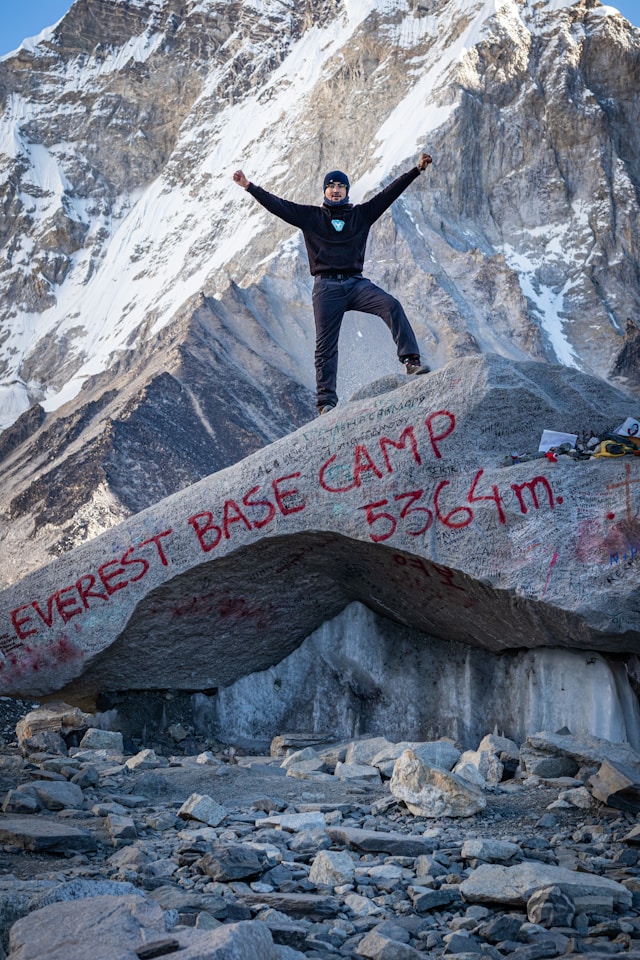
Mount Everest Base Camp Trek - 15 Days

5.0 by 1 Review

Tour Info

trip code

E-001

Starting Point/ End Point

Kathmandu

Accommodations

Lodge/Tea House

Max Altitude

5,545m(at Kala Patthar) / 5,364m (at EBC)

Duration

14 days

country

Nepal

Trip grade

Challenging

Activities

Trekking

Best Season

Spring (March to May) and Autumn (September to November)

Overview

Mount Everest Base Camp Trek offers a direct way to explore the Everest region without needing technical climbing skills. With gradual acclimatization days, it suits trekkers who have good fitness but no high-altitude experience. Route trails go through important Sherpa villages, allowing insights into their culture and way of living, which is deeply influenced by the grand mountains. It further includes a tranquil Tengboche Monastery, enchanting forest trails, river crossings, suspension bridges, and nearby views of glaciers and the Khumbu Icefall. The comfortable tea houses on this journey allow rest stops to balance out the challenge, making it both achievable and rewarding.

Details

One can use the Mount Everest Base Camp Trek if interested in visiting the region without any technical climbing knowledge. Being a low-level trek, it allows acclimatization days, thus, it fits the people who have decent physical fitness but do not have any experience with trekking at altitude. Trekking routes pass quaint but thriving Sherpa villages; thus, you can observe the culture and everyday life of the local population that is tightly connected to the mountains.

Sherpas are known for their unusual strength, friendliness, and humility. They are also the primary people who represent the Khumbu culture and spirituality. Their picturesque mountain villages are not just villages; they are also the embodiment of a thriving nad serene mountain lifestyle, in which everything is interconnected with the magnificent mountains. Sherpas are descendants of Tibetan Buddhism. The surrounding nature is rich with spiritual symbols, including prayer flags fluttering in the wind on the tops of the mountains, stones beautifully carved with spiritual mantras, and chortens found along ancient paths. Known as the outstanding climbers, Sherpas serve as mountain guides, porters, and expedition leaders, practicing animal husbandry, farming, and tourism. 

Living in peaceful villages where stone houses rest in the shadows of snow-topped mountains, breathing air fragrant with incense smoke, villagers are surrounded by harmony and tranquility that merge their way of life, culture, and spirituality. Namche Bazaar village is one of these settlements that can be considered the core of the region or the entrance point to Mount Everest. 

Having been constructed inside an amphitheater created by surrounding hills, the village combines traditional features with trekker's facilities. It includes small hotels operated by locals, cafes, shops, as well as the presence of Buddhist monasteries in the close vicinity of Namche. 

Further down the track, one can find Khumjung, which is an idyllic Sherpa village located under holy mountain peaks. This region takes one through a serene pace of life involving yak herding, cultivation of land, as well as spiritual activities, such as visiting ancient Buddhist monasteries and other sacred sites where the teachings of Buddhism have been kept for several years. Buddhism is evident here from the mani stone walls and the stupa that people visit and circle around for meditation purposes.

The trek also entails walking through beautiful forest trails, traversing serene rivers, using hanging bridges, and exploring humbling glacial areas. Moreover, the spiritual aspect can be observed by walking near Tengboche Monastery during the expedition. The grand icefall of the Khumbu glacier gives one the feeling of the raw natural environment, and the various tea houses provide the needed comfort after the strenuous climb.

All in all, the Everest Base Camp Trek offers a great experience in terms of altitude exploration, Sherpa culture, Buddhist spirituality, and Himalayan villages.
Highlights

  • Stand at Everest Base Camp and see the world’s highest mountain up close.

  • Enjoy scenic flights to and from Lukla, one of the most famous high-mountain airports.

  • Walk through classic Sherpa villages like Namche, Tengboche, and Dingboche.

  • Visit Tengboche Monastery, the spiritual heart of the Khumbu region.

  • Experience wide mountain views of Everest, Lhotse, Ama Dablam, Nuptse, Pumori, and many more. 

  • Reach Kala Patthar

  • Explore Sagarmatha National Park, home to pine forests, rhododendron hills, and high-altitude wildlife. 

  • Learn about Sherpa culture, traditions, and daily life along the trail.

Itinerary

Day 01: Arrival in Kathmandu and Pre-trip meeting

As soon as you arrive in Kathmandu, one of our representatives will pick you up and transfer you to your hotel. After you rest, you meet your trekking guide, who shall provide you with a briefing regarding the trip, itinerary, and required preparations. If you arrive late, the meeting will be held the next day after the city tour. In this session, we finalize the remaining booking procedures, and we gather your passport copy, three passport-sized photographs, and travel insurance information for permits.

  • Max Elevation: 1400 meters (Kathmandu)

  • Travel Distance: 6 to 8 kilometers

  • Travel Hours: 20 to 30 minutes

  • Accommodation: 3-star hotel

  • Meals: Dinner

Day 02: Guided Kathmandu Valley Sightseeing Tour

After breakfast, if you did not have the pre-trip briefing on the day before, you will hold the briefing on this day. Following this, you start your sightseeing trip at around 8 am. The trip is done on a private vehicle and is conducted with the aid of a tour guide. During this sightseeing tourism trip, you shall visit the following heritage sites:

Pashupatinath Temple (UNESCO World Heritage Site):

One of Nepal’s most important Hindu temples, Pashupatinath is dedicated to Lord Shiva and sits along the Bagmati River. Entry is restricted to Hindus, but visitors can observe the temple complex and daily rituals clearly from the eastern bank.

Boudhanath Stupa (UNESCO World Heritage Site):

Boudhanath is a major Buddhist pilgrimage site and one of the largest stupas in Nepal. Built in the 5th century, it features Buddha’s all-seeing eyes and prayer wheels, with devotees circumambulating the stupa in a spiritual procession.

Swayambhunath Stupa (Monkey Temple):

Perched on a hill, Swayambhunath offers panoramic views of Kathmandu Valley. Known as the Monkey Temple for the monkeys living around the site, it is a sacred place for both Buddhists and Hindus.

Kathmandu Durbar Square (UNESCO World Heritage Site): 

This historic palace complex of the Malla kings features ancient temples, courtyards, and museums. It also has a unique 17th-century inscription written in 15 different languages, reflecting Kathmandu’s rich heritage.

Patan Durbar Square (UNESCO World Heritage Site):

Located in Lalitpur, Patan Durbar Square is famous for its elegant Newari architecture from the Malla era. The area showcases traditional craftsmanship, temples, palaces, and a strong artistic legacy.

  • Max Elevation: 1,450 meters (Swayambhunath Stupa)

  • Travel Distance: 25–30 km (total driving)

  • Travel Time: 6–7 hours

  • Accommodation: 3-Star Standard Hotel

  • Meals: Breakfast, Lunch, Dinner

Day 03: Fly to Lukla (2840m) from Kathmandu or Manthali (Ramechhap), Trek to Phakding (2,610 m/8,563 ft)

Your day starts with a flight to Lukla from either Kathmandu or Manthali, depending on the season, as Manthali airport is only around 4 to 5 hours away from Kathmandu. While taking the flight, you have to note that we also provide helicopter flights at an extra cost. Once you reach Manthali, you trek for roughly 3 to 4 hours, giving you plenty of time to settle in your destination - Phakding, regardless of which route you choose. The trek for this day is relatively easy and gives you time to settle into the pace of the trek. 

  • Max Elevation:  2,840 meters (Highest Point Between Kathmandu/Manthali and Lukla)

  • Travel Distance: 8 kilometers

  • Travel Hours: 3 to 4 hours

  • Accommodation: Tea house

  • Meals: Breakfast, Lunch, Dinner

Day 04: Trek from Phakding to Namche Bazaar (3,440m)

On this day, you follow the Dudh Koshi River, crossing many suspension bridges. You pass through pine forests, small villages, and Buddhist monuments as you head towards Monjo. After you pass Monjo, you officially enter the Sagarmatha National Park and head towards Jhorsalle for lunch. The final section of this trek begins at the Hillary Bridge, from where you begin a long climb towards Namche Bazaar. If you make it on a clear day, you can even spot Everest for the first time. The trek for this day is relatively short, as you can complete it in 5 to 6 hours, covering a distance of 11 km. You make an overnight stay at Namche Bazaar once you reach the destination. 

  • Max Elevation: 3,440 meters (Highest Point Between Phakding and Namche Bazaar)

  • Travel Distance: 11 kilometers

  • Travel Hours: 5 to 6 hours

  • Accommodation: Tea house

  • Meals: Breakfast, Lunch, Dinner

Day 05: Acclimatization Day - Namche Bazaar

Day four is all about acclimatization. This day helps your body adjust to a higher altitude. You take a short acclimatization hike to the Sherpa Museum, the Syangboche Airstrip, and the Hotel Everest View. These locations offer you wide and clear views of Everest, Ama Dablam, Lhotse, and Nuptse. After the hike, you return to Namche and explore the shops, cafes, and local bakeries. 

  • Max Elevation: 3,880 meters (Hotel Everest View, highest point between Namche Bazaar and Syangboche)

  • Travel Distance: 4 kilometers

  • Travel Hours: 3 to 4 hours

  • Accommodation: Tea house

  • Meals: Breakfast, Lunch, Dinner

Day 06: Trek from Namche Bazaar to Tengboche (3,870m)

The trail begins with a scenic walk which offers you the views of Everest and Ama Dablam. You walk along an easy path before gradually descending to the Imja Khola, where you can stop for lunch. After crossing the river, you steadily ascend towards Tengboche, which is a small village, home to the popular Tengboche Monastery. It is the largest and most spiritually significant site in this region. Since the trekking duration is roughly 5 to 6 hours, you can still roam around the small village before heading out for the night. 

  • Max Elevation: 3,870 meters (Tengboche, highest point between Namche Bazaar and Tengboche)

  • Travel Distance: 9.2 kilometers

  • Travel Hours: 5 to 6 hours

  • Accommodation: Tea house

  • Meals: Breakfast, Lunch, Dinner

Day 07: Trek from Tengboche to Dingboche(4,360m)

You start the morning by getting views of Ama Dablam, Lhotse, and Mount Everest. You begin by walking through the forests before following a trail towards Pangboche, which is one of the oldest Sherpa settlements. As you ascend, the landscape changes, becoming more open and drier. The trail passes through the chortens, stone walls, and small farm areas as you reach the Imja Valley. After crossing the Imja Valley, you reach Dingbodhe, which is a high-altitude village surrounded by mountain views. Following this, you head towards Dingboche for an overnight stay. 

  • Max Elevation: 4,360 meters (Dingboche, highest point between Tengboche and Dingboche)

  • Travel Distance: 11 kilometers

  • Travel Hours: 5 to 6 hours

  • Accommodation: Tea house

  • Meals: Breakfast, Lunch, Dinner

Day 08: Acclimatization Day

Day seven is another acclimatization day on this trek. This day allows you to prepare for trekking and tourism at higher altitudes. You take a morning hike to Nangkartshang Peak, which offers you views of Ama Dablam, Island Peak, and the Imja Valley. The climb is steady but manageable. Following this ascent, you return to Dingbodhe and spend the day resting, hydrating, and adjusting to the altitude. Doing so allows you to adjust to the higher altitude. 

  • Max Elevation: 4,561 meters (Nangkartshang Peak, highest point between Dingboche and Nangkartshang hike)

  • Travel Distance: 4 kilometers

  • Travel Hours: 3 to 4 hours

  • Accommodation: Tea house

  • Meals: Breakfast, Lunch, Dinner

Day 09: Trek from Dingboche to Lobuche (4,940m)

The trek for this day starts with a gradual climb through open Yak pastures with views of Tawache and Cholatse. You stop for lunch at Thukla before the steep ascent towards the memorial area dedicated to climbers who lost their lives on Everest. The section is a bit demanding on the physique but short. After passing the memorial, you continue towards the Lobuche, where you end the day with an overnight stay. On your way here, you need to pass a rocky path along the side of Khumbu Glacier. 

  • Max Elevation: 4,940 meters (Lobuche, highest point between Dingboche and Lobuche)

  • Travel Distance: 8 kilometers

  • Travel Hours: 5 to 6 hours

  • Accommodation: Tea house

  • Meals: Breakfast, Lunch, Dinner

Day 10: Trek to Gorak Shep (5,170 m) Detour Mt.EBC (5,364m)

You walk along the rocky trail beside the Khumbu glacier and reach Gorak Shep for an early lunch. After resting for a while, you then head towards Everest Base Camp on the glacial and uneven path. Once you reach the base camp, you can see the Khumbu Icefall and the surrounding peaks. After spending some time at the viewpoint, you return to Gorakshep for the night. The trekking duration for the day is 5 to 6 hours, and you cover roughly 13km during this time. 

  • Max Elevation: 5,364 meters (Everest Base Camp, highest point between Gorak Shep and Everest Base Camp)

  • Travel Distance: 13 kilometers

  • Travel Hours: 5 to 6 hours

  • Accommodation: Tea house

  • Meals: Breakfast, Lunch, Dinner

Day 11: Trek from Gorak Shep to Pheriche (4,288m) via Kala Patthar (5,545m)

You begin the day early in the morning to climb the Kala Patthar. This point is a good viewpoint for sunrise around the region. If you time your visit right, you can take photos and enjoy a good sunrise view. After taking in the views, you return to Gorak Shep for breakfast before heading to Pheriche. As you descend, the air becomes thicker, and breathing becomes easier. Once you reach the pheriche, you head towards a guest or a tea house for an overnight stay. The trek for this day is a bit long, lasting for roughly 7 to 8 hours and covering roughly 16 km. 

  • Max Elevation: 5,545 meters (Kala Patthar, highest point between Gorak Shep and Pheriche)

  • Travel Distance: 16 kilometers

  • Travel Hours: 7 to 8 hours

  • Accommodation: Tea house

  • Meals: Breakfast, Lunch, Dinner

Day 12: Trek from Pheriche to Namche Bazaar (3,440m)

Day 11 is all about continuing the descent. You descend from Periche to Pangboche and Tengboche. The trail passes through the forests, river crossings, and familiar sections. As you move along the trek, you gradually descend and reach Namche Bazaar by the late afternoon. The trek is around 7 to 8 hours, and you cover roughly 20 km. Although the duration is long and you cover a long distance, it is relatively easier since the trail is mostly descent. Once you arrive in Namche Bazaar, you can rest or explore the region on your own.

  • Max Elevation: 4,288 meters (Pheriche, highest point between Pheriche and Namche Bazaar)

  • Travel Distance: 20 kilometers

  • Travel Hours: 7 to 8 hours

  • Accommodation: Tea House 

  • Meals: Breakfast, Lunch, Dinner

Day 13: Trek from Namche Bazaar to Lukla (2,800m)

The twelfth day is your final day of trekking, and you trek back along the Dudh Koshi River trail. You cross suspension bridges and pass the Sherpa Villages such as Jorsalle, Monjo, and Phakding. The trekking path for this day is mostly downhill, so although you do have to trek for around 6 to 7 hours and cover a distance of 19km, it is relatively easy. By late afternoon, you arrive in Lukla. You have plenty of time to explore this small town. Alternatively, you can also just rest for the day in your designated lodge or a guest house. 

  • Max Elevation: 3,440 meters (Namche Bazaar, highest point between Namche Bazaar and Lukla)

  • Travel Distance: 19 kilometers

  • Travel Hours: 6 to 7 hours

  • Accommodation: Tea house

  • Meals: Breakfast, Lunch, Dinner

Day 14: Flight back to Kathmandu or Manthali (Ramechhap) from Lukla

On this day, you head back to Kathmandu or Manthali, depending on your destination. Regardless, you take a light breakfast and then pack up. After gathering all your belongings, you head towards the airport for departure. Helicopter options can be arranged if preferred. After landing, you are transferred to your hotel. The evening includes a farewell dinner where you can celebrate the journey, share stories, and enjoy a relaxing return to city comfort.

  • Max Elevation: 2,840 meters (Lukla Airport)

  • Travel Distance: 138 kilometers (Lukla to Kathmandu) or 110 kilometers (Lukla to Manthali by air)

  • Travel Hours: 35 to 40 minutes (Lukla to Kathmandu) or 25 to 30 minutes (Lukla to Manthali)

  • Accommodation: 3-star hotel

  • Meals: Dinner


Day 15: Departure

You wake up early in the morning and pack your bags. According to your flight schedule, we will transfer you to Tribhuvan International Airport. This marks the end of the Everest Base Camp experience as per this itinerary, as you head towards your home on an international flight. Do note that if your documents allow, you can stay for longer or start another tourism and trekking journey with us at Ever Nepal Adventure. 

  • Max Elevation: 1,300 meters (Kathmandu, Tribhuvan International Airport)

  • Travel Distance: 6 to 8 kilometers (Airport transfer)

  • Travel Hours: 20 to 30 minutes (depending on hotel location in Kathmandu)

  • Meals: Breakfast

Note:

During peak trekking seasons (March–June and September–November), flights to Lukla were previously shifted from Kathmandu to Manthali Airport in Ramechhap due to heavy air traffic. This required travelers to drive 4–5 hours from Kathmandu to Manthali before flying to Lukla, and the same applied on the return. This system was used from March 2019 to early 2020. Currently, flights operate from Kathmandu, but the change may return in the future. If it does, it may affect your itinerary, and you will be informed immediately.

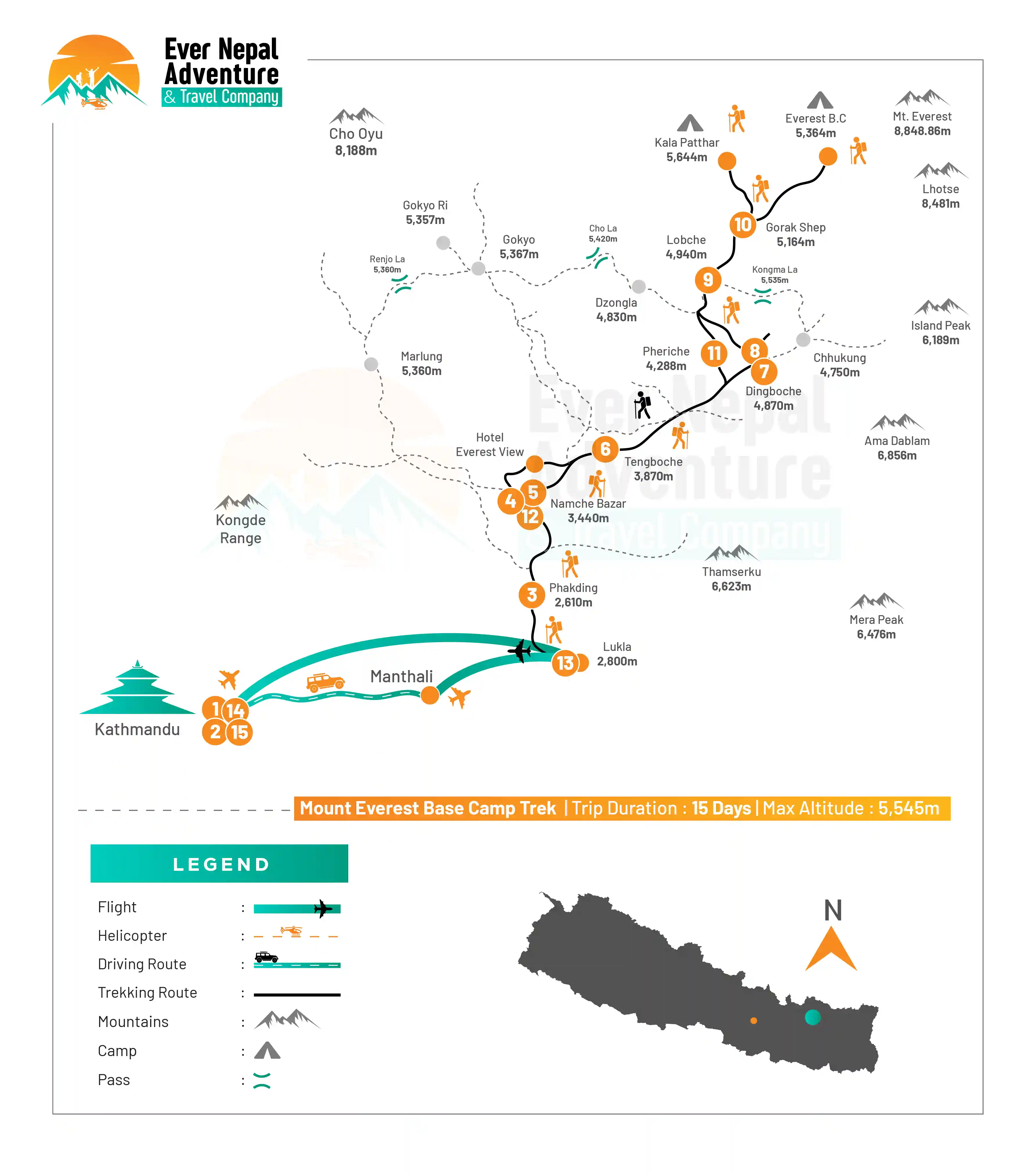
Trek Route

Mount Everest Base Camp Trek Route Map | Ever Nepal

Featured Video

None

Packing List for Mount Everest Base Camp Trek

Since you are going on the ascent of Mount Everest, we suggest that you carry the following items with you on the trek. The Everest Base Camp Trek goes through changing weather, high altitude and cold mountain conditions making it very important to be prepared for the trip. Having the appropriate gear makes sure that you can be warm, comfy, and ready for lengthy hikes.

1. Essential Clothing

  • Thermal tops and bottoms
  • Comfortable trekking t-shirts
  • Warm fleece jacket
  • Heavy down jacket
  • Waterproof outer shell jacket
  • Windproof trekking pants
  • Extra innerwear and socks
  • Light summer clothing for bottom parts

2. Headwear & Protection

  • Warm hat or Cap
  • Sun hat or cap
  • UV sunglasses
  • Sunscreen (high SPF)
  • Use a lip balm for dry weather
  • Headlamp (with spare batteries)

3. Hand & Foot Protection

  • Waterproof gloves
  • Warm insulated gloves
  • Waterproof trekking boots
  • Sandals or camp shoes
  • Thick wool socks
  • Gaiters for snow and/or dusty trails

4. Hygiene & Toiletries

  • Toothbrush and toothpaste
  • Cloth or paper wipes and tissues
  • Small soap and shampoo
  • Hand sanitizer
  • Moisturizer and cold cream
  • Quick-drying towel

5. Trekking Equipment

  • Trekking poles
  • Duffel bag
  • Day backpack
  • Sleeping bag
  • Refillable water bottle
  • Water purification tablets or filter

6. Medical & Safety Items

  • Personal medicines
  • Diamox
  • Blister treatment
  • Pain relief tablets
  • Bandages and anti-septic cream
  • Basic first aid supplies

7. Useful Extras

  • Power bank
  • Mobile phone and Charger
  • Camera or GoPro
  • Snacks, dry fruits
  • Travel adapter
  • Notebook or journal

8. Specific gear for Women

While on a Mount Everest Base Camp Trek; women travelers may carry some extra personal essentials to stay comfortable in changing weather conditions around the Everest region of Mount Everest.

  • Comfortable undergarments
  • Sports bra
  • A sanitary pad or tampon
  • Handbag shampoos and care products
  • Moisturizer and sunscreen
  • Skin cleanser
  • Fleece headband
  • Warm up leggings or tight thermal wear

Documents

It is essential for the trekkers to have some important travel and trekking documentation before embarking on the Mount Everest Base Camp Trek. These papers will be required for permits, identification and emergencies on the trip.

  1. Sagarmatha National Park Entry Permit: Trekkers must obtain this entry permit for Sagarmatha National Park. It is collected in Kathmandu by the NEPAL TOURISM BOARD. Foreign visitors will have to pay NPR 3,000 ($23); SAARC nationals will be charged NPR 1,500 ($10) and Nepalis will be charged NPR 100.
  2. Khumbu Municipality Permit: A local area permit for trekking in the Khumbu is required, the Khumbu Municipality Permit. In general, it's issued at Lukla or Monjo checkpoints. It depends on the trekking area and nationality, ranging from NPR 2,000 to NPR 3,000 per person.
  3. Passport: Foreign trekkers are required to bring their original passport at least 6 months before the date of their arrival in Nepal. Must be used for verification of permits, domestic flights and hotel registration.
  4. Photographs: It helps to keep some fresh passport size pictures for permit applications and in case of an emergency along the trek. A minimum of 2 to 4 copies is recommended to carry.
  5. Travel Insurance: For the Everest Base Camp Trek, it is highly recommended to have some travel insurance with high altitude trekking and emergency helicopter rescue coverage. Weather conditions can change rapidly in the mountains and evacuation by ambulance over long distances is extremely costly and there is inadequate coverage.

What's included

  • Airport pick-up and drop-off using a private tourist vehicle

  • Hotel stay in Kathmandu at a 3-star standard property on a twin/double sharing basis with breakfast

  • Lodge/tea house accommodation during the trek on a twin-sharing basis with meals (MAP plan)

  • Complimentary hot drinks like tea and coffee during the trek

  • All ground transportation in a comfortable private vehicle, as mentioned in the itinerary

  • Domestic flights between Kathmandu and Lukla (round trip)

  • A licensed, English-speaking trek leader, along with an assistant guide

  • Required porters (one porter for every two trekkers)

  • All staff expenses: salary, insurance, gear, domestic flights, food, and lodging

  • A trekking duffel bag, sleeping bag, T-shirt, and map provided by United Nepal Treks & Tours

  • Farewell dinner in Kathmandu featuring a cultural performance

  • All permits and trekking-related documents

  • Medical kit carried by the trek leader

  • All applicable taxes and official charges

  • Guaranteed trip departures

  • Lifetime transferable deposit

  • No booking fees

What's excluded

  • International flights to and from Nepal

  • Nepal entry visa (available on arrival at Tribhuvan International Airport)

  • Travel insurance

  • Personal spending

  • All alcoholic and non-alcoholic beverages

  • City tours and entrance fees (refer to sightseeing and entrance fee details)

  • Lunches and dinners in Kathmandu, plus any extra nights in the city

  • Charges for excess baggage

  •   Tips for guides, porters, and drivers (customary but not mandatory)

Frequently Asked Questions

How difficult is the Everest Base Camp Trek?

The Everest Base Camp Trek is a moderately challenging trek. Trekkers walk for several hours a day on steep and rocky trails and in high altitude. For most travelers, the journey is not so difficult once they are physically fit, acclimatized and prepared.

Which season is best for the trek?

The Everest Base Camp trek is best done in spring (March to May) or autumn (September toNovember). The months are typically dry with a moderate amount of snow, and without any heavy rain or monsoons, winds and weather are generally good, with mountains visible better than in windy winter or monsoon months, and trails are generally in good condition.

What is the altitude of Everest Base Camp?

The elevation of Everest Base Camp is 5364 m (17598 ft) above sea level. The oxygen level is substantially lower from normal at this elevation and they need to be acclimatised throughout the trip with gradual descents to minimise the risks associated with altitude.

Is prior trekking experience necessary?

Experience in trekking is nice but not required. If you are well prepared, walk at a steady pace and make sure to utilize acclimatization days in the trek, then, many first timers manage to complete the Everest Base Camp Trek successfully.

What kind of accommodation is available?

The accommodation on Everest Base Camp route is primarily teahouses and mountain lodges. Most rooms have twin beds and shared bathrooms. The higher elevations offer less luxuries while on the trail, but there is always a warm meal and a comfy spot to rest along the ride.

Can altitude sickness occur during the trek?

The trek does exceed 5,000 meters, so that's indeed one of the concerns is altitude sickness. To avoid the risks of serious altitude sickness, drink sufficient water, take it easy on your feet, get plenty of rest, and follow acclimatization guidelines.

Is Wi-Fi or mobile network available?

Mobile network coverage or paid Wi-Fi is available in many villages along the way; but at high altitudes, it can occasionally be weak. So, it is better not to fully rely on the internet while on your trek.

How long does the Everest Base Camp Trek take?

The typical 5 or 6 days Everest Base Camp Trek is 12 to 16 days as per the trek package offering along with 5 or 6 acclimatisation days and walking pace. Some tours may have additional days for visits of interest or delay due to the weather.

What food is served during the trek?

Teahouse offers food like dal bhat, noodles, pasta, rice, soups, potatoes, eggs and tea. As you ascend, food options become less and less diverse, but food is usually fresh, compact, and meets the energy demands of hiking.

Is hiring a guide necessary?

It is recommended to have a guide particularly for the first time trekker. The guides support navigation, accommodation, altitude monitoring and local information, thus making the trekking a safer and organized experience.

User Review

Reviews and Ratings

5.0
Based on 1 ratings
Read More Reviews