Everest Trek Via Lamjura Pass - 19 Days

Tour Info

trip code

EN-016

Starting Point/ End Point

Kathmandu

Accommodations

Lodge/Tea House

Max Altitude

5545m (Kala Patthar)

Duration

19 days

country

Nepal

Trip grade

Easy

Activities

Trekking

Best Season

March, April, May, September, October, November

Overview

Everest Base Camp Trek is one of the best adventures in Nepal, which takes you to the base of the highest mountain. On this trek, you can witness the beautiful mountain landscape and get familiar with the Sherpa culture. This 18-day trekking and tourism journey combines natural beauty and cultural depth as you follow the traditional routes which have been in use for many decades. 

Details 

The Everest Trek via Lamjura Pass is ideal for you if you want the experience of Everest trekking without the noise and crowd. This is an alternate route that still takes you towards Everest Base Camp (EBC) but away from the popular route filled with crowds. The route is quieter and more cultural. On this route, you pass through routes and regions that most trekkers towards the EBC never see. Because of the low volume of tourists and trekkers on this route, you can see locals living their traditional lifestyle rather than catering to other explorers and trekkers. 

In addition, the ascent on this route is more gradual when compared to the more popular route, allowing you to acclimatize naturally and gradually as you follow the itinerary. The biodiversity in this trek is also filled with dense rhododendron forests, chances of spotting Himalayan wildlife, and a mix of ethnic communities that bring different languages, traditions, and festivals along the trail.
Highlights

  • Arrival in Kathmandu and pre-trek briefing 

  • Full-day guided sightseeing of major UNESCO World Heritage Sites.

  • Drive from Kathmandu to Bamti Bhandar, the trek starting point.

  • Trek through Sethe, Jun Besi, Nunthala, and Bupsa villages.

  • Enter the Everest region via Phakding and continue toward Namche Bazaar.

  • Acclimatisation day in Namche with short hikes and local exploration.

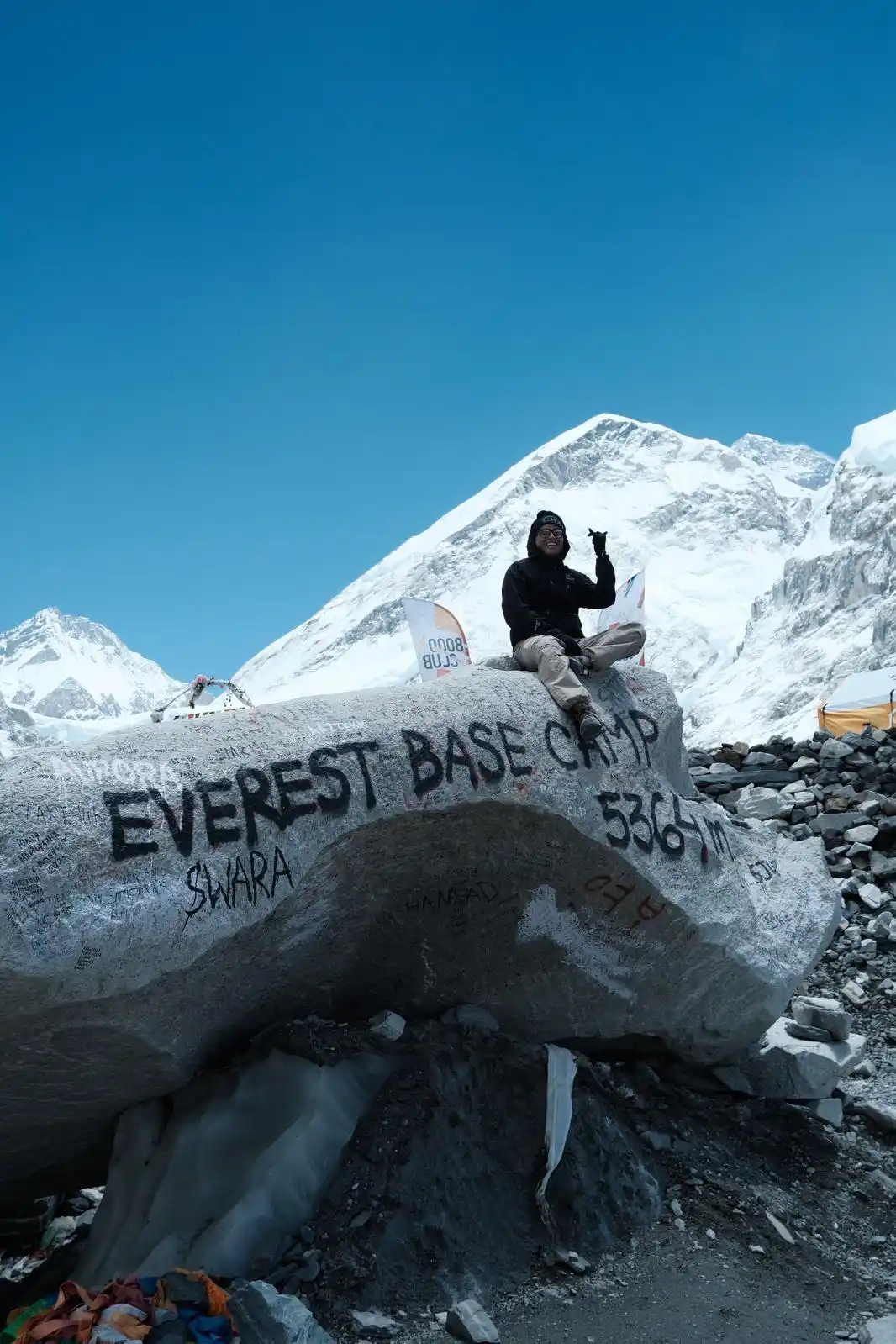
  • Tengboche Monastery-Views of Everest, Ama Dablam, and Lhotse. Continue the trek into Dingboche and on to Lobuche to higher elevation areas. Everest Base Camp via Gorak Shep-5,364m

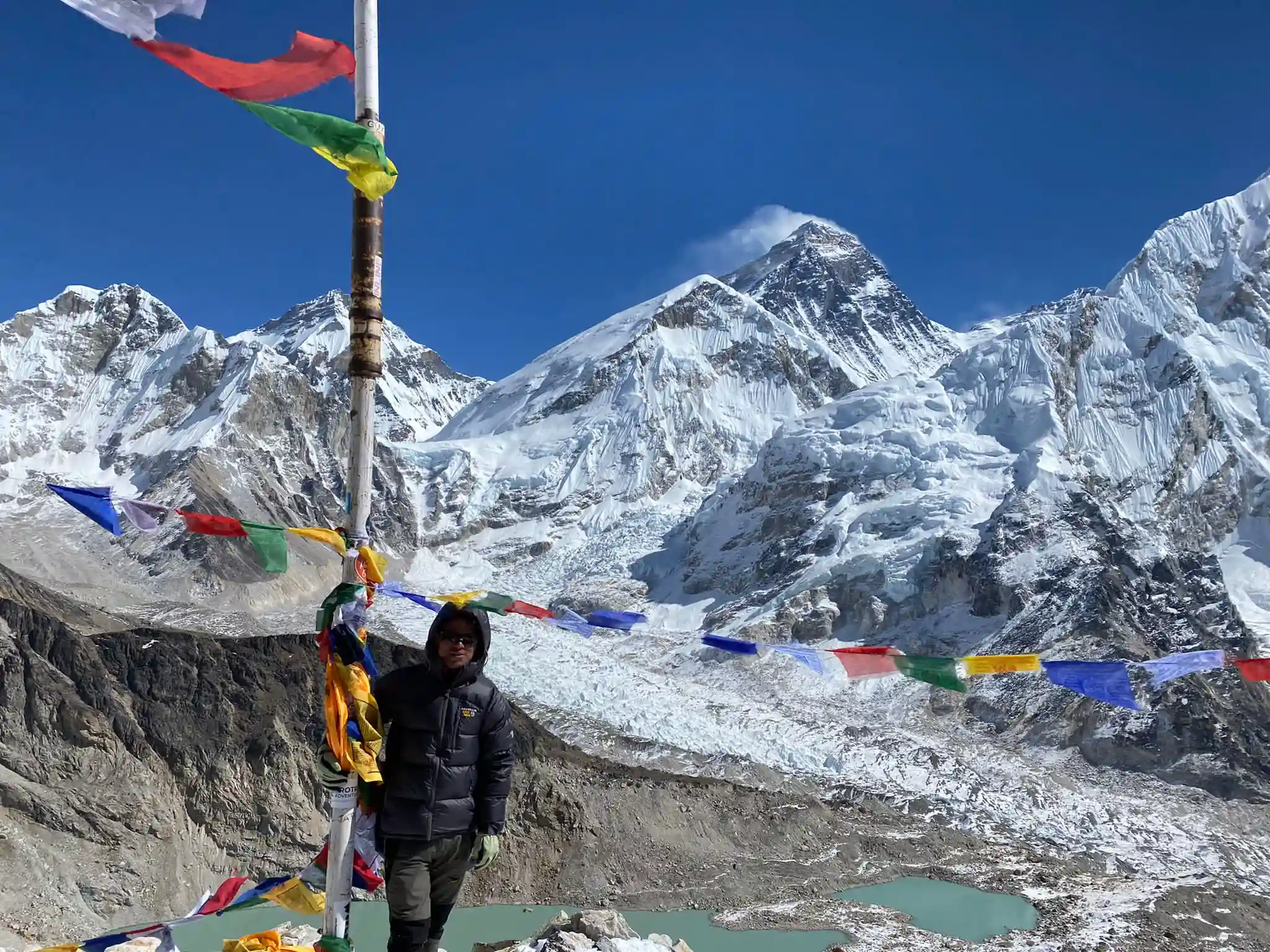
  • Hike to Kala Patthar (5,545m) for panoramic views of Mount Everest. Descend via Pheriche, Phortse, and Namche to Lukla. You end the trek by flying back from Lukla to Kathmandu.

Itinerary

Day 01: Arrival in Kathmandu and Pre-Trip preparation

After your arrival in Kathmandu, our representative from Ever Nepal Adventure will receive and greet you heartly and transfer you to hotel. After a short rest and recovery of jetlag, you meet your trekking and tour guide, who will guide you about the trip. During this meeting, you will learn about the overall itinerary, necessary documents, and other aspects. You can spend the rest of the day roaming the local streets and market.

Overnight in Hotel,Kathmandu

Max Elevation: 1,350meters (Kathmandu)

Travel Distance: 6 to 8 kilometers

Travel Hours:  20 to 30 minutes

Accommodation: 3-4 star hotel

Meals Included: Welcome Dinner

Day 02: A full day guided tour and sightseeing in Kathmandu valley

After breakfast, Ever Nepal Adventure's professional Tour guides will meet you in the hotel to take you on an all-day sightseeing tour by comfortable vehicle. The journey will be planned to allow you enough time for exploration of each destination. Your guide will explain you about the culture, history, and religious significance of each location, helping to give you a better insight into the rich heritage of Kathmandu Valley.

During the tour, you will visit a number of UNESCO World Heritage Sites.

Swayambhunath Stupa (Monkey Temple):

Swayambhunath is one of the ancient Buddhist Stupas which is referred to as Monkey Temple due to its location on a hill in the southwestern region of Thamel. This temple is known to offer beautiful views from its top. It is among the religious monuments in Nepal that are respected by both Buddhists and Hindus. Monkey Temple is named after the monkeys found there.

Pashupatinath Temple:

One of the prominent temples in Nepal is that of Lord Shiva. The temple is located along the river Bagmati. There is a main temple in the pagoda architecture style, apart from other small temples and ghats, where the cremation process is conducted by the Hindus.

Boudhanath Stupa: 

Boudhanath's stupa is the largest Buddhist stupa in the world. It is also a major center for Tibetan Buddhism. The 5th-century stupa features the famous Buddha eyes, which symbolize wisdom and awareness. The stupa has monasteries surrounding it, as well as prayer wheels where pilgrims and monks walk clockwise, chanting their prayers.

Bhaktapur Durbar Square

Bhaktapur Durbar Square used to be the royal palace for the Malla kings. It is still one of the best examples of the Newari architectural tradition. This square is known for the beautifully carved Temples, Courtyards, and Historical Structures. The 55-Window Palace is one of the most important highlights, as are the Nyatapole Temple and the Golden Gate. All three showcase the artistic legacy of medieval Nepal.

After the tour, return to the hotel for the evening. Spend the rest at leisure, reflecting on the cultural experience of the day.

Overnight in Hotel,Kathmandu

Max Elevation: 1,450 meters (Swayambhu)

Travel Distance: 25 to 30 kilometers (total driving between sites)

Travel Hours: 6 to 7 hours

Accommodation: 3-4 star hotel

Meals Included: Breakfast 

Day 03: Drive from Kathmandu to Bamti Bhandar(2,255m)

On the third day of trip, you begin your journey towards the Everest region.This day is all about driving from Kathmandu to Bamti Bhandar or Shivalaya via Ghaurishanker conservation region.The drive is a long one as it lasts for roughly 9 to 10 hours. During this drive, you cover a distance of around 235 km, and you could see and encounter many village of different ethinic group,terrace field, forests, and river valleys.At the same time, you pass through many hills around the towns. Once you reach the destination  of Bhamti Bhander village(2990m) which is known as Chyangma among local community,situated on a flat hilltop plain above Likhu River.

Overnight in Bhamti Bhander Village

Max Elevation: 2,255 meters 

Travel Distance: 235 kilometers

Driving Hours: 9 to 10 hours

Accommodation: Tea house or a lodge

Meals Included: Breakfast, Lunch, Dinner

Drinks: Tea,coffee,Hot water & purified water

Day 04: Trek from Bamti to Sethe (2,575m/8446fts)

You officially commence your trek on the fourth day. The trek begins a descent to Kinja and Likhu river and takes you through many terraced farms and small villages of sherpa and other ethinic group .Then you will ascend to our destination of Sethe village.This trail has both up and downhill sections, which makes it a bit draining on your body. Along the way, you explore the traditional lifestyle of the Himalayan people. You can also see traditional Himalayan houses with a distinct form of architecture. This day ends with your arrival at Sethe. 

  • Max Elevation: 2,575 meters (Highest Point Between Bamti Bhandar and Sethe)

  • Travel Distance: 10.5 kilometers

  • Travel Hours: 5 to 6 hours

  • Accommodation: Overnight stay at a tea house or a lodge

  • Meals Included: Breakfast, Lunch, Dinner

Day 05: Trek from Sethe-Jun Besi via Lamjura Pass(3530m)

The destination for this day is Jun Besi village in the Solu Khumbu district. On this trek, you pass through small forests and open ridges, during which you can see the surrounding hills and valleys. You also need to cross Lamjura Pass, which is the highest point of the day. The day’s route gives a clear sense of the changing altitude and terrain as you move deeper into the Khumbu region. After a 7 to 8-h no our trek, you arrive at your destination, where you rest and recover for the evening.  

  • Max Elevation: 3,530 meters (Highest Point Between Sethe and Jun Besi via Lamjura Pass)

  • Travel Distance: 14 kilometers

  • Travel Hours: 7 to 8 hours

  • Accommodation: Overnight stay at a tea house or a lodge

  • Meals Included: Breakfast, Lunch, Dinner

Day 06: Trek from Jun Besi- Nunthala via Taksindu Pass(2930m)

The sixth day of this trekking and tourism journey is about gradually ascending to Taksinddu Pass and then descending towards Nunthala. On your way to the destination, you pass through rhododendron forests, small farmlands, and many small villages. This 6 to 7-hour trek offers a mix of moderate climbs and gentle descents, preparing you for the treks at higher elevations. 

  • Max Elevation: 3,120 meters (Highest Point Between Jun Besi and Nunthala via Taksindu Pass)

  • Travel Distance: 12 kilometers

  • Travel Hours: 6 to 7 hours

  • Accommodation: Overnight stay at a tea house or a lodge

  • Meals Included: Breakfast, Lunch, Dinner

Day 07: Trek from Nunthala-Bupsa Village( 2360m)

For the seventh day of the trek, your destination is Bupsa Village. You descend to the Dudh Koshi river and then slowly climb towards Bupsa through the forests and fields. Although the activities for this day are limited, the view makes up for it. During this trek, you can see and enjoy the local Rai community and culture. This is a relatively mild trekking day, so you can roam the village after you reach your destination. 

  • Max Elevation: 2,720 meters (Highest Point Between Nunthala and Bupsa Village)

  • Travel Distance: 10 kilometers

  • Travel Hours: 5 to 6 hours

  • Accommodation: Overnight stay at a tea house or a lodge

  • Meals Included: Breakfast, Lunch, Dinner

Day 08: Trek from Bupsa village- Chauri Kharka/ Phakding

The trail on the Everest Trek Via Lamjura Pass continues on the 8th day through the small forests and along the banks of Dudh Koshi River. On this day, you pass through many small settlements and farmlands before you join the main Everest trekking route. Following the main route, you reach your destination for the day - Phakding - a small village in the Khumbu region of Nepal, after a 6 to 7-hour long trek. 

  • Max Elevation:  2,610 meters (Highest Point Between Bupsa Village and Phakding)

  • Travel Distance: 12 kilometers

  • Travel Hours: 6 to 7 hours

  • Accommodation: Overnight stay at a tea house or a lodge

  • Meals Included: Breakfast, Lunch, Dinner

Day 09: Trek from Phakding to Namche Bazaar (3438m/11280ft)

Following your stay at Phakding, you follow the Dudh Koshi river and cross multiple suspension bridges, including the popular Hilary Bridge. Then you take a steep ascent near the end, which leads to Namche Bazaar. This is your destination for the day, and reaching this point marks the mid-point of your Everest Trek Via Lamjura Pass. Namche Bazaar offers markets, shops, and lodges, and is an important hub for acclimatisation before higher altitude trekking.

  • Max Elevation: 3,440 meters (Highest Point Between Phakding and Namche Bazaar)

  • Travel Distance: 10 kilometers

  • Travel Hours: 5 to 6 hours

  •  Accommodation: Overnight stay at a tea house or a lodge

  • Meals Included: Breakfast, Lunch, Dinner

Day 10: Acclimatisation in Namche Bazaar (3,438m/11,280ft)

On this day, you rest and take a short hike if you want to. Nothing is compulsory on this day as it is meant for acclimatisation. That said, if you want to, you can take a short hike to nearby viewpoints and visit local attractions such as the Sherpa Museum. This day allows you to acclimatise properly and prepare for the subsequent higher elevation sections of the trek.

  •  Max Elevation: 3,860 meters (Highest Point Between Namche Bazaar and Everest View Point)

  • Travel Distance: 5 kilometers (round trip optional hike)

  • Travel Hours: 3 to 4 hours

  • Accommodation: Overnight stay at a tea house or a lodge

  • Meals Included: Breakfast, Lunch, Dinner

Day 11: Trek from Namche Bazaar to Tengboche (3870m/12697 ft)

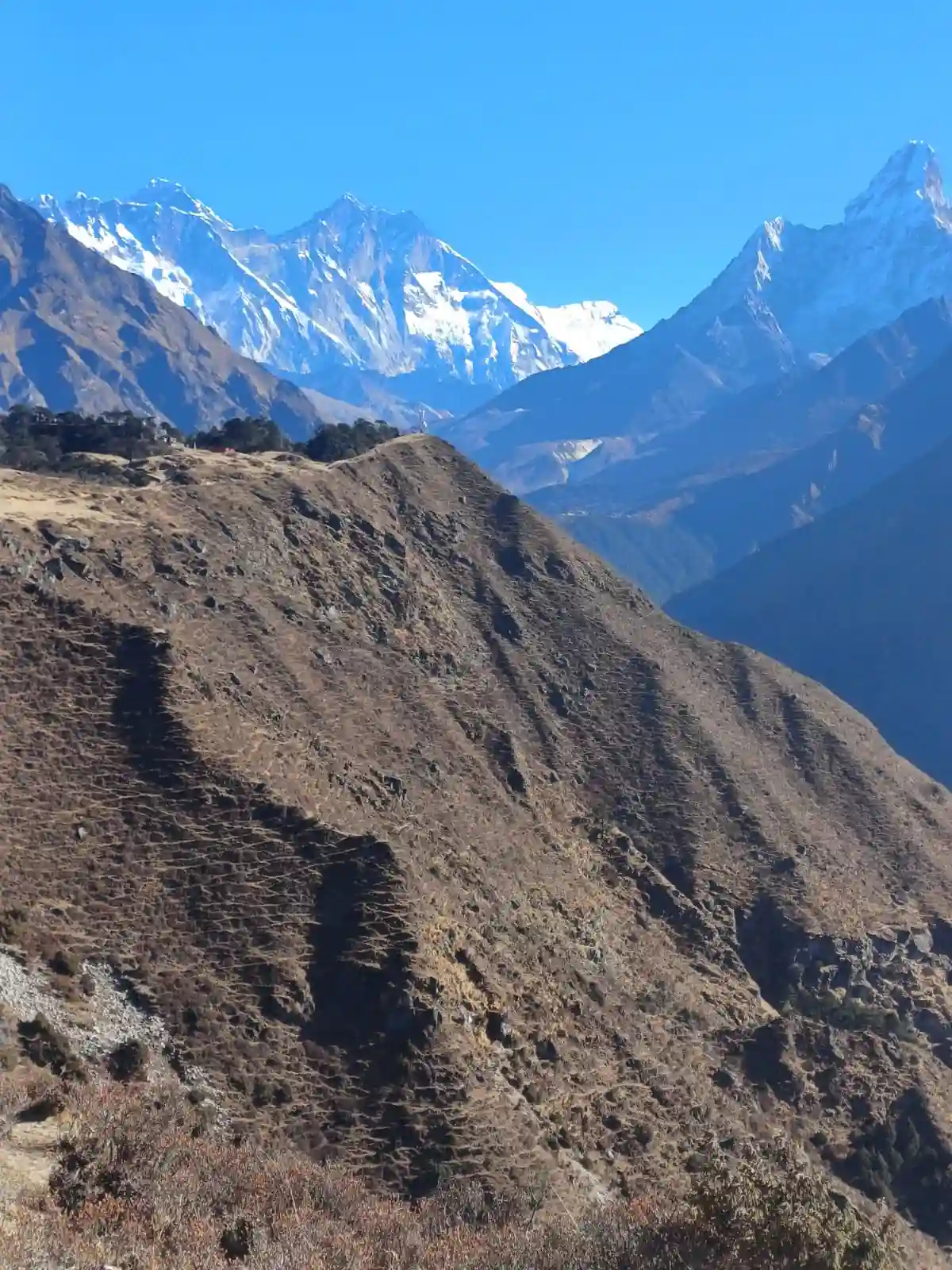
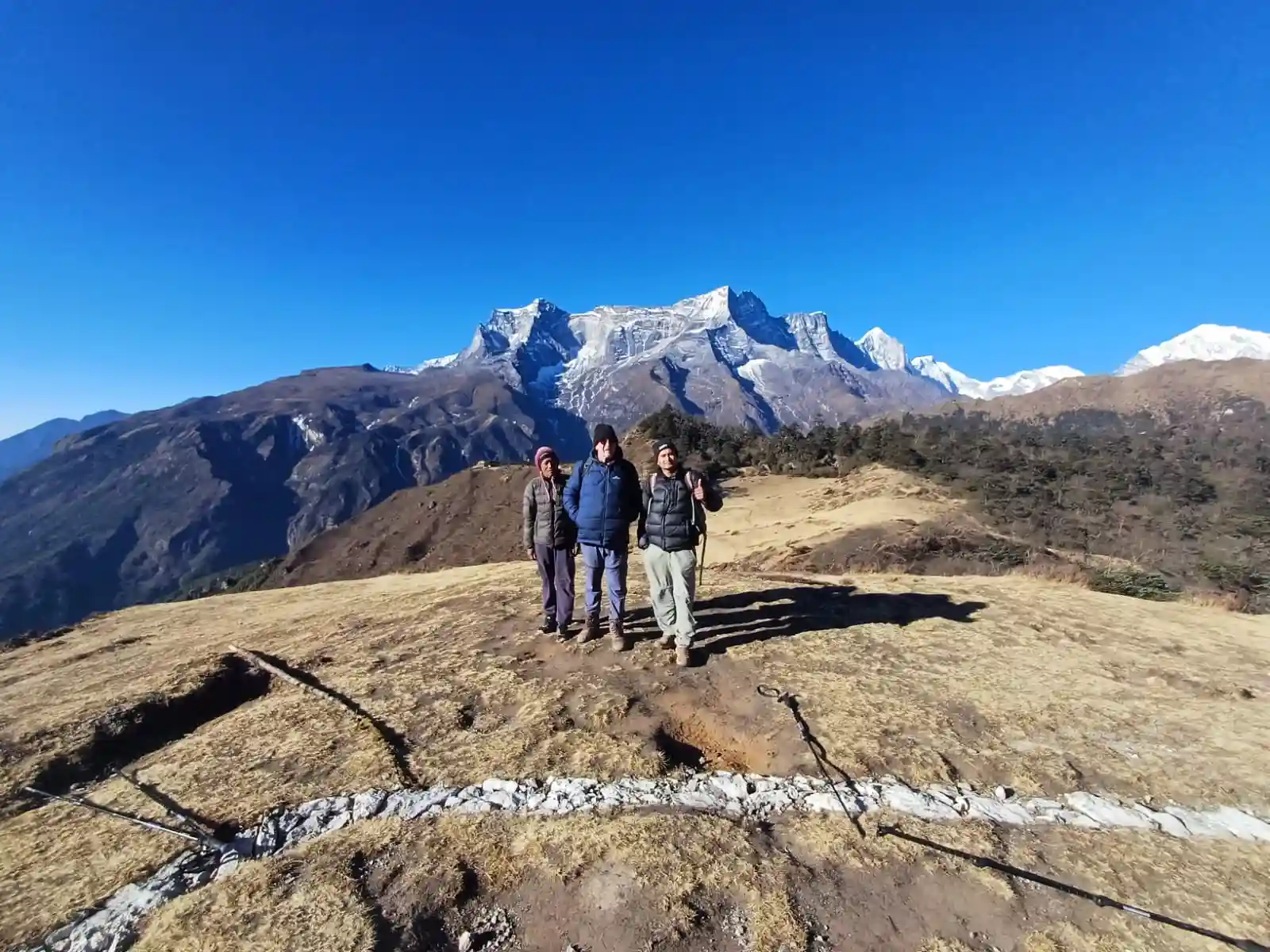
You begin the day by descending a bit towards the Dudh Koshi River. Following this slight descent, you slowly ascend towards the destination - Tengboche. The village is known for the Tengboche Monastery, and from here you can view many Himalayan peaks such as Ama Dablam, Mount Everest and Mount Lhotse. You can roam around the village for some time before heading off to rest, as the trek for this day is only around 5 to 6 hours, leaving you with a bit of extra time. 

  • Max Elevation: 3,870 meters (Highest Point Between Namche Bazaar and Tengboche)

  • Travel Distance: 9.5 kilometers

  • Travel Hours: 5 to 6 hours

  • Accommodation: Overnight stay at a tea house or a lodge

  • Meals Included: Breakfast, Lunch, Dinner

Day 12: Trek from Tengboche to Dingboche (4360m/14305ft)

As you start the journey on the 12th day, you pass Pangboched village and follow the Imja Khola Valley. While walking on this trail, you can see the surroundings being more alpine with fewer trees, a rocky path, and wide mountain views. After a trek of roughly 5 to 6 hours, you reach your destination of Dingboche, located at an altitude of 4360m. This is a village with a few lodges providing simple accommodation and simple meals.

  • Max Elevation: 4,360 meters (Highest Point Between Tengboche and Dingboche)

  • Travel Distance: 11 kilometers

  • Travel Hours: 5 to 6 hours

  • Accommodation: Overnight stay at a tea house or a lodge

  • Meals Included: Breakfast, Lunch, Dinner

Day 13: Acclimatisation day-Dingboche (4360m/14305ft)

This is another day that is reserved for acclimatisation. As with your previous acclimatisation day, you can relax at your lodge or visit local attractions. The attractions that you can visit include Nagarjun Hill and Nangkartsang. Both of these locations offer you a clear view of the surrounding mountains and are near the village. After visiting these locations, you can spend the day walking around the village or resting. Although you can rest for the entire day, light activity is recommended for getting used to low-oxygen terrain. 

  • Max Elevation: 4,360 meters (Highest Point in Dingboche)

  • Travel Distance: 6 kilometers (Short Hikes around Dingboche)

  • Travel Hours: 4 to 5 hour

  • Accommodation: Overnight stay at a tea house or a lodge

  • Meals Included: Breakfast, Lunch, Dinner

Day 14: Trek from Dingboche to Lobuche (4940m)

After a day of acclimatisation at Dingbodhe, you resume your trek towards the destination of Lobuche. The trail towards this village is alpine with a rocky landscape. Along the way, you pass Dughla - a memorial area dedicated to the climbers who lost their lives while climbing Mount Everest. The path towards Lobuche is steep, and therefore, you need to ascend it slowly. After a long day of trekking a steep path, you reach your destination, where you can rest.

  • Max Elevation: 4,940 meters (Highest Point Between Dingboche and Lobuche)

  • Travel Distance: 8 kilometers

  • Travel Hours: 5 to 6 hours

  • Accommodation: Overnight stay at a tea house or a lodge

  • Meals Included: Breakfast, Lunch, Dinner

Day 15: Trek to Gorak Shep (5,170 m) Detour Mt.EBC (5,364m)

The trek begins with a moderate ascent to Gorak Shep. Once you reach here, you leave your heavier luggage and head towards the Everest Base Camp (EBC). To reach EBC, you need to cross moraines and walk through rocky terrain. Once you reach base camp, you can observe the Khumbu Icefall and the other surrounding mountains. After spending some time at the base camp, you return to Gorakshep for an overnight stay.

  • Max Elevation: 5,364 meters (Highest Point Between Gorak Shep and Everest Base Camp)

  • Travel Distance: 12 kilometers

  • Travel Hours: 6 to 7 hours

  • Accommodation: Overnight stay at a tea house or a lodge

  • Meals Included: Breakfast, Lunch, Dinner

Day 16: Trek from Gorak Shep to Pheriche (4,288m) via Kala Patthar (5,545m)

You wake up early in the morning to take a hike towards the Kala Patthar, which is the best viewpoint to observe Mount Everest and other peaks. This is a steep ascent which requires a bit more care but is manageable with some planning. Once you enjoy the view at Kala Patthar, you head down the trail towards Periche. The descent allows your body to adjust gradually to an oxygen-rich atmosphere. Once you reach your destination, you stop for an overnight stay.

  • Max Elevation: 5,545 meters (Highest Point Between Gorak Shep and Pheriche via Kala Patthar)

  • Travel Distance: 10 kilometers

  • Travel Hours: 6 to 7 hours

  • Accommodation: Overnight stay at a tea house or a lodge

  • Meals Included: Breakfast, Lunch, Dinner

Day 17: Trek from Pheriche to Phortse(3,810m)

At this point, you are already on the return trip, and on this day, you trek to Phortse. On this journey, you pass small Sherpa villages and slowly reach your destination for the day. Phortse is a relatively less crowded village which offers a quieter ambience when compared to villages on the main route. The day ends with an overnight stay at a local tea house or a lodge.

  • Max Elevation: 3,810 meters (Highest Point Between Pheriche and Phortse)

  • Travel Distance: 12 kilometers

  • Travel Hours: 5 to 6 hours

  • Accommodation: Overnight stay at a tea house or a lodge

  • Meals Included: Breakfast, Lunch, Dinner

OR

Day 17: Trek from Pheriche to Namche(3438m)

On the seventeenth day of your trek and tourism journey, you head down to Namche Bazaar as your destination. On the trekking trail, you pass through forests and small villages. The trek is relatively short, lasting only around 5 to 6 hours. By the time you reach the Namche Bazaar, the sun will still be up, so you have plenty of time to enjoy the tourism aspect of the journey. You end the day with an overnight stay at a local tea house or a lodge.

  • Max Elevation: 3,438 meters (Highest Point Between Pheriche and Namche)

  • Travel Distance: 13 kilometers

  • Travel Hours: 5 to 6 hours

  • Accommodation: Overnight stay at a tea house or a lodge

  • Meals Included: Breakfast, Lunch, Dinner


Day 18: Trek from Namche Bazaar to Lukla (2,800m)

As the second last day of this trekking and tourism journey, you retrace your way back to Lukla from Namche Bazaar. You cross the Dudh Koshi river and cross a few suspension bridges as you move past Phakding and other small to medium-sized villages before reaching Lukla. On this day, you trek for around 6 to 7 hours. Once you reach your destination for the day, you stop for an overnight stay at a local tea house or a lodge.

  • Max Elevation: 3,438 meters (Highest Point Between Namche Bazaar and Lukla)

  • Travel Distance: 18 kilometers

  • Travel Hours: 6 to 7 hours

  • Accommodation: Overnight stay at a tea house or a lodge

  • Meals Included: Breakfast, Lunch, Dinner

Day 19: Fly back to Kathmandu

On the final day of your trekking/ tourism journey, you take a short flight from Lukla to Kathmandu. The flight only takes around 20 to 30 minutes, and they generally depart early in the morning. So you need to be well prepared. Once you reach Kathmandu, you have the rest of the day free, and you can spend it either roaming the streets, visiting local cafes or resting at your hotel.

  • Max Elevation: 2,800 meters (Lukla Airport)

  • Travel Distance: 135 kilometers (Lukla to Kathmandu by air)

  • Travel Hours: 2o to 30 minutes

  • Accommodation: Overnight stay at a tea house or a lodge

  • Meals Included: Breakfast

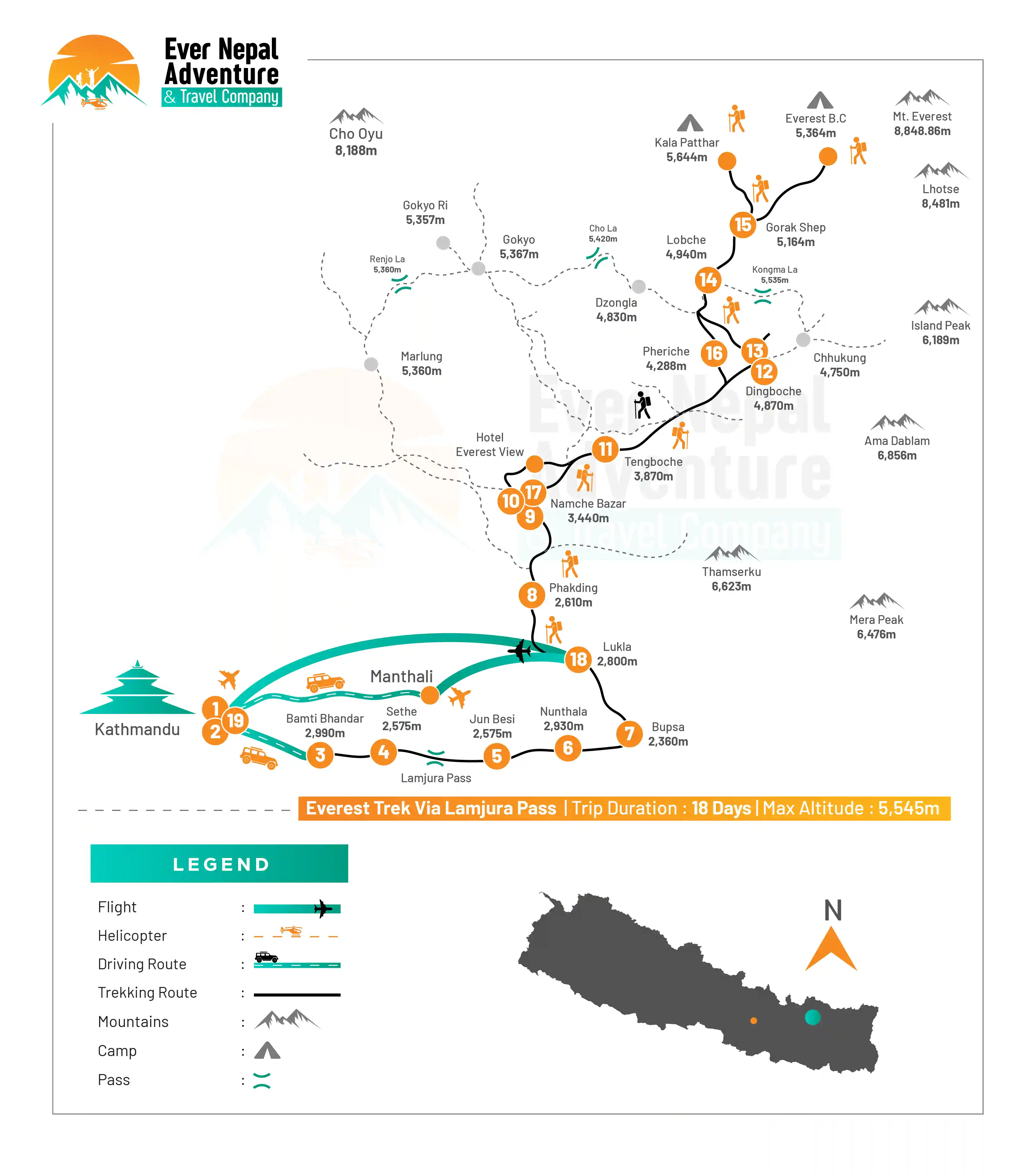
Trek Route

Everest Lamjura Pass Route Map | Ever Nepal

What's included

  • Airport transfers to and from the hotel by private tourist vehicle.

  • Accommodation in standard guesthouses on a twin-sharing basis during the trek, with meals provided on a MAP plan (Breakfast and Dinner).

  • Hot beverages (tea or coffee) are served three times a day with meals.

  • All overland transportation in a private, comfortable luxury vehicle as per the itinerary.

  • Domestic round-trip flights between Kathmandu and Lukla.

  • Professional, government-licensed, and English-speaking trekking guide throughout the journey.

  • Wages, insurance, meals, domestic airfare, accommodation, and necessary equipment for trekking staff.

  • Complimentary United Nepal Treks & Tours duffel bag, T-shirt, and trekking map.

  • Farewell dinner with a traditional cultural performance in Kathmandu.

  • Required trekking permits and documentation.

  • Basic medical kit.

  • All applicable government taxes and official service charges.

  • Guaranteed trip departures and lifetime deposit policy.

  • No booking or hidden service fees.

What's excluded

  • A Nepal entry visa can be easily obtained upon arrival at Tribhuvan International Airport in Kathmandu.

  • Travel insurance covering emergency evacuation and medical expenses.

  • Personal expenses of any kind.

  • Alcoholic and non-alcoholic beverages, including soft drinks and bottled water.

  • Charges for hot showers, battery charging, Wi-Fi access, and electric blankets during the trek.

  • Lunches and dinners in Kathmandu, as well as any additional nights beyond the itinerary.

  • Costs for excess baggage on domestic flights.

  • Tips  for guides and support staff.

Packing List for Everest Trek Via Lamjura Pass

The trek through Lamjura pass (Jiri to Everest route) is long and strenuous with different weather conditions and remote trails. Pack light but smart, it's a key point for safety and comfort.

Head

  • Warm woolen beanie
  • Wide-brim sun hat
  • UV-protected sunglasses
  • Headlamp (extra batteries included)
  • Lip balm with SPF
  • High SPF sunscreen
  • Neck gaiter or buff

Hands

  • Waterproof gloves
  • Warm insulated gloves

Upper Body

  • Moisture-wicking base layers
  • Fleece jacket
  • Down insulated jacket
  • Waterproof/windproof shell jacket
  • Quick-dry t-shirts
  • Long-sleeve trekking shirts
  • Lightweight puffy jacket

Lower Body

  • Thermal innerwear
  • Hiking pants (2 to 3 pairs)
  • Waterproof trousers
  • Fleece pants are suitable on cold nights

Footwear

  • Excellent waterproof trekking boots
  • A comfortable pair of sandals (for Teahouse use)
  • Wool trekking socks (4 to 6) pairs
  • Gaiters (helpful in the snowy/muddy sections)

Toiletries

  • Toothbrush and toothpaste
  • Toilet paper
  • Hand sanitizer
  • Hand and hair soap (travel size)
  • Quick-dry towel
  • Moisturizer and sunscreen

Accessories

  • Trekking poles
  • Daypack (20L to 30L)
  • Large duffle bag
  • Water Beverage (reusable) / Hydration Bladder
  • Water purification tablets/filter
  • Sleeping bag ( -10°C or lower)

First Aid Kit

  • Diamox (altitude sickness)
  • Painkillers
  • Know how to treat blisters and bandages
  • Antiseptic wipes
  • Anti-diarrhea medicine
  • Personal medicines

Miscellaneous

  • Power bank
  • Charging cable & adapter
  • Camera/phone
  • Snacks (energy bars and nuts)

Specific gear for Women

On an Everest Trek Via Lamjura pass trek women travellers can carry a few extra essentials for their comfort during variable weather conditions around the Everest region of Mount Everest.

  • Comfortable undergarments
  • Sports bra
  • A sanitary pad/tampon
  • Travel shampoo and toiletries
  • Moisturizer and sunscreen
  • Skin cleanser
  • Fleece headband
  • Wear leggings or tight thermal wear for warm up

Documents

Some documents are essential for getting to Everest Trek through the Lamjura Pass route. These are a must-have when applying for permits; keeping an eye on safety, or accessing the Everest region. The following documents will be needed:

  • Sagarmatha National Park Permit: This permit is a must have for entry into the Sagarmatha National Park. It can be procured from the Nepal Tourism Board, Kathmandu. The foreign nationals have to pay NPR 3,000 ($23) and the SAARC nationals have to pay NPR 1,500 ($10) while Nepali nationals have to pay NPR 100.
  • TIMS Card (Trekkers Information Management System): The card needed to be used for trekking registration and safety tracking on the trek. Can be issued in Kathmandu or through a licensed trekking agency. Individuals will pay NPR 2000 ($15) and those who trek via an agency will pay NPR 1000 ($10).
  • Passport: Passport with original and at least 6 months validity from the date of entry into Nepal. As, it is required for identification, issuance and official verification for the trek.
  • Passport Size Photos: At least 2 to 4 passport size photos are required; for the permit application and registration process. It's always helpful to have extras in case they're needed on the trip.
  • Travel Insurance: Travel insurance is compulsory; for this trek and essential to cover high altitude trekking and emergency helicopter evacuation. This is significant because the way traverses far back and up into the mountains where health care is limited.

Frequently Asked Questions

What is the Everest Trek Via Lamjura Pass route?

This route is a part of the old and well-known Jiri to Everest trail which leads to the Lamjura Pass and leads into the main Everest region. Higher than Lukla trail but with less steepness, traditional villages and less crowded with people, hence more authentic trekking experience.

How difficult is the Lamjura Pass section?

Lamjura Pass is quite demanding because of steep ascents, long hours of walking and variable weather conditions. One of the highest points of the Jiri ride. It is best to have good fitness, go at a slow pace and acclimatize properly to crossing it without getting too tired or having altitude problems.

How many days does this trek take?

Typically the Everest Trek via Lamjura Pass lasts for 18 to 22 days based on trek speed and acclimatization stops. It is a lower altitude (Jiri) route and therefore takes longer than the Lukla route, but can be useful for acclimatising the body before ascending to the high altitudes of Everest.

Do I need special permits for this route?

Yes, trekkers must need to have a Sagarmatha National Park permit and a TIMS card. These are needed for entry, safety tracking and for conservation support. Unless these permits are obtained, no one can enter the Everest region and hike in controlled areas.

Is altitude sickness a concern on this route?

Yes, it is possible to get altitude sickness since the hike takes on gradually ascending high altitudes. Its ascent is slower than Lukla, however, which helps minimise risk. Rest, appropriate pacing and water breaks are still extremely crucial for safe running.

What is the best time for this trek?

Spring (March to May), and autumn (September to November) are the best seasons. These months have clear skies, predictable weather and better views of the mountains. Winter can be very cold and monsoon can make trails slippery and unsafe particularly in the lower hill regions.

What kind of accommodation is available?

The main accommodation is teahouse and local lodges. The rooms are basic and have twin beds and a shared bathroom. Along the Lamjura trail lodging is very simple and lacks amenities compared with the main path of Everest but there is food and shelter on the way.

Is this route suitable for beginners?

It can be used by fit beginners with the ability to do long walking days. Climbing slowly allows time to acclimatise but it takes a long time. It is recommended that the route is done after basic trekking preparations and after having good physical fitness.

What food is available during the trek?

Teahouses provide simple meals such as dal bhat, noodles, rice, soups, potatoes and eggs. This allows travellers to maintain energy levels throughout the long trek, as food options become more limited the higher you get.The food is more limited in this area with the higher altitudes while at the same time it is freshly prepared and packed with energy.

Do I need prior trekking experience?

Experience is not compulsory but will help. It is longer and is farther from the standard Everest hiking path, so for a smoother expedition, it is very recommended to prepare the walking endurance, cardio fitness and mental readiness.

User Review