Dhorpatan Trek 14 Days Journey

Tour Info

trip code

EN-41

Starting Point/ End Point

Kathmandu

Accommodations

Lodge/ Tea House

Max Altitude

4000m (Phagun Danda Viewpoint)

Duration

14 days

country

Nepal

Trip grade

Moderate

Activities

Trekking

Best Season

March, April, May, September, October, November

Overview

Dhorpatan Trek is one of the best treks in Nepal. You will be taken to some of Nepal's remotest regions, far from the busy Everest-Annapurna trail. This trail will lead you into Nepal's only hunting preserve, which offers you the rare combination of wilderness, traditional mountain life, and raw landscapes. This journey brings you into the Dhorpatan and lush hills in western Nepal.

This 14-day journey is ideal for anyone who wants to explore the quieter side of the Himalayas. The journey begins in Kathmandu. From there, it moves on to Pokhara. After that, the route takes you through Beni and Darbang into the foothills. From here, the path gradually ascends to the Dhorpatan grasslands via dense forests and terraced fields. The trail continues on to higher ridges where forested camps are located before looping around traditional settlements in order to return to Pokhara or Kathmandu. This moderate hike offers a unique blend of natural wonders, cultural encounters and exploration off the beaten track.

Details

Dhorpatan Trek offers a journey unlike any other. It connects the mid-hills region of western Nepal to the alpine landscapes found in the Dhorpatan Hunting Reserve. The trail has a pristine environment with diverse ecosystems. It also offers a rich cultural heritage. This is an entirely different trekking experience from Nepal's most commercial routes.

The journey begins in Pokhara with a scenic driving tour to Darbang through Beni. This is where the trek starts. The path climbs gradually through the forests between Dharapani (with rhododendron forests) and Lamsung (with pine forests). With higher altitudes come high ridges and views that emerge, especially around the area of Jaljala. From here, one can see the Himalayas.

The route for Dhorpatan Trek leads further down through the dense greenery of the flatlands of Dhorpatan. The area has undulating terrain and far-off mountain ranges, making it a serene place. This is home to the Magar community, who have an intimate connection with nature. Dhorpatan leads to Phagun Phedi via a jungle-camp experience.

Phagun Danda hike is a highlight of Dhorpatan Trek . It offers panoramic views across endless ridgelines with untouched landscapes. The return path follows Gurjaghat through Patichaur. It gradually descends into lower elevations before returning to Darbang. The journey is concluded with a trip back to Pokhara.

Dhorpatan Trek  offers a unique experience for travelers who want to enjoy the wilderness, culture, and solitude in Nepal.
 

Highlights

  • Dhorpatan Region: Explore its remote, untouched beauty
  • Trek through the one hunting reserve in Nepal
  • Explore diverse landscapes, including subtropical and alpine forests.
  • Explore the traditional Magar culture and its unique villages.
  • Wander through dense forests and high ridges to wide open grasslands.
  • Jaljala, Phagun Danda and other panoramic viewpoints offer breathtaking views.
  • Enjoy an overnight jungle camping experience in a remote Himalayan environment.
  • Trek along less-crowded trails that are far from commercial routes
  • In a protected area, you can see a large variety of plants and animals.
  • Western Nepal is a great place to start and finish your journey.

Itinerary

Day 1: Welcome to Kathmandu!

Kathmandu's vibrant capital is where the adventure begins. As you step off the plane, you can immediately feel the energy that the city has to offer. Here, ancient traditions coexist alongside modern life. Then, after a warm welcome, you'll be taken to your hotel. After a warm welcome, you transfer to your hotel and settle in.

As you walk along the nearby streets, colorful shops, local eateries, and the rhythms that accompany daily life are all around you. Prayer flags flutter in the wind above narrow lanes. Temple bells can be heard far away. This is a perfect introduction to Nepal, before heading off into the quieter, more remote regions. In the evening, we prepare for our journey and enjoy a peaceful night.

  • Max Elevation: 1,400 meters (Kathmandu)
  • Travel Distance: 5–7 kilometers (airport transfer)
  • Travel Hours: 20–30 minutes
  • Accommodation: 3-star hotel
  • Meals Included: Dinner

Day 2: Explore Kathmandu

Following your breakfast, you will be picked up by your guide from Ever Nepal Adventure, who will take you on a full-day tour of all the major sights in Kathmandu Valley. You will have enough time to see all these attractions slowly. You will also get information on the importance of these sites from a cultural, religious, and historical point of view.

Some of the heritage sites you will be visiting today are:

Swayambhunath Stupa or Monkey Temple

Swayambhunath Stupa is a stupa situated on a hill overlooking the valley of Kathmandu. It is also called the Monkey Temple because of the presence of several monkeys here. Some of the major attractions of this stupa are serenity, prayer flags, shrines, and the famous eye of Buddha, which symbolizes wisdom and awareness. Both Buddhists and Hindus revere it and enjoy the panoramic views of the city.

Pashupatinath Temple

Pashupatinath, one of Nepal's holiest Hindu temples dedicated to Lord Shiva and located on the banks of the Bagmati River, is the most important Hindu temple in Nepal. The complex is characterized by traditional pagoda architecture, sacred shrines and riverside ghats. Hindu cremation ceremonies are performed on these ghats. The main shrine, where entry is allowed only to Hindus and members of their family, reflects the spirituality and religion practiced in Nepal.

Bouddhanath

Bouddhanath, being one of the biggest stupa monuments of Nepal as well as the world, is considered the place of Tibetan Buddhism. The monument was constructed in the 5th century and is known for its white domed structure symbolizing the eyes of Buddha. Around the stupa are monasteries and shops as well as prayer wheels. Pilgrims and monks chant prayers while walking clockwise around.

Bhaktapur Durbar Square

Bhaktapur Durbar Square, a historical royal complex, is the best example of the Newari architectural style and medieval craftsmanship. It was once the home of the Malla Kings and is now filled with temples, ancient palaces and intricately carved wood structures. Some of the most important artistic monuments of Nepal include the 55 Window Palace and Nyatapola Temple.

On the following day, after the end of the tour, you head back to your hotel. Your cultural adventure is now over.

  • Max Elevation: 1,400 meters (Kathmandu)
  • Travel Distance: 10–15 kilometers (sightseeing)
  • Travel Hours: 4–5 hours (including stops)
  • Accommodation: 3-star hotel
  • Meals Included: Breakfast

Day 3: Drive from Pokhara to Darbang via Beni (899 m/ 2,949 ft; 5-6 hrs)

On Day Three, you will continue your journey westward, towards Darbang. While driving along winding rivers and through rolling hills, the scenery changes constantly. You will pass through small villages and see terraced farms on the hillsides. As the road proceeds, the landscape becomes natural and quieter. In place of the city’s noises, you hear the flowing sound of the river as well as far-off waterfalls. Darbang has a calm and peaceful environment. It is here that you embark on your trekking journey. On this particular day, you move from driving to trekking as you make preparations for the trek ahead.

  • Max Elevation: 899 meters (Darbang)
  • Travel Distance: 250–300 kilometers
  • Travel Hours: 7–9 hours
  • Accommodation: Local lodge/guesthouse
  • Meals Included: Breakfast, Lunch, Dinner

Day 4: Trek to Dharapani (1,859 m/6,102 feet; 5 hrs)

It is on day four that the trek actually begins with your departure from Darbang. The route commences at a small village and then moves to cultivated land, and then through the forests. The trek takes you through gentle descents and ascents, helping you get into the swing of things. Gradually, the surroundings become calmer and greener. As you trek, you get to listen to natural sounds, including those of the birds, as you trek through various small rivers. At Dharapani, the village comes into view and provides you with a humble resting place.

  • Max Elevation: 1,859 meters (Dharapani)
  • Travel Distance: 10–12 kilometers
  • Travel Hours: 5 hours
  • Accommodation: Tea house/lodge
  • Meals Included: Breakfast, Lunch, Dinner

Day 5: Dharapani to Lamsung (2,160 m/ 7,086 ft; 6 hrs)

On day five, the trail leads you deeper into the hills as you move toward Lamsung. The path gradually climbs up through dense forests. The higher you go, the cooler and more refreshing the air will become. The trip consists of several continuous uphill climbs through narrow paths.

The isolation of the landscape will become increasingly apparent. You'll find yourself immersed in the sounds of nature, and villages will gradually become rarer sights. There is an appearance of some waterfalls alongside the path, which adds a refreshing feel to the trip. Lamsung is nestled quietly amid the forest and makes for a great place to spend the night. It seems like the end of the day, and with it, the feeling of getting deeper into the forest.

  • Max Elevation: 2,160 meters (Lamsung)
  • Travel Distance: 10–13 kilometers
  • Travel Hours: 6 hours
  • Accommodation: Tea house/lodge
  • Meals Included: Breakfast, Lunch, Dinner

Day 6: Lamsung to Jaljala (3,430 m/ 11,253 ft; 7 hrs)

The sixth day's trip to Jaljala will be harder than the previous ones. The path rises steadily; the higher you get, the more the landscapes change. The forests will become thinner with time, giving way to ridges where visibility will improve. The scenery near Jaljala is quite striking.  The air becomes crisper, and the sense of altitude increases. On the higher points, you can see rolling hills as well as distant Himalayan ranges. Jaljala's beautiful high ridge is open and peaceful. It is the perfect place to reward yourself after a tiring day. You will be rewarded with beautiful views and an incredible sense of achievement.

  • Max Elevation: 3,430 meters (Jaljala)
  • Travel Distance: 12–14 kilometers
  • Travel Hours: 7 hours
  • Accommodation: Tea house/basic lodge
  • Meals Included: Breakfast, Lunch, Dinner

Day 7: Jaljala to Dhorpatan (2,860 m/ 9,383 ft; 7 hrs)

On the 7th day, the trail descends towards the Dhorpatan wide valley. The route takes you through open terrain and forest sections before settling into a wider landscape. The descent is a refreshing change after the previous climb. The scenery also continues to change. Dhorpatan has a wide expanse of grassland surrounded by gentle hills. The area is calm, quiet, and has an untouched feel. This region has a reputation for natural beauty and a traditional lifestyle. Dhorpatan offers a sense of entering a secret world far removed from the busy trekking trails. The evening is spent enjoying the peace and quiet of the valley.

  • Max Elevation: 3,430 meters (highest point during the day)
  • Travel Distance: 13–15 kilometers
  • Travel Hours: 7 hours
  • Accommodation: Lodge/tea house
  • Meals Included: Breakfast, Lunch, Dinner

Day 8: Explore around Dhorpatan; Trek to Phagun Phedi (3,850 m/ 12,631 ft; 4 hrs); Overnight in jungle camp

With such a peaceful setting provided by the hills and the grasslands, walking would be perfect. Once you have had enough of that, head towards Phagun Phedi. It is a gentle climb through the forests and farmlands.  The landscape becomes quieter as you rise in elevation. After a steady uphill climb, you'll reach Phagun Phedi. Here, you will spend an overnight stay in a jungle tent. The remoteness of the location makes camping a unique experience. The peace and tranquility of the night in the wilderness are enhanced by being surrounded by nature.

  • Max Elevation: 3,850 meters (Phagun Phedi)
  • Travel Distance: 8–10 kilometers
  • Travel Hours: 4 hours
  • Accommodation: Tented jungle camp
  • Meals Included: Breakfast, Lunch, Dinner

Day 9: Hike to Phagun Danda and return to camp (7 hrs total)

On the ninth day, you will have a pleasant hike back up to Phagun Danda. You will continue your journey by climbing on the ridges with expansive views all around. Your hike remains steady, but there is always a new view from everywhere you step.

There will be plenty of views of the endless mountains and hills from the hilltop. There is silence and space all around to remember the place forever. You get back to Phagun Phedi after a short while at one of the viewpoints. The gentle descent makes your walk all the more enjoyable as you get to see the scenic beauty around you. End a great day in the wild with peace of mind for the night.

  • Max Elevation: 4,000 meters (approx. Phagun Danda viewpoint)
  • Travel Distance: 10–12 kilometers (round trip)
  • Travel Hours: 7 hours
  • Accommodation: Tented jungle camp
  • Meals Included: Breakfast, Lunch, Dinner

Day 10: Trek to Gurjaghat (3,104 m/ 10,183 ft; 6 hrs)

The high ridges are finally abandoned on the tenth day of the trek. You trek through the countryside, moving through the forested land. The land rises and falls, offering you an ever-changing landscape.

You will walk through tranquil forested lands and clear glades where you can view the hills all around you. The route is not as steep as the previous day, giving you ample time to move leisurely. Gurjaghat offers you a peaceful and picturesque stopping point amid nature. The day ends with you relaxing and contemplating your trip.

  • Max Elevation: 3,850 meters (starting point)
  • Travel Distance: 11–13 kilometers
  • Travel Hours: 6 hours
  • Accommodation: Tea house/lodge
  • Meals Included: Breakfast, Lunch, Dinner

Day 11: Gurjaghat to Patichaur (2,097 m/ 6,883 ft; 6 hrs)

On the Eleventh day, you will be going down the mountain trails en route to Patichaur. As you decrease your altitude, the route becomes easy. In addition, you will notice the familiar surroundings as you trek. The forests become denser, and the presence of village signs is seen.

While hiking, you come across cultivated areas and villages with a slower way of living. The weather becomes warmer, and everything becomes lively. Patichaur village is a pleasant place to rest and relax after an exhausting day of trekking. The return of the trek to the lower region brings a sense of completion.

  • Max Elevation: 3,104 meters (starting point)
  • Travel Distance: 12–14 kilometers
  • Travel Hours: 6 hours
  • Accommodation: Tea house/lodge
  • Meals Included: Breakfast, Lunch, Dinner

Day 12: Trek from Patichaur to Darbang (1,150 m/ 3,772 ft), Drive to Beni

On the 12th day, you will trek back to Darbang. The trail follows well-known paths through villages, farmland and other areas. This makes the walk enjoyable and reflective. The descent will be steady and allow you to appreciate the surrounding area one last time. Darbang marks the end of the trekking journey. From Darbang, you drive towards Beni, retracing some of the previous route. For the final few hours of your mountain adventure, you will be traveling to Beni. This will be a period when you can rest and feel at ease due to all the hard days of trekking behind you.

  • Max Elevation: 2,097 meters (starting point)
  • Travel Distance: 14–16 kilometers (trek) + 20 km drive
  • Travel Hours: 5–6 hours trek + 1–2 hours drive
  • Accommodation: Hotel/guesthouse in Beni
  • Meals Included: Breakfast, Lunch, Dinner

Day 13: Drive to Pokhara (2-3 hrs)

As you embark on your thirteenth day, you will be moving through scenic routes, rivers, and hills as you go from Beni to Pokhara. Pokhara presents you with the serene lakeside city as well as breathtaking scenery. The mood in Pokhara will definitely differ from the treks. The mood created by the serene environment and views of the surrounding mountains, as well as the lakeside, is Enjoy the rest.

  • Max Elevation: 822 meters (Pokhara)
  • Travel Distance: 80–100 kilometers
  • Travel Hours: 2–3 hours
  • Accommodation: 3-star hotel
  • Meals Included: Breakfast

Day 14: Depart Kathmandu

Departure from Kathmandu Dhorpatan Trek leaves you with a lifetime of memories, including remote landscapes with quiet trails and mountain life. As you prepare for departure, you will feel a closer connection to Nepal's lesser-known regions. The trek is not just about adventure; it's also an unforgettable experience. Although the journey is over, the Himalayan memories will remain for a long time.

  • Max Elevation: 1,400 meters (Kathmandu)
  • Travel Distance: 5–7 kilometers (airport transfer)
  • Travel Hours: 20–30 minutes
  • Accommodation: Not included
  • Meals Included: Breakfast

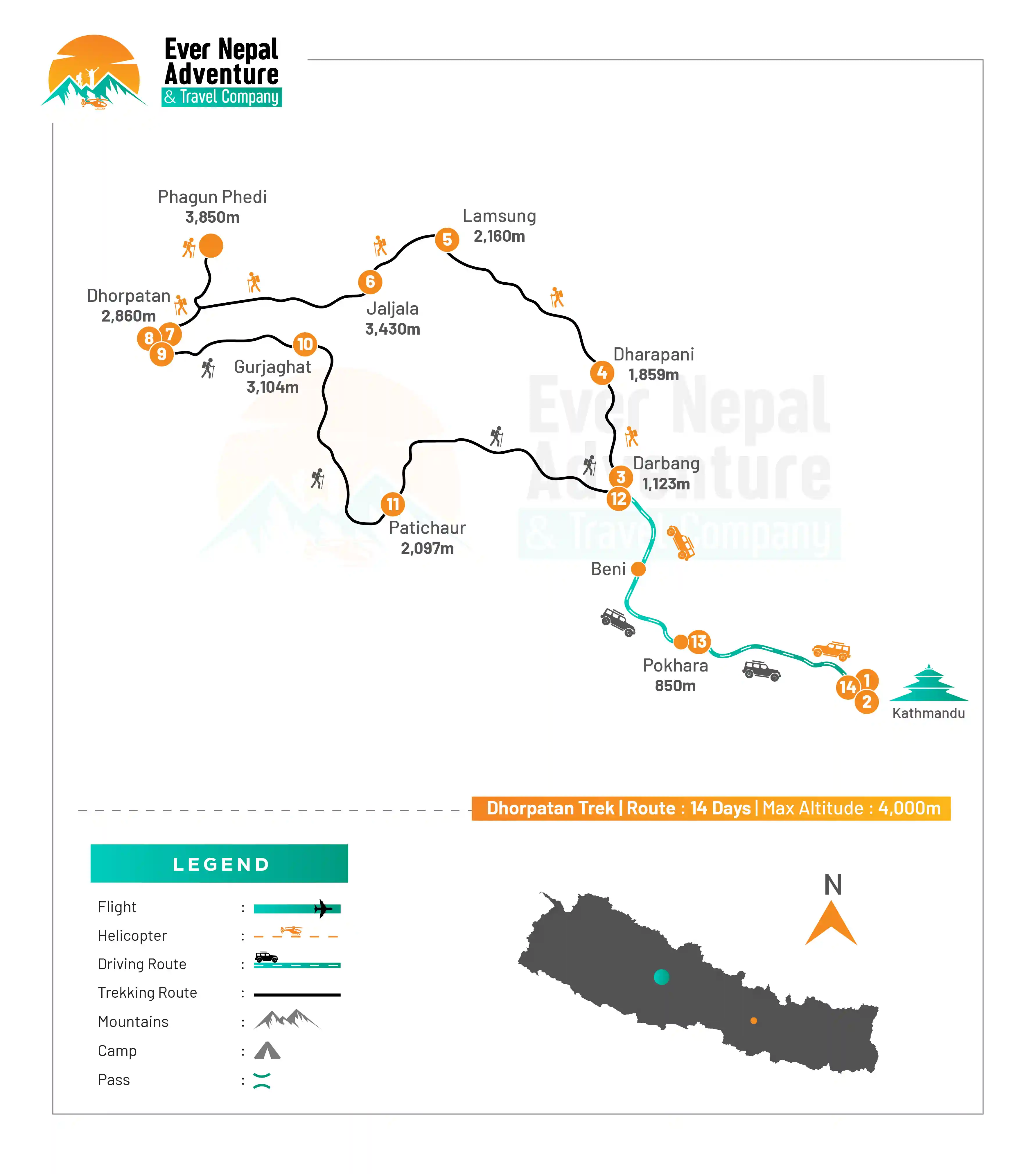
Trek Route

Dhorpatan Trek route map

What's included

  • Airport Pickup and Drop-off in Kathmandu
  • Accommodation in Kathmandu or Pokhara (standard hotels with breakfast)
  • All ground transportation as per itinerary (Kathmandu-Pokhara-Darbang-Beni-Pokhara-Kathmandu)
  • Transportation arrangements within the United States and transfers while on the trip
  • Full board meals (breakfasts, lunches, and dinners) are included in the trek.
  • Phagun Phedi has jungle camps and tea houses/lodges to accommodate trekkers.
  • Trekking guide licensed and experienced
  • Need for porters (one porter per two trekkers)
  • Dhorpatan Hunting Reserve Entrance Permits and all required Trekking permits.
  • All Government Taxes & Service Charges
  • The guide carries a basic First Aid Kit.
  • A map of the trekking route and an introduction to the trek.

What's excluded

  • Nepal visa fees and international flights
  • Travel Insurance (mandatory coverage, including emergency evacuation)
  • Meals in Kathmandu (except for breakfast)
  • Personal expenses including drinks, snacks such as beverages, snacks, laundry and phone calls.
  • Tips for porters, guides
  • Personal trekking gear
  • Extra meals or accommodations due to late arrivals, early arrivals, or itinerary modifications
  • Emergency rescue and Evacuation Costs (in case of unforeseen situations).
  • Bar bills for non-alcoholic and alcoholic beverages while on the trek
  • There may be additional costs not included in the cost includes section.

Packing List for Dhorpatan Trek

When you are planning for trekking the Dhorpatan Trek, it is very essential that you have the appropriate trekking equipment that has been tested, especially when you have to cross remote trails, alpine forest and changing weather conditions in the mountains. Ensuring safety, comfort and adjustment during a trek can be achieved through proper packing. It also assists you to stay organized and enjoy the travel in relaxed landscapes of the Dhorpatan Hunting Reserve.

Head

  • Wide-brimmed sun hat

  • Neck gaiter or buff

  • Facial wipes

  • Lip balm

  • Lightweight headlamp

  • Warm beanie

  • High-SPF sunscreen

  • UV-protected sunglasses

Hands

  • Waterproof gloves

  • Insulated gloves

Upper Body

  • Warm base layers

  • Waterproof and windproof outer jacket

  • Quick-drying t-shirts

  • Fleece jacket and insulated down jacket

  • Breathable long-sleeved trekking shirt

  • Light, compressible puffy jacket

  • Raincoat or poncho

Lower Body

  • Insulated pants

  • Fleece or trekking trousers (2 sets)

  • Full-length trekking pants

  • Warm thermal innerwear

  • Comfortable cotton pants

  • Waterproof pants

Footwear

  • Lightweight sandals

  • Durable waterproof hiking boots

  • Gaiters

  • Moisture-wicking wool socks (multiple pairs)

Toiletries

  • Toothbrush and small toothpaste

  • Toilet paper

  • Soap

  • Quick-dry towel

  • Small shampoo bottle

  • Hand sanitizer

  • Wet wipes

Accessories

  • Lightweight trekking poles

  • Water purification tablets or filter

  • Large duffel bag

  • Sleeping bag (cold-rated recommended)

  • Small backpack or daypack

  • Water bottle or hydration system

First Aid Kit

  • Diamox (if needed for altitude)

  • Antiseptic wipes

  • Painkillers (ibuprofen or paracetamol)

  • Bandages

  • Anti-diarrhea medication

  • Blister care kit

  • Personal prescription medicines

Miscellaneous Items

  • Camera or phone

  • Power banks

  • Travel adapter

  • Binoculars for wildlife and mountain views

  • Energy bars and snacks

Specific Gears for Women

While trekking in the Dhorpatan region, female trekkers may need a few extra personal items for comfort and hygiene due to limited facilities on the trail. Carrying these essentials ensures a smoother and more comfortable trekking experience.

  • Undergarments

  • Sanitary pads or tampons

  • Sports bra

  • Travel-size shampoo

  • Skincare items (moisturizer, cleanser, sunscreen)

  • Fleece headband

  • Warm leggings or thermal wear

Documents

The Dhorpatan Trek is located in a protected and isolated conservation area of Nepal where the necessary permit and travel documents are needed to enter Nepal and to trek safely.

  • Valid Passport: Passport with 6 months validity is required for an foreign trekking partner. It is utilized for confirmation of identity and permit process in the trek.
  • Nepal Visa: Foreign tourists to Nepal need to have a valid tourist visa, which is issued on arrival or prior to entry to Nepal. It lets one access and hike in the protected areas of Nepal.
  • TIMS Card: A TIMS (Trekkers' Information Management System) Card in Nepal is a must have for a safe trek and trekking registration in the remote trekking routes in Nepal.
  • Conservation Area Permit: A special permission is needed to be in the Dhorpatan Hunting Reserve. This permit is used to help control conservation rules and to help protect the wildlife and natural resources of the region.
  • Passport-Sized Photos: Carry 2 to 4 passport-size photos for permit registration and official trekking documentation.
  • Travel Insurance: Travel insurance is highly recommended and it should include trekking coverage, emergency evacuation, and medical treatment; due to the remote nature of the region.

Frequently Asked Questions

How long is the Dhorpatan Trek?

It will take about 7 to 12 days for Dhorpatan Trek, depending on the starting point and route. There are shorter routes in combination with road travel. Walking speed, weather conditions, and rest days and exploration will also determine the duration.

Is the Dhorpatan Trek difficult?

The trek is considered moderate in difficulty.It has uphill and downhill walking on forest trails and ridges. There is no technical climbing involved but trekkers must have basic fitness and be ready for long hours of walking in the remote regions.

What is the best time for Dhorpatan Trek?

Spring (March to May) and autumn (September to November) are the best times to visit. These months offer more predictable weather patterns, clearer skies and more comfortable trekking conditions that are not quite as rough as monsoon or winter.

Do I need a guide for Dhorpatan Trek?

Yes, it is recommended to get a guide, because the route is remote, less developed. Navigation, local permits, safety, and communication with local communities are all covered by a guide.

Are there hotels or tea houses on the trail?

The level of accommodation is basic, primarily teahouses local to the region and simple lodges. Huts are basic and limited compared to more popular routes for trekking, so trekkers should expect simple huts and basic food.

User Review