Ganesh Himal Base Camp Trek - 18 Days

Tour Info

trip code

03

Starting Point/ End Point

Kathmandu

Accommodations

Lounge and tea house

Max Altitude

4000

Duration

17 days

country

Nepal

Trip grade

Moderate

Activities

Trekking

Best Season

march , april , may, september , october , november

Overview

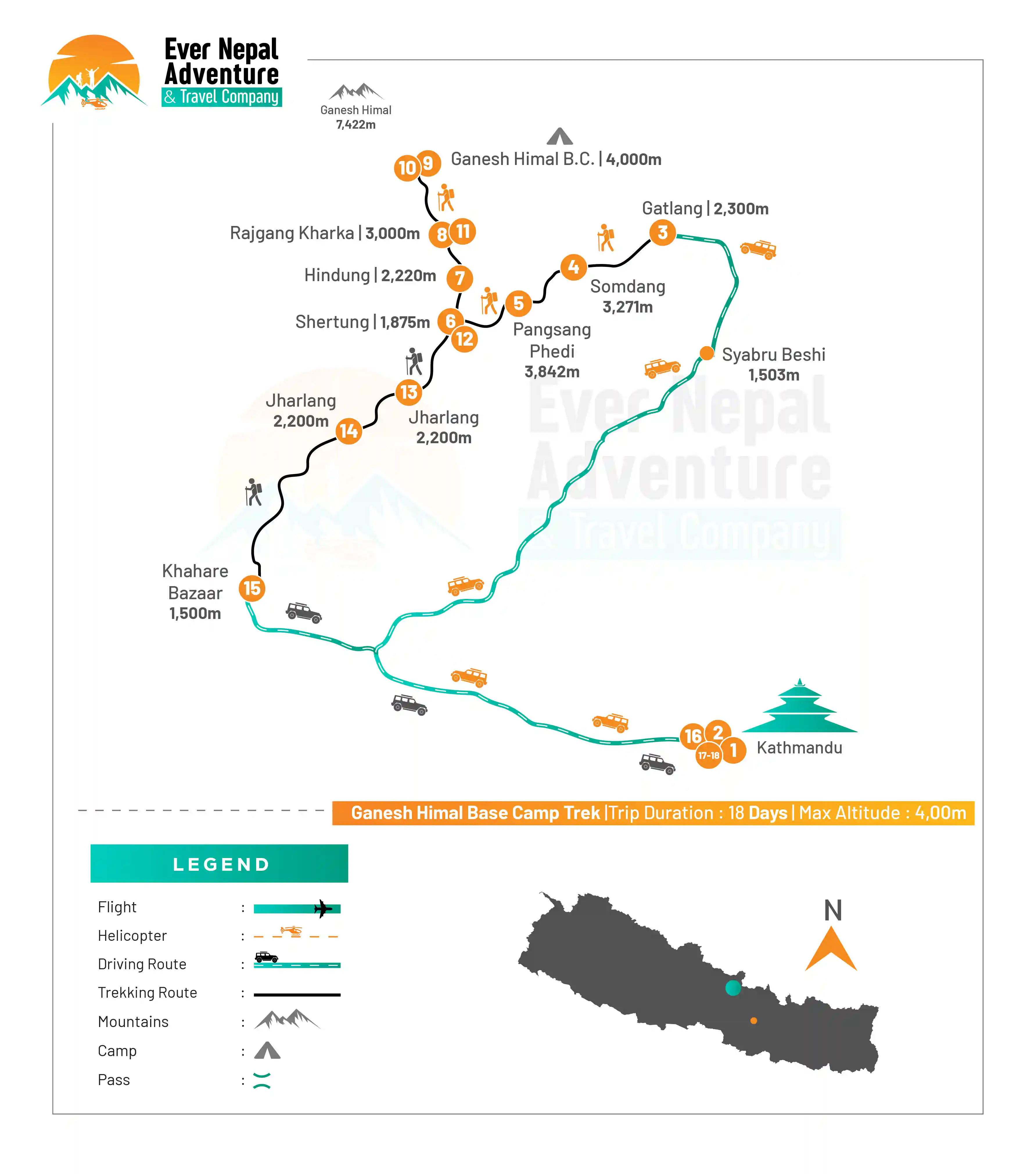
The Ganesh Himal Base Camp Trek is a blend of both cultural heritage and stunning Himalayan landscapes. The trail travels through Tamang settlements and Magar villages, where stone houses with prayer flags are common. Terraced fields, prayer banners and traditional Tamang lifestyles define the daily lives. As you leave Gatlang, the trail climbs steadily into a quieter, isolated terrain. Forests of rhododendrons and pines surround the trail. Ascending to Somdang Pass or Pangsang Pass is a dramatic change in scenery. The open ridges provide panoramic views of the Ganesh Himal Range and Langtang Himal as well as other valleys. The Pangsang Pass appears pristine and huge in size, forming an important feature of the trekking route. It then leads to a descent into valleys.

The landscape on Ganesh Himal Base Camp Trek gets more remote and alpine as you head towards Rajgang Kharka. This trail will take you through Kalo Seto Kunda - a unique formation of black and white lakes. This place is considered sacred by most people. The next destination on your journey is Ganesh Himal Base Camp. The return journey follows a similar remote rhythm. This allows you to visit villages and landscapes again with a stronger sense of connection.
Highlights

  • Ganesh Himal Base Camp Trek - a less-traveled and remote area

  • Explore the culture and traditions of authentic Tamang & Magar villages

  • Pangsang Pass is a scenic pass with a panoramic Himalayan view.

  • Wander through diverse landscapes that include forests, ridges and mountain valleys.

  • Visit the sacred Kalo Seto Kunda, also known as Black and White Lakes

  • Ganesh Himal Base Camp: Surrounded by glaciers and peaks, this serene camp is the perfect place to relax.

  • Enjoy peaceful hiking away from commercial routes.

  • Changes in Himalayan ecosystems: from lush green hills to high mountain terrain

  • Enjoy the warm hospitality of the mountains and traditional lifestyles

  • Complete a circuit that takes you through picturesque scenery and remote villages

Itinerary

Day 01: Arrive in Kathmandu.

Kathmandu is the vibrant capital of Nepal. The energy of the city surrounds you immediately. Arriving at Tribhuvan International Airport, you will complete your formalities before entering a world of chaos and warmth. Our representative will greet you at the airport and transfer you to your accommodation through streets full of temples, shops and locals. After your journey, you can either relax at your leisure or explore the nearby area. It is the perfect way to start discovering the amazing culture of Nepal. Prepare for the journey through the Ganesh Himal range by staying overnight here. 

  • Max Elevation: 1,350 m
  • Travel Distance: 6 km
  • Travel Hours: 30 mins
  • Accommodation: Hotel
  • Meals Included: Dinner

Day 02: Sightseeing in Kathmandu

After breakfast, we will take you around the Kathmandu Valley on a tour. You will definitely enjoy your tour around the historical landmarks of Kathmandu guided by an expert guide.

Monkey Temple -Swayambhunath Stupa 
Swayambhunath Stupa is located atop a hill overlooking the Thamel area of Kathmandu Valley. It is a sacred site that embodies both Hindu and Buddhist influences, thus representing the peaceful coexistence of the two religions in Nepal. Samhengu is another name for the Monkey Temple, which is so named because there are many monkeys in the area. You will enjoy a peaceful environment and panoramic city views as you make your way to the top.

Pashupatinath Temple 
Pashupatinath Temple, devoted to Lord Shiva, is one of the most sacred Hindu temples in the world. Situated along the Bagmati, this temple complex has pagoda-style architecture and ancient shrines. It also includes detailed sculptures. Besides serving as a religious structure, it is a historical and cultural landmark that represents spiritual customs from ancient eras.

Boudhanath Stupa
Boudhanath is one of the biggest Buddhist Stupas of Nepal. It is considered to be a spiritual symbol of harmony and dates back hundreds of years. The stupa has the Buddha’s eyes on each side, symbolizing awareness and knowledge. As they walk, monks and tourists spin prayer wheels in a quiet, meditative manner.

Bhaktapur Durbar Square 
The Durbar Square in Bhaktapur is a beautiful example of Newari traditional architecture. The Malla-era square contains notable monuments, including Nyatapole Temples and Golden Gates. Bhairava Temples and Vatsala Temples are also included. The entire area represents the artistic and cultural riches of ancient Nepal.

Thamel
At the end of a busy day, you can spend it in Thamel. It is a vibrant area with lots of shops, cafés, and markets. The streets of Thamel are lively and energetic, with everything from handcrafted goods to trekking gear. This is a great spot to relax, explore and soak up the atmosphere before embarking on your Himalayan trip.

  • Max Elevation: 1,350 m
  • Travel Distance: 20 km
  • Travel Hours: 5–6 hrs
  • Accommodation: Hotel
  • Meals Included: Breakfast

Day 03: Drive from Kathmandu to Gatlang via Syabru Beshi (1503m/4945Ft.)

The drive from Kathmandu to Gatlang is scenic and long. The road takes you through rolling hills, river basins, and rural villages that gradually replace the city landscape. The road passes through Syabru Beshi - a gateway for the Langtang Himal and Ganesh Himal regions - before continuing on to Gatlang. It takes 7 to 8 hours, depending on road conditions. On the way, you will pass terraced farms, flowing rivers and distant mountain views. Gatlang welcomes you with its classic Tamang houses and tranquil mountain environment. The village offers a culturally rich experience and a tranquil introduction to rural Himalayan culture. 

  • Max Elevation: 1,503 m
  • Travel Distance: 150 km
  • Travel Hours: 7–8 hrs
  • Accommodation: Teahouse/Lodge
  • Meals Included: Breakfast, Lunch, Dinner

Day 04: Gatlang to Somdang (3271m/10760Ft)

As you leave Gatlang, you will gradually climb up to Somdang. The hike follows through thick forests and rocky trails. The route also crosses ridges, which at times offer breathtaking views of the mountains. As you move, the scenery gets rugged, and there are chances of seeing tiny villages and yak pastures in the area. The ascent might seem tough, but nature's beauty keeps your motivation alive. There will be coniferous and rhododendron trees in the lower parts, while alpine zones will dominate the upper regions. After 6 or 7 hours of walking, you arrive at Somdang. A quiet mining settlement surrounded by hills and wilderness. You will notice that the air is thinner and cooler as you gradually ascend higher in altitude. 

  • Max Elevation: 3,271 m
  • Travel Distance: 12 km
  • Travel Hours: 6–7 hrs
  • Accommodation: Lodge/Camp
  • Meals Included: Breakfast, Lunch, Dinner

Day 05: Somdang to Pangsang Phedi (3842m/ 12640Ft)

Today will be spent making an ascent through mostly open areas, followed by some forests. As the altitude increases along the path, so does your ability to see the valleys and other mountains. The trail is shorter but steeper than the previous days, so you need to keep a steady pace. As you get closer to Pangsang Phedi and the alpine terrain takes over, there are fewer trees. The ridgelines become more open. The scenery in the area is quite tough and raw, as mountain breezes blow fiercely in the region, and beautiful views abound. At an elevation of three to four hours' walk, Pangsang Phedi is found. It is quite a serene place, and one gets to spend the night here.

  • Travel Distance: 6 km
  • Travel Hours: 3–4 hrs
  • Accommodation: Camp
  • Meals Included: Breakfast, Lunch, Dinner

Day 06: Pangsang Pass to Shertung (1875m/ 6188Ft)

Today, you will pass the Pangsang Pass. This is the highlight of the trek. You ascend early in the morning to the pass, where dramatic Himalayan views are revealed. The endless panorama of deep valleys and snow-capped peaks is breathtaking. After spending some time on the pass, begin your long descent to Shertung. The trail travels through open ridges as well as forested sections and traditional grazing grounds. As you lower your altitude, vegetation and air become warmer. You reach Shertung after 5 to 6 hours of walking. It is a culturally rich village, surrounded by terraced hills and fields. The village has a calm atmosphere with warm local hospitality. 

  • Max Elevation: 3,850 m
  • Travel Distance: 10 km
  • Travel Hours: 5–6 hrs
  • Accommodation: Teahouse/Lodge
  • Meals Included: Breakfast, Lunch, Dinner

Day 07: Shertung to Hindung (2220m /7425Ft)

The peaceful paths that connect Shertung with Hindung are the perfect way to start your day. This route takes you through small settlements and forest patches. There are also gentle uphill and downward sections. The higher alpine zones are more barren and desolate. Along the way, you can interact with locals and gain insight into their traditional mountain life. Trail for this section of Ganesh Himal Trek is comfortable and moderately long, so you can enjoy the surroundings without having to rush. After hiking for 5-6 hours, you will arrive at Hindung. Hindung is a little village that is surrounded by farms and mountains. It has a calm and friendly atmosphere. 

  • Max Elevation: 2,220 m
  • Travel Distance: 9 km
  • Travel Hours: 5–6 hrs
  • Accommodation: Teahouse/Lodge
  • Meals Included: Breakfast, Lunch, Dinner

Day 08: Hindung to Rajgang Kharka

The route takes you deep into the wilderness as you head towards Rajgang Kharka. As you move on the route, it gets more natural with its forested and open grazing areas. It is an undisturbed journey along ridges as you walk in peace. After about 5-6 hours of hiking, you arrive at Rajgang Kharka which is a high pastureland surrounded by silence and wide landscapes. The wild and untamed nature of the Himalayas is where the adventure is located. While sleeping, you find yourself amidst the tranquil nature and air of the mountains.

  • Max Elevation: 3,000 m
  • Travel Distance: 10 km
  • Travel Hours: 5–6 hrs
  • Accommodation: Camp
  • Meals Included: Breakfast, Lunch, Dinner

Day 09: Rajgang Kharka to Kalo Seto Kunda (Black and White Lake) Ganesh Himal Base camp

Your trip from Rajgang Kharka to the Ganesh Himal Base Camp and Kalo Seto Kunda Lake will turn out to be extremely satisfying. You will walk on an ascending route amid Alpine and glacier environments. As the altitude increases, the environment becomes even more spectacular. You will observe majestic mountains ruling the skyline. After a hike of 6-7 hours, you will finally arrive at Kalo Seto Kunda lakes, which is one of the most revered destinations in Nepal. The base camp of Ganesh Himal is an ideal site for meditation due to the serenity and glaciated surroundings around it.

  • Max Elevation: 4,000 m
  • Travel Distance: 12 km
  • Travel Hours: 6–7 hrs
  • Accommodation: Camp
  • Meals Included: Breakfast, Lunch, Dinner

Day 10: Rest day at the Ganesh Himal Base camp

A rest day will be arranged at Ganesh Himal base camp. Utilize this opportunity effectively because the environment is quite interesting and offers you an excellent opportunity to get accustomed to the altitude. Reflect on what you have achieved during the day. There is always that feeling of being connected to nature in such silent and massive spaces. You will rest, recharge your batteries, and prepare yourself for the return trip. 

  • Max Elevation: 4,000 mTravel Distance: 3 km
  • Travel Hours: 2–3 hrs
  • Accommodation: Camp
  • Meals Included: Breakfast, Lunch, Dinner

Day 11: Ganesh Himal Base Camp to Rajgang Kharka

The descent begins from Ganesh Himal Base Camp. You retrace the steps you took to reach Rajgang Kharka. You notice things you missed on your way up that you now see. The glaciers slowly disappear as the landscape changes from alpine to more lush. Your descent is gradual and takes between 6 and 7 hours. Of course, it definitely feels cozy because you have already arrived at Rajgang Kharka. As you descend, you feel relaxed as you reflect on the difficulties you faced during your time at base camp. Overnight stop at Rajgang Kharka.

  • Max Elevation: 4,000 m
  • Travel Distance: 12 km
  • Travel Hours: 6–7 hrs
  • Accommodation: Camp
  • Meals Included: Breakfast, Lunch, Dinner

Day 12: Rajgang Kharka to Shertung (2000 m)

On this day, you move down further and head for Shertung. It also passes scattered settlements. The long walk is comfortable and allows you to enjoy the changing scenery. As you descend in altitude, the air gets richer, and the vegetation becomes more vibrant. After 6 or 7 hours of hiking, you will reach Shertung. The village is welcoming and familiar. It offers a peaceful resting place after the high mountains section.

  • Max Elevation: 3,000 m
  • Travel Distance: 12 km
  • Travel Hours: 6–7 hrs
  • Accommodation: Teahouse/Lodge
  • Meals Included: Breakfast, Lunch, Dinner

Day 13: Shertung to Jharlang

On the thirteenth day, the trail leads you through rural terrain and forest trails as you depart Shertung. This route is both ascending and descending, along with small villages and terraced fields. The culture of the place is very rich, with people living their lives around the mountains and farming as well. Walking for up to 7 to 8 hours, we reach the destination called Jharlang. It is quite a serene village with lots of greenery and hills all around, with a cool climate.

  • Max Elevation: 2,200 m
  • Travel Distance: 14 km
  • Travel Hours: 7–8 hrs
  • Accommodation: Teahouse/Lodge
  • Meals Included: Breakfast, Lunch, Dinner

Day 14: Jharlang to Darkha

You continue to trek towards Darkha on the scenic rural trails. The route is long, passing through forests, riverside, and scattered villages. The route is a mix of natural beauty and cultural encounters. The terrain can be challenging, but it is rewarding. You will see different landscapes every day. Having hiked for seven to eight hours, you will have arrived at the peaceful hamlet of Darkha. It is surrounded by hills and farms.

  • Max Elevation: 2,100 m
  • Travel Distance: 15 km
  • Travel Hours: 7–8 hrs
  • Accommodation: Teahouse/Lodge
  • Meals Included: Breakfast, Lunch, Dinner

Day 15: Darkha to Khahare Bazaar

Your trek ends with you descending into the Khahare Bazaar area. The route that you take begins to change from being in the countryside to cities. As you come closer to the end of this trekking route, you pass through farmlands, forested areas, and roadside settlements.  After walking for 7 to 8 hrs, you will reach Khahare Bazaar, where the road resumes. You will feel a sense of completion as you leave remote trails behind. 

  • Max Elevation: 1,500 m
  • Travel Distance: 16 km
  • Travel Hours: 7–8 hrs
  • Accommodation: Lodge
  • Meals Included: Breakfast, Lunch, Dinner

Day 16: Drive from Khahare Bazaar to Kathmandu by bus /private vehicle

The journey back to Kathmandu is by bus or your own vehicle. The journey is approximately 7 to 8 hours long, with winding roads and river crossings, as well as hillside settlements. The rural hills are gradually left behind as you enter the busy atmosphere of Kathmandu. You will check into your hotel in Kathmandu and have a nice sleep. You will be able to have an enjoyable evening in Kathmandu after your trekking adventure. 

  • Max Elevation: 1,350 m
  • Travel Distance: 140 km
  • Travel Hours: 7–8 hrs
  • Accommodation: Hotel
  • Meals Included: Breakfast

Day 17: Leisure Day in Kathmandu

You will have a leisurely day in Kathmandu after your exhausting journey. Today, you will have a leisurely day to do some shopping or visit some places. You can visit local cafes, roam hidden alleyways, and shop for hidden handmade gems in local stores. After the serene mountains, it feels great to relax in the bustling city of Kathmandu. You will take time to reflect on your Himalayan trekking adventure. 

  • Max Elevation: 1,350 m
  • Travel Distance: 10 km
  • Travel Hours: 3–4 hrs
  • Accommodation: Hotel
  • Meals Included: Breakfast

Day 18: Departure

Today, your journey in Nepal ends. After breakfast, you are transferred to Tribhuvan International Airport. As you depart Kathmandu, you will carry with you memories of remote trails and sacred lakes as well as the magnificent Ganesh Himal base camp. You will always remember the experience as a mix of culture, wilderness and personal achievement. 

  • Max Elevation: 1,350 m

  • Travel Distance: 6 km

  • Travel Hours: 30 mins

  • Meals Included: Breakfast

What's included

  • Private vehicle pick up and drop off at the airport

  • Accommodation in Kathmandu (3-star standard hotel) for twin sharing

  • Private vehicle and professional guide for a guided sightseeing tour of Kathmandu

  • All ground transportation is required as per the itinerary. (Kathmandu - Gatlang and Khahare Bazaar - Kathmandu).

  • Breakfast, Lunch and Dinner are included in the price.

  • Accommodation on the trek is available in teahouses/lodges and camping, if required.

  • Experienced, English-speaking trekking guide

  • Number of porters required (1 porter per 2 trekkers).

  • All salaries, insurances, food and accommodation

  • Ganesh Himal trekking permits and entry fees

  • Guides carry a basic first aid kit

  • Taxes and charges

What's excluded

  • Nepal international airfare

  • Nepal entry visa fees

  • Travel Insurance (required for Trekking)

  • Personal trekking equipment and gear

  • Breakfast in Kathmandu is not included

  • Personal expenses include drinks, snacks and laundry as well as phone calls, internet, and other personal expenses.

  • If available, hot showers, charging of batteries and Wi-Fi are available during the trek.

  • Guide, porter and driver tips

  • Your insurance may cover emergency rescue and evacuation

  • Additional costs due to unforeseeable circumstances such as weather delays, strikes or itinerary changes

Ganesh Himal Peak Packing List

It is necessary to have appropriate equipment while climbing Ganesh Himal Peak; it will ensure safety, comfort, and versatility of your trekking. The trip will require both high-altitude trekking and glacier hiking, and some mountaineering skills. Packing wisely will also help you to stay organized and ready for the rapidly changing weather conditions of the Everest region. Here is a packing list that you should consider for Ganesh Himal Peak.

  • Head

    • Wide-brimmed sun hat

    • Neck gaiter, or buff

    • Warm insulated beanie

    • Balaclavas for Summit Push

    • Glacier sunglasses with UV protection

    • Ski goggles with wind and snow protection

    • High-SPF sunscreen

    • Lip Balm with SPF

    • Extra batteries are included in the lightweight headlamp

    • Facial wipes

  • Hands

    • Inner liner gloves

    • Insulated waterproof gloves

    • Gloves or mitts for heavy summits

    • Hand Warmers

  • Upper Body

    • Thermal base layers that wick away moisture

    • T-shirts for trekking that dry quickly

    • Long-sleeved hiking shirts that are breathable

    • Fleece jacket

    • Insulated down jacket

    • Heavy down jacket for summit Climbing

    • A shell jacket that is waterproof and windproof

    • Raincoat or Poncho

    • Lightweight puffy Jacket

    • Sportswear for layering

  • Lower Body

    • Thermal innerwear

    • Softshell trekking pants

    • Waterproof shell trousers

    • Insulated climbing pants

    • Fleece trekking trousers

    • Comfortable camp pants

    • Warm leggings and compression layers

  • Footwear

    • Waterproof trekking boots that are durable

    • Mountaineering Boots Compatible with Crampons

    • Lightweight sandals and camp shoes

    • Gaiters for Snow Protection

    • Wool trekking socks

    • Thermal Summit Socks

    • Microspikes and crampons

  • Climbing Gear

    • Climbing harness

    • Helmet

    • Ice axe

    • Safety cords and carabiners

    • Ascenders and descenders devices

    • Crampons

    • Trekking poles

    • Mountaineering backpack

    • Duffel bag

    • Sleeping bag suitable for extreme cold

    • Sleeping bag liner

  • Toiletries

    • Toothbrushes and toothpaste

    • Biodegradable soap

    • Quick-dry towel

    • Small shampoo bottle

    • Hand sanitizer

    • Wet wipes

    • Toilet paper

    • Moisturizing cream for dry skin

    • Nail clipper

  • Accessories

    • Hydration bladders or water bottles

    • Filters or tablets for water purification

    • Power banks

    • Travel adapter

    • Camera or phone

    • Memory cards and Batteries Extra

    • Dry bags or waterproof stuff sacks

    • Snacks, energy bars and snacks

    • Journal or notebook

    • Binoculars

  • First Aid Kit

    • Diamox is used to treat altitude sickness.

    • Prescription medications for personal use

    • Painkillers: Ibuprofen and paracetamol

    • Bandages and gauze

    • Blister Treatment Kit

    • Antiseptic creams and wipes

    • Anti-diarrhea medication

    • Electrolyte packet

    • Altitude sickness medication

    • Pulse Oximeter (optional).

  • Miscellaneous Items

    • Passports and travel documents

    • Passport-sized Photos

    • Spending money on personal expenses

    • Insurance documents

    • Maps and trekking notes

    • Book or other entertainment items that are lightweight

  • Special Gears for Women

Women should bring certain essentials to the Ganesh Himal Peak trip in order for them to be comfortable, prepared, and protected during both the trekking and the climbing sections. The right gear can make this experience more enjoyable and safer, especially since the adventure includes high altitudes, cold weather and physically demanding climb days. Here are some specific gears designed for women.

  • Sports Bra

  • Thermal Leggings

  • Fleece Headband

  • Sanitary Pads/Tampons

  • Personal Hygiene Products

  • Skincare products (Moisturizer, Sunscreen, Cleanser)

  • Comfort Trekking Tights

  • Small toiletry packs

  • Hair care and additional hair ties

Required Documents and Permits

For the trekking and climbing to be successful, one will require specific documents and permits. These documents will enable you to embark on the trekking journey hassle-free, safely, and legally. Some of the essential documents and permits are:

  • Entry Permit for Sagarmatha National Park: The entry permit is a very important document which allows an individual to enter the Sagarmatha National Park in the Everest region. The Nepal Tourism Board in Kathmandu, or the Monjo park entrance point, can issue this permit. For foreigners, the charges are around NPR 3,000 ($23), NPR 1,500 for SAARC nationals and NPR 100 if you're a Nepali citizen.

  • Khumbu Pasang Lhamu Rural Municipality Entrance Permit: This permit is needed for entry into the Khumbu area. You can get it at either the Lukla or Monjo Checkpoints. For foreign trekkers, the fee ranges from NPR 2,000 up to NPR 3,500 ($15-$23).

  • TIMS Card: The TIMS Card is necessary in certain situations for registration and safety tracking purposes. These can be obtained from the trekking agencies and tourism information centers in Kathmandu.

  • A valid passport is a requirement for your trek and climbing in this journey; this should be original with at least 6 months' validity period from the day you enter Nepal.

  • Passport photos: You should also have 6 passport-sized photos, as you require them for official registration and obtaining permits.

  • Entry visa to Nepal: An entry visa to Nepal is required for all foreign visitors. The visa is obtained after arriving at Tribhuvan International Airport or the embassies of Nepal overseas.

  • Travel insurance: You need to have travel insurance because if you are going to participate in the Ganesh Himal Peak. The plan must cover climbing and trekking, and also the cost of helicopter evacuation if needed.

  • Certificate showing physical fitness: Even though it is optional, it is advisable to have a medical certificate which shows your physical fitness to go on a high altitude climbing and trekking.

Frequently Asked Questions

How difficult is the Ganesh Himal Base Camp Trek?

 The Ganesh Himal Base Camp Trek is considered a moderately challenging to difficult trek. This trek entails long walking days, uphill and downhill hiking, mountain trail sections, and also high altitude sections up to about 4,000 meters. Prior trekking experience is an added advantage; however, individuals with physical fitness will be able to achieve success through well-prepared beginners.

How many days does the Ganesh Himal Base Camp Trek take?

The complete Ganesh Himal Base Camp Trek generally takes about 18 days to be completed. The duration involves days of arrival, sightseeing in Kathmandu, trekking days, acclimatization days, and days of going back home.

What is the ideal time for doing the Ganesh Himal Base Camp Trek?

The ideal months for the Ganesh Himal Base Camp Trek are spring (March-May) and autumn (September-November).

Do I need any previous trekking experience?

Previous trekking experience is preferred but not compulsory for this trek. The trekkers should be in good physical shape to make a safe trek through rough mountainous trails for consecutive days. Proper preparation and practice play an important role here to enjoy the whole process comfortably.

What kind of accommodation is provided during the trek?

Teahouses and local lodging, along with camping in some remote areas with teahouse facilities, are provided to the trekkers as accommodation options during the trekking trip. The rooms at the teahouses are basic in design, and the camping provides you with an adventure in the high Himalayas.

Am I susceptible to any altitude sickness?

Yes, altitude sickness can occur on this trekking since you can ascend up to around 4,000 meters in height near Ganesh Himal Base Camp during your travel. Altitude sickness can be avoided by acclimatizing yourself properly and taking all the necessary precautions like staying hydrated, slow pace and proper resting.

Do I need guides and porters on the Ganesh Himal Base Camp Trek?

 It is advisable to hire a guide and porter on this Ganesh Himal Base Camp Trek because the area is relatively remote and non-commercialized. The guide will facilitate navigating, communicating, and ensuring safety and cultural sensitivity, while the porter will lessen the burden of carrying the heavy luggage.

Is there internet and electricity along the way?

There are places in the village where you will have access to electricity and charge your gadgets, although you cannot find this facility in camping sites in higher elevations. Access to the internet and mobile signals can be poor due to remoteness.

What makes the Ganesh Himal Base Camp Trek distinct?

 What makes the Ganesh Himal Base Camp Trek distinct is its unpolluted pathways, peaceful surroundings, cultural heritage of the Tamang and Magar communities, pristine lakes known as Kalu Sato Kunda, splendid views of the Himalayas, and scenic alpine landscapes. It is unlike any other trek since it provides a personal experience of the Himalayas.

User Review