Kailash Mansarovar Trek - 15 Days

Tour Info

trip code

EN-039

Starting Point/ End Point

Kathmandu

Accommodations

Lodge/ Tea House

Max Altitude

5545m

Duration

15 days

country

Tibet

Trip grade

Easy

Activities

Trekking

Best Season

March, April, May, September, October, November

Overview

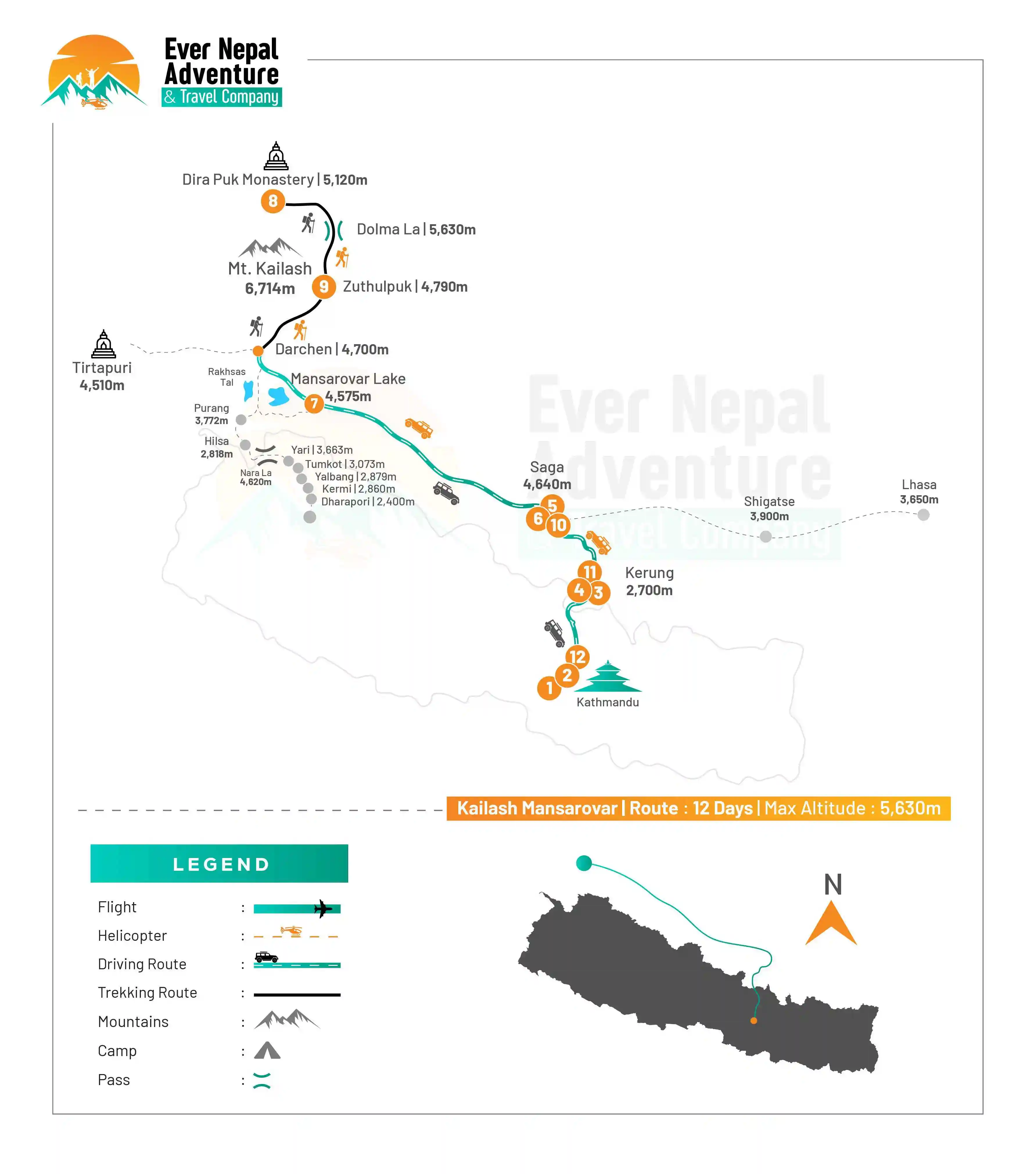
One of the most significant religious trips in the Himalayan area is the pilgrimage of Mount Kailash and Lake Mansarovar. The route is in the remote region of western Tibet and traverses through the high mountain roads, border towns, and expansive Tibetan terrain. The tour will involve driving, brief hiking, and acclimatisation because of the elevated altitude. Pilgrims traverse such destinations as Kerung and Saga to arrive at the sacred lake and start the Kailash circuit. This trip is a blend of religious significance, mountainous landscape, and a guided route of traveling throughout Nepal and Tibet.

Details 

The trip is aimed at tourists who would like to explore Mount Kailash and Lake Mansarovar by a well-organized overland trip with simple comfort and logistic support. Roads there enable a slow increase in altitude with an acclimatization rest at Kerung. Tourists go through Tibetan towns, mountain passes, and mountain plateau landscapes before accessing the pilgrimage sites. Accommodation will be organized in the regular hotels or guesthouses in the towns and plain yet comfortable accommodation during the trek part. The road also covers the Kailash Kora, a three-day walk around the mountain. Adventures in this trip involve road adventure, walking paths, religious places, and coordinated assistance for the easier high-altitude adventure.

Highlights

  • Tour the holy Mount Kailash, which is a significant pilgrimage for Hindus, Buddhists, Jains, and Bon followers.
  • Explore the sacred Lake Mansarovar with an altitude of 4,500 m.
  • Land trip between Kathmandu and Tibet by the Rasuwagadhi Border Crossing.
  • Stay at Kerung to acclimatize to the altitude.
  • Cross the Tibetan plateau and pass through such towns as Soga.
  • Three-day Kailash Kora trek, Dirapuk and Zuthulpuk with high mountain pass view.
  • The trek across the high Dolma La Pass (5,630 m).
  • Arranged transportation, service, and accommodation in the overland trip.

Itinerary

Day 01: Kathmandu Arrival

You will arrive at the international airport in Kathmandu, the main gateway for travel in Nepal and Tibet. Once you are through with the immigration and airport formalities, you will be met by our representative and handed over to the hotel in the city. The hotel is approximately 20-30 minutes away by road. Kathmandu is situated at approximately 1,350m, and it is the central point of departure in the Kailash pilgrimage. The rest of the time is at liberty after check-in to prepare the trip. In the evening, a briefing session concerning the journey and travel plans can be done in the hotel.

  • Max Elevation: 1,350 m
  • Travel Distance: 6 km (approx.)
  • Travel Hours: 20 to 30 minutes drive
  • Accommodation: Hotel in Kathmandu
  • Meals Included: Dinner 

Day 02: Tour in Kathmandu

Your day starts with breakfast at your hotel, followed by a guided cultural tour of Kathmandu in a private vehicle. You will be visiting some of Nepal’s most respected spiritual sites under the guidance of an expert guide who will introduce you to the spiritual practices of this land, which have flourished over the centuries. There is plenty of leisure time available in between to visit and understand each place and its significance.

A. Pashupatinath Temple

Pashupatinath Temple is one of the most important Hindu temples in the world and serves as a place of worship for Lord Shiva. It is located near the Bagmati River, which is considered to be sacred in the Hindu religion, and features magnificent pagoda-style architecture, sacred ghats where the dead are cremated, and religious services performed throughout the year. Even though entrance to the temple is not allowed to people other than Hindus, tourists can freely roam around the site and witness spiritual practices performed there.

B. Bouddhanath Stupa

The Bouddhanath Stupa is among the largest stupas in Buddhism in the world, and it is also one of the most important sites of Tibetan Buddhism in Nepal. The white dome with its golden spire is a spectacular landmark of this place, where numerous prayer flags, monasteries, and prayer wheels create an aura of sacredness around the stupa. It is common to meet pilgrims and monks performing their circumambulation clockwise around the stupa, praying as they do. This is a great place to get acquainted with Buddhist culture and tradition and learn more about the cultural links between Nepal and Tibet.

After the tour around the city ends, you return to your hotel to spend the remaining part of the day at leisure in preparation for your further travels.

  • Max Elevation: 1,350 m
  • Travel Distance: 15 to 20 km (approx.)
  • Travel Hours: 4 to 5 hours sightseeing
  • Accommodation: Hotel in Kathmandu
  • Meals Included: Breakfast, Lunch, and Dinner

Day 03: Kathmandu to Nepalgunj

You will visit Kathmandu in Nepal to Nepalgunj, a city in western Nepal near the Indian border and a major transit center on flights to the remote Himalayan areas. It is normally a short domestic flight of approximately an hour. Nepalgunj is located at a lower altitude, and the climate is warmer than Kathmandu. Upon arrival, you will move to the hotel and have some time to rest and prepare for the mountain flight the following day.

  • Max Elevation: 1,350 m
  • Travel Distance: 365 km (approx.)
  • Travel Hours: 1 hour flight
  • Accommodation: Hotel in Nepalgunj
  • Meals Included: Breakfast, Lunch, and Dinner

Day 04: Nepalgunj to Dunai/Simikot

Today you are going to have a mountain flight in Nepalgunj to Simikot or Dunai, according to the route of traveling and the schedule of the flight. The flight goes through remote Himalayan valleys and small settlements to the destination. Main access to remote trekking routes and pilgrimage paths in the Nepal-Tibet area is Simikot and Dunai. Upon arrival, you will be transferred to the lodge or guesthouse where you will spend the day preparing to move on to the next part of the trip.

  • Max Elevation: 2,910 m (Simikot)
  • Travel Distance: 190 to 200 km (approx.)
  • Travel Hours: 1 to 1.5 hours flight
  • Accommodation: Guesthouse / Lodge
  • Meals Included: Breakfast, Lunch, Dinner

Day 05: Simikot to Hilsa / Border Crossing / Drive to Purang

After breakfast, you continue your journey from Simikot toward Hilsa which is the key Nepal–Tibet border point on this route. Depending on weather and logistics, this travel may be by helicopter or combined overland transfer. After completing immigration formalities, cross into Tibet and meet your local guide and driver. Continue by road to Purang (Taklakot), an important town for pilgrims and traders in western Tibet. Upon arrival, check in to your hotel and rest after the journey.

  • Max Elevation: ~3,900 m
  • Travel Hours: 4 to 6 hours
  • Accommodation: Hotel
  • Meals Included: Breakfast, Lunch, Dinner

Day 06: Kathmandu - Rashuwagadhi - Kerung

On day six, the trip starts by driving in the morning from Kathmandu to the Nepal-Tibet border at Rasuwagadhi Border Crossing. Road cuts across the mountain trails, crossing rivers, forests, and small settlements on the hillsides. Upon arrival at the border, immigration procedures are done, and then you will be introduced to the Tibetan guide and driver. There, a short 20km drive takes us to Kerung. On arrival, receive a welcome to the hotel and have a night's sleep.

  • Max Elevation: 2,800 m
  • Travel Distance: 168 km
  • Travel Hours: 7 to 8 hours
  • Accommodation: Hotel in Kerung
  • Meals Included: Breakfast, Lunch, Dinner

Day 07: Kerung: (2800 m)

This is a rest and acclimatization day at Kerung, and then on to the higher altitude regions. Kerung is a small border town located in the southern part of Tibet and is a major destination for travelers who are heading to Mount Kailash. The day here is beneficial in enabling the body to adapt to the altitude, and it minimizes the chances of altitude sickness. One can spend the day doing some light walking around the town and doing the last-minute preparation for the journey.

  • Max Elevation: 2,800 m
  • Accommodation: Hotel in Kerung
  • Meals Included: Breakfast, Lunch, Dinner 

Day 08: Kerung – Saga : ( 4350 m) 160 km [5 to 6 hr]

Following breakfast, the road proceeds to Saga, starting at Kerung. The path crosses the Ghantula Pass at 5,226 m and goes along the Brahmaputra River roads. Saga is a small town located in the Tibetan plateau, which is a transit station for travelers who are heading to Mansarovar and Mount Kailash. Upon arrival, check in at the hotel and take a rest for the night to get ready for the next phase of the trip.

  • Max Elevation: 4,500 m
  • Travel Distance: 160 km
  • Travel Hours: 5 to 6 hours
  • Accommodation: Hotel in Saga
  • Meals Included: Breakfast, Lunch, Dinner

Day 09: Saga – Mansarovar : (4500 m) 466 km [7-8 hr]

After breakfast, the travel proceeds towards the holy site of Lake Mansarovar from Saga. It may take some time, but it promises to be an adventurous trip across the wide Tibetan plateau with scenic open spaces, high mountain passes, and snow-capped mountains in the distance. During the trip, you will see small settlements, streams, dry areas, and even desert-like lands until the destination point comes into view at the end of the pilgrimage route leading to Mount Kailash. Lake Mansarovar, which is considered to be one of the highest freshwater lakes in the world, is of great religious importance for several religions.

  • Max Elevation: ~4,500 m
  • Travel Distance: Approx. 450–470 km
  • Travel Hours: 7 to 8 hours
  • Accommodation: Guesthouse / Lodge near Mansarovar
  • Meals Included: Breakfast, Lunch, Dinner

Day 10: Mansarovar – Darchen : (4500 - 4600 m) 40 km [ 2-3 hr ]

The trip goes on by road after the holy bath and ritual puja at Lake Mansarovar to Darchen, the base camp of Mount Kailash. This drive is approximately 40 km, and it takes 2-3 hours via plateau roads that have few settlements in between. After arrival, register at the guesthouse or lodge and sleep to make ready for the start of the Kailash Kora trek.

  • Max Elevation: 4,600 m
  • Travel Distance: 40 km
  • Travel Hours: 2 to 3 hours
  • Accommodation: Guesthouse / Lodge in Darchen
  • Meals Included: Breakfast, Lunch, Dinner 

Day 11: Darchen – Dirapuk

Yamadwar, which is located at a distance of 7 km, is a short drive that follows breakfast at Darchen. From there, the walk starts off to Dirapuk, by hillside paths, with little cascades, and a panoramic view of Mount Kailash. The hike will span 18km in 5-6 hours and will culminate in the high altitude settlement of Dirapuk, where you will spend the night in a guesthouse or a basic lodge.

  • Max Elevation: 5,100 m
  • Travel Distance: 18 km (trek)
  • Travel Hours: 5–6 hours
  • Accommodation: Guesthouse / Lodge in Dirapuk
  • Meals Included: Breakfast, Lunch, Dinner

Day 12: Dera puk- Zuthul puk

On day 12, the walk starts before sunrise with the walk from Dirapuk to Zuthulpuk. The route goes to the top of the Kailash Kora, Dolma La Pass at 5,630 m, where the view of the surrounding mountains is broad. On the way, another important sacred site is Gauri Kunda. The walk is 22 km and approximately 78 hours, and is mainly on stone and dirt roads with slow downward slopes after the pass. In the afternoon, you will arrive at Zuthulpuk, where you will spend the night in a small guesthouse or lodge, and can rest before returning.

  • Max Elevation: 5,630 m (Dolma La Pass)
  • Travel Distance: 22 km (trek)
  • Travel Hours: 7 to 8 hours
  • Accommodation: Guesthouse / Lodge in Zuthulpuk
  • Meals Included: Breakfast, Lunch, Dinner

Day 13: Zuthul puk –saga

The trek part of the trip ends with a 10 km walk out of Zuthulpuk after breakfast. After this, you will proceed by bus over the rest of the distance to Saga. The daily traveling distance amounts to approximately 479 km, and the time taken is approximately 7-8 hours, which is mostly on plateau roads with small settlements in between. Arrival in Saga and check in to the hotel or guesthouse, and have a rest.

  • Max Elevation: 4,400 m
  • Travel Distance: 479 km (bus) + 10 km (trek)
  • Travel Hours: 7 to 8 hours
  • Accommodation: Hotel / Guesthouse in Saga
  • Meals Included: Breakfast, Lunch, Dinner

Day 14: Saga – Kerung

After breakfast, the journey continues by road from Saga back toward Kerung. The distance is about 160 km, and it is covered by plateau and mountain roads, taking 4 to 5 hours. The gradual falling of the elevation enables the body to acclimatize. Arrive in Kerung, stay in the hotel, and have a night's rest before the last drive to Kathmandu the following day.

  • Max Elevation: 2,800 m
  • Travel Distance: 160 km
  • Travel Hours: 4 to 5 hours
  • Accommodation: Hotel in Kerung
  • Meals Included: Breakfast, Lunch, Dinner 

Day 15: Kerung – Kathmandu : (1350 m) 168 km [7 - 8 hr]

The last part of the trip involves a drive through Kerung to Kathmandu via Rasuwagadhi Border Crossing after breakfast. The overall journey has a distance of approximately 168 km, and the trip can be completed in 7-8 hours using mountain roads, rivers, and forests. This journey ends after reaching Kathmandu in the evening. Guests will be transferred to their hotel or airport according to their further plans.

  • Max Elevation: 1,350 m
  • Travel Distance: 168 km
  • Travel Hours: 7 to 8 hours
  • Accommodation: Hotel in Kathmandu
  • Meals Included: Breakfast, Lunch, Dinner

What's included

  • Twin-sharing room according to the itinerary on a bed and breakfast (BB) basis.
  • A Tibetan guide who speaks English throughout the trip.
  • Itinerary transportation by van or jeep.
  • Monastery entrance fees and all the documents required for the Kailash trip.
  • Tibet Travel Permit
  • Kerung border to Kathmandu pick-up by jeep.

What's excluded

  • Lunch and dinner
  • Travel or health insurance
  • Any losses or delays due to natural incidents or political circumstances that are outside our control.
  • Personal expenses during the Kora. This includes drinks, tips, or hiring helpers and yaks to carry your luggage while walking around Mount Kailash.

Packing List for Kailash Mansarovar Trek

Kailash Mansarovar trek is a spiritual and high altitude trek which takes you near to the sacred Mount Kailash and the holy lake Manasarovar. The route passes through cold and windy, and remote Himalayan areas,  where weather conditions can change quickly. It is essential to take warm clothes, personal medications, and reliable trekking equipment for the safe and comfortable pilgrimage experience.

Head and Face Gear

  • Warm woolen cap
  • Wide-brim trekking hat
  • UV-protected sunglasses
  • Neck buff or scarf
  • Sunscreen with a high Sun Protection (SPF)
  • Lip balm
  • Lightweight headlamp and extra batteries
  • Dust mask or face covering

Upper Body Clothing

  • Thermal base layers
  • Quick-dry trekking t-shirts
  • Full-sleeved hiking shirts
  • Warm fleece jacket
  • Insulated down jacket
  • Waterproof and windproof shells jacket
  • Raincoat or poncho for slight rain (light weight)

Lower Body Clothing

  • Trekking trousers
  • Thermal inner pants
  • Comfortable hiking shorts
  • Waterproof pants
  • Warm fleece pants for evenings
  • Casual camp pants

Gloves and Handwear

  • Inner liner gloves
  • Warm insulated gloves
  • Waterproof outer gloves

Footwear

  • Waterproof and durable trekking boots
  • Relaxed sandals or slippers
  • Moisture-wicking trekking socks
  • Warm wool socks
  • Gaiter for dusty or snowy areas

Toiletries and Personal Hygiene

  • Toothbrush and toothpaste
  • Soap or body wash
  • Wet wipes and tissues
  • Hand sanitizer
  • Quick-dry towel
  • Small shampoo bottle
  • Skin moisturizing lotion
  • Toilet paper

Trekking Equipment

  • Trekking poles
  • A sleeping bag
  • Duffel bag
  • Day pack with a rain cover
  • Reusable water bottles
  • Water purification tablets or filter
  • Dry bags for electronics and clothing

Medical and First Aid Supplies

  • Diamox for altitude sickness
  • Personal medicines
  • Painkillers
  • Antiseptic cream
  • Blister care pads
  • ORS packets
  • Bandages and tape
  • Remedies for cold and flu

Electronics and Miscellaneous Items

  • A cell phone or camera
  • Power bank
  • Charging cables
  • Universal adapter
  • Snacks and energy bars
  • Notebook or travel journal
  • Binoculars for mountain views

Extra Essentials for Female Travelers

These items are helpful for women pilgrims as the trek is remote and not many facilities are available.

  • Sports Bra and comfortable underwear
  • Proper sanitary pads or tampons
  • Intimate hygiene wipes
  • Hairbands or fleece headband
  • Apply a moisturizer and skin-care products
  • Fleece combed leggings for evenings

Documents

There are a number of travel documents and permits needed to reach Kailash Mansarovar as the area is where restricted areas in Tibet are traversed.

  • Valid Passport: Passport must be valid for at least six months from the date of travel. It is needed for visa applications, permit processing, and at the borders.
  • Chinese Group Visa: Most people visiting Tibet from Nepal require a Chinese Group Visa which is organized by the travel agency. It's not recommended to take China tourist visas individually for this trip.
  • Tibet Travel Permit: Tibet Travel Permit is a kind of permit which must be obtained before entering Tibet Autonomous Region. This is usually organized by the tour company prior to embarking on a tour.
  • Alien Travel Permit and Military Permit: Alien Travel Permit and Military Permit: There are other permits issued by Chinese authorities for some restricted areas around Kailash. These are usually taken care of by the trekking or pilgrimage agency.
  • Passport-Sized Photographs: Keep at least 4 to 6 recent passport-sized photos for permits and travel documentation.
  • Travel Insurance: Travel insurance with high-altitude trekking, medical treatment and emergency evacuation coverage is highly recommended as it is a remote trek with difficult weather conditions.

Frequently Asked Questions

How difficult is the Kailash Mansarovar Trek?

The journey is deemed physically challenging due to the long walking distances, cold temperatures and altitude. The Dolma La Pass is a particularly difficult section so it is recommended that trekkers exercise regularly and build up their fitness level before attempting the trek.

What is the best time for Kailash Mansarovar Trek?

The ideal period is from May to September when the weather is somewhat predictable and the road access is better. During this time, weather is more stable, and mountain views are typically much clearer in the surrounding areas of Kailash and Mansarovar.

Is altitude sickness common during the trek?

Yes, everybody is concerned about the risk of altitude sickness, which becomes a major problem while climbing to heights of more than 5000 meters. Proper acclimatization, hydration, slow walking pace, and carrying altitude medicine like Diamox can help reduce health risks.

Do I need trekking experience for Kailash Mansarovar?

It's preferable but not required, if you have trekking experience. The trek can be completed successfully if a traveller is physically and mentally fit. But older travelers and novices need to plan carefully as there are challenging high altitude conditions.


How many days does the Kailash Mansarovar Trek take?

The duration of most trips range from 12 to 18 days, depending on your travel route, acclimatization scheme and the formalities and requirements of the borders. Some packages have overland trips from Nepal or some packages have flight connections for a shorter time.

Can I do the Kailash Parikrama by horse or yak?

Yes, horses or yaks can be rented to do the Kailash Parikrama and are specifically available for tourists who cannot walk long distances. However, steep sections near Dolma La Pass can still require some walking effort.

What kind of accommodation is available during the trek?

In Tibet, the basic guesthouses, dormitory-style hotels or lodges are commonly referred to as accommodation. Facilities are simple with limited heating, and basic toilets, particularly in the remote pilgrimage areas around Mount Kailash.

Is vegetarian food available during the journey?

Yes, vegetarian food is available as many pilgrims have a preference for eating vegetarian food during the sacred walk. Teahouses typically offer rice, noodles, soup, vegetables, potatoes, bread and simple Tibetan or Nepali cuisine.

Why is Mount Kailash considered sacred?

Mount Kailash is sacred to four religions Hinduism, Buddhism, Jainism and Bon religion. Pilgrims feel that the journey of Kailash Parikrama releases spiritual purification and blessings, thus one of the most venerated pilgrimages in Asia.

Can I take a bath in Lake Mansarovar?

Yes, many pilgrims take a holy bath in Lake Manasarovar, for religious purposes. The water is very cold, however, travellers should exercise caution and stay for no longer than they are able to given the high altitudes and the conditions, as the water will be very cold.

User Review