Mundum trail - 12 Days Journey

Tour Info

trip code

EN-42

Starting Point/ End Point

Kathmandu

Accommodations

Lodge/ Tea House

Max Altitude

4152m

Duration

13 days

country

Nepal

Trip grade

Moderate

Activities

Trekking

Best Season

March, April, May, September, October, November

Overview

Mundum Trail is one of the most culturally rich and spiritually immersive treks in Nepal. This journey takes you into the eastern hills, far from the crowded Everest and Annapurna regions, where ancient traditions and untouched landscapes still shape everyday life.

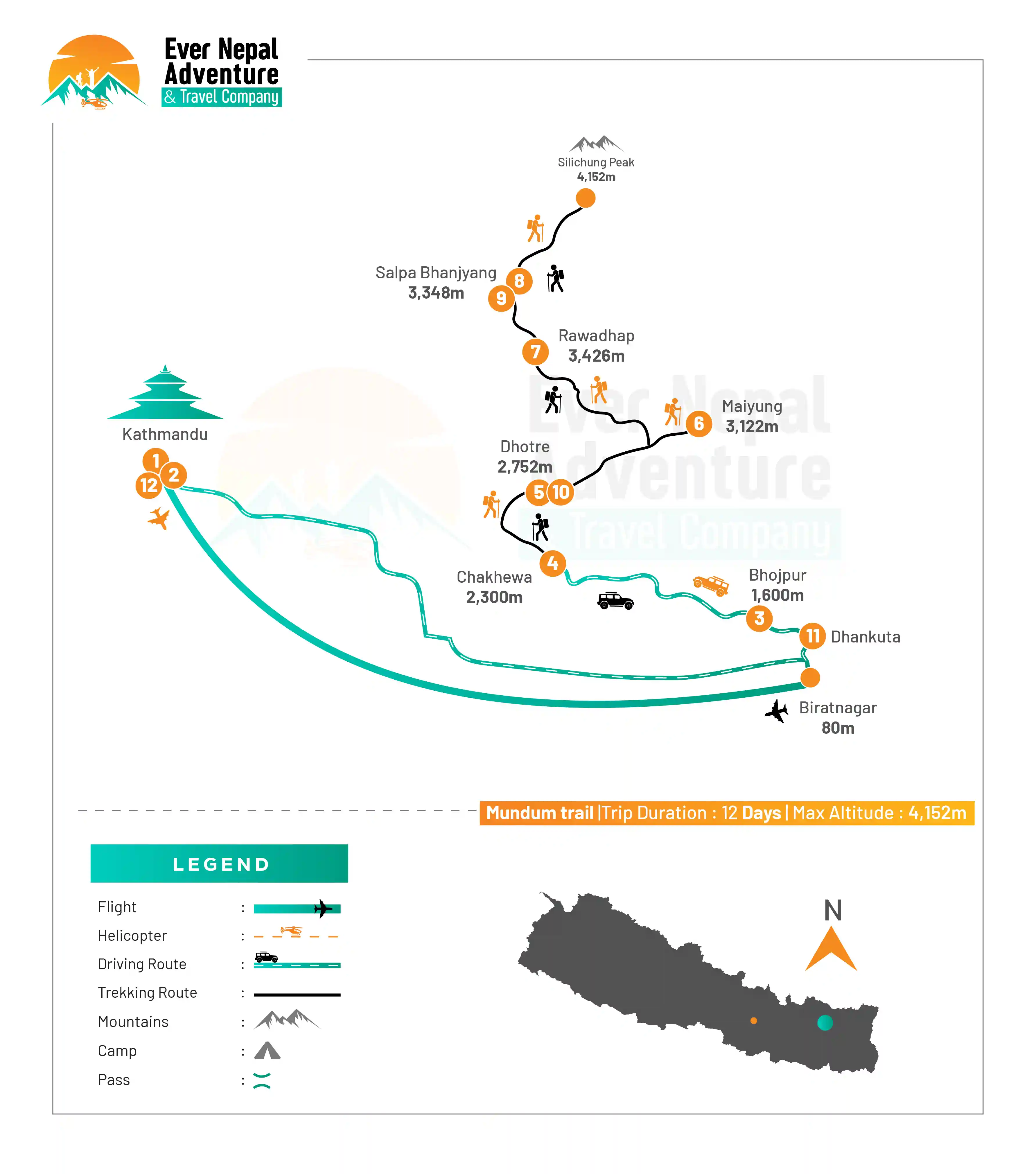
This 12-day journey begins in Kathmandu before flying to Biratnagar. From there, the route moves through Bhojpur or Diktel to Chakhewa, where the trek starts. The trail gradually ascends through forests and villages to high ridgelines around Salpa Bhanjyang and Silichung, before retracing the route back to Kathmandu.

Details

Mundum Trail takes you on a journey that is unique to Nepal. It follows the ancient Kirati spiritual route, connecting the middle hills of eastern Nepal to high mountain ridges. The trail is pristine and less commercialized. This allows trekkers a chance to experience both culture and nature at their best. The journey begins after a scenic flight from Kathmandu. Next, you will drive to Bhojpur/Diktel. The journey then continues onwards to Chakhewa. It is here that the trekking adventure begins. The trail slowly climbs through dense forest filled with rhododendrons. oaks and bamboo, heading towards Dhotre.

As the terrain opens, you will see wide ridgelines. The route toward Rawadhap offers stunning views of the Himalayan mountain ranges in the east, as well as a sense that you are alone. These highland zones are deeply connected with Kirati traditions and spiritual beliefs.

Silichung Peak excursion is a highlight of the Mundum Trail. This sacred viewpoint offers panoramic views that include endless hills and distant Himalayan summits. As the rising sun illuminates the surrounding landscapes, an early morning trek to Silichung can be both serene and powerful. Traversing the same path back through Chakhewa provides a chance to view these serene villages and woods from a unique vantage point.

The journey concludes with the drive to Dhankuta, followed by a plane back to Kathmandu. Mundum Trail offers a unique experience for tourists seeking spirituality, seclusion, and cultural linkages in the Himalayan region.
Highlights

  • Take the unique Mundum Trail Tour to Eastern Nepal
  • Navigate the spiritually charged Kirati Spirituality Trail with its rich tradition
  • Walk through varied terrains, including subtropical and alpine forests
  • Experience village life and culture from the Rai ethnic group and their traditions
  • Marvel at the ridge-line in the Himalayas
  • Salpa Bhanjyang Pass. This is one of the key passes on the trail.
  • Silichung Peak allows you to experience the beautiful sunrise
  • Explore quiet and peaceful paths away from tourist trails
  • Explore a pristine nature with abundant diversity
  • Drive and flight across Eastern Nepal is ideal for kicking off and concluding your tour.

Itinerary

Day 1: Arrival in Kathmandu (1,302m)

Kathmandu greets you with energy, culture, history, and a mixture of all three. As you enter the Tribhuvan International Airport and leave your daily surroundings, you are greeted by a vibrant, traditional environment. After the arrival process is complete, you will then be transported to your accommodation through the streets of the vibrant city. Temples, shops, local life, and more are all around you.

The rest of your day is at leisure to recover and relax from the journey. You can enjoy a warm dinner, take a short stroll around your hotel, or just relax to prepare for the next few days. This is the day to settle into your new surroundings. An evening briefing may be held to provide you with a clearer idea of your trek.

  • Max Elevation: 1,302 m
  • Travel Hours: 25 min
  • Accommodation: Hotel
  • Meals Included: Dinner

Day 2: Kathmandu Sightseeing and Preparation

Kathmandu, the city before the trek starts, offers a rich and cultural experience. Your full-day guided excursion takes you to some of the city's most important monuments, while preparing you for your trip ahead. You can visit the following places:

  1. Pashupatinath Temple: A Hindu temple located on the Bagmati River in Nepal. It's a spiritual spot where daily rituals, ceremonies and rites are performed.
  2. Boudhanath Stupa: A huge Buddhist stupa. An important pilgrimage site. It is a peaceful experience to be in this area with the prayer wheels and calm atmosphere.
  3. Swayambhunath Stupa: This temple, also called the Monkey Temple or the Monkey Hill, is perched on a mountain overlooking the valley. It provides a panoramic view of Kathmandu as well as cultural and religious importance.
  4. Kathmandu Durbar Square: A palace complex full of temples and traditional architecture. It is an excellent example of Nepal's rich royal history. 

And more. After sightseeing, return to the hotel for trek planning. You make the final adjustments to your gear before getting ready for the journey.

  • Max Elevation: 1,302 m
  • Travel Distance: 12 km
  • Travel Hours: 5 hrs
  • Accommodation: Hotel
  • Meals Included: Breakfast

Day 3: Fly to Biratnagar, then drive to Bhojpur/Diktel.

A scenic flight takes you from Kathmandu, Nepal, to Biratnagar. You can enjoy the scenery as the plane moves towards the east. On arrival, you continue by road towards Bhojpur (or Diktel). The drive takes a long time but is worth it. Along the way, you will see small towns and rural villages as well as changing landscapes.

As you leave the lowlands behind, your road slowly climbs up the hills. On the way, you can see more of the cultivated fields and rivers. This drive offers a glimpse into everyday life in Eastern Nepal. When you reach Bhojpur or Diktel, you'll notice that the environment has changed to a quieter, more traditional one.

This is the time you rest up after your long journey. This is the day you begin your trek, which will take you from the urban areas to the remote regions.

  • Max Elevation: 1,650 m
  • Travel Distance: 280 km (flight + drive combined)
  • Travel Hours: 45 min flight + 8 hrs drive
  • Accommodation: Lodge/guesthouse
  • Meals Included: Breakfast, Lunch, Dinner

Day 4: Drive to Chakhewa (2300m).

Chakhewa is the destination for today's scenic drive. The road becomes rougher as you head further away from towns. As you travel, you will see forests, hillsides and villages with a traditional, simple lifestyle.

With rising altitude, there will be cooling of the air and also a serene atmosphere. Although the journey will be a bit slow at some point, the trip is an amazing experience, giving one the chance to observe the surrounding scenery. This is where you get the opportunity to enjoy both the natural beauty and serenity of your surroundings when you get to Chakhewa in the mountains.

Here, your hike ends. It is a good idea to take a rest, prepare your gear and get ready for the walking days ahead. Chakhewa's calm atmosphere is perfect for mentally and physically preparing you to embark on the Mundum Trial.

  • Max Elevation: 2,300 m
  • Travel Distance: 45 km
  • Travel Hours: 3–4 hrs
  • Accommodation: Lodge/guesthouse
  • Meals Included: Breakfast, Lunch, Dinner

Day 5: Trek up to Dhotre (2.752m).

Your trek begins officially today when you leave Chakhewa in the past and begin to walk along trails through forests. The path ascends slowly, so your body can get used to the new altitude. You will walk through lush vegetation, where trees offer shade and create a tranquil atmosphere.

Along the route, you can see the life of locals up close. The trail starts off easy, with a gentle slope. You will be accompanied by the sounds of nature, including birds, flowing water and other animals.

As you continue to climb, the landscape changes. As you climb, the air gets fresher. By the time you arrive at Dhotre, your first full-day trek is over. You take a break, enjoy a warming meal, then relax and enjoy the quiet mountain atmosphere.

  • Max Elevation: 2,752 m
  • Travel Distance: 9 km
  • Travel Hours: 5 hrs
  • Accommodation: Tea house/lodge
  • Meals Included: Breakfast, Lunch, Dinner

Day 6: Trek to Maiyung (3.122m).

The hike today will be a steady uphill climb toward Maiyung. The trail goes through dense forests, but gradually widens as you increase altitude. You should walk at an easy pace to allow your body time to adjust. The landscape gets better as you get higher. You may start to see distant ridgelines or hills stretching into the distance. The surrounding environment seems more remote. There are fewer signs of human activity.

The trail is a bit more difficult but manageable due to the gradual ascent. As you approach Maiyung, the landscape will have changed to a peaceful one with fresh mountain air. This evening, you rest and prepare ourselves for the next day's higher sections.

  • Max Elevation: 3,122 m
  • Travel Distance: 10 km
  • Travel Hours: 5–6 hrs
  • Accommodation: Tea house/lodge
  • Meals Included: Breakfast, Lunch, Dinner

Day 7: Trek to Rawadhap (3.426m).

The journey continues up the hill to Rawadhap. Today's trail offers more views and more open ridgelines than earlier. You can see hills and valleys on both sides as you walk along the path. 
The landscape begins changing into alpine terrain. Tree density decreases, and the surrounding environment appears more open. It also allows a better view of the area, making your walk more visually satisfying.

As you climb, it is vital to maintain a steady rhythm. The air gets thinner, but the gradual ascent will help you to adapt. Rawadhap offers a peaceful and scenic location. This is a beautiful stop on the trail.

  • Max Elevation: 3,426 m
  • Travel Distance: 11 km
  • Travel Hours: 6 hrs
  • Accommodation: Lodge/tea house
  • Meals Included: Breakfast, Lunch, Dinner

Day 8: Trek to Salpa Bhanjyang (3,348m)

The hike today is shorter than usual and includes a mild descent. The trail passes through open fields and gentle slopes. It is a great way to relax. This day helps you to adjust to the high altitude. The surrounding area is calmer, wider and has fewer and fewer trees. Take your time and relax in the tranquil environment. The trail doesn't require much effort, so it allows you to conserve your energy and prepare for the next day.

Salpa Bhanjyang will take you to an important highland section of the Mundum Trail. The location is of cultural and ecological significance, which makes it a special spot to stay. You prepare and rest for the early-morning hike to Silichung.

  • Max Elevation: 3,348 m
  • Travel Distance: 8 km
  • Travel Hours: 4 hrs
  • Accommodation: Lodge/tea house
  • Meals Included: Breakfast, Lunch, Dinner

Day 9: Excursion to Silichung Peak (4,152m), and return

You'll be rewarded for your efforts on this day. You begin early the next morning to hike towards Silichung Peak. The trail is more difficult, but worth it when you reach higher elevations. On the way up, you will see distant Himalayan peaks and hills. Sunrise adds a unique touch to this landscape, as it lights up in soft shades. This peaceful moment will be remembered for a lifetime.

After spending some quality time at the viewpoint, descend back towards Salpa Bhanjyang. As you walk downhill, it is easier. Resting and reflecting upon the experience is what the rest of the day is all about. This excursion has often been deemed the highlight of the entire trek.

  • Max Elevation: 4,152 m
  • Travel Distance: 9 km (round trip)
  • Travel Hours: 6–7 hrs
  • Accommodation: Lodge/tea house
  • Meals Included: Breakfast, Lunch, Dinner

Day 10: Trek to Dhotre

You begin your return trip by walking back towards Dhotre. The same trail is followed, but you will feel a different sensation as you descend. Downhill walking is usually easier and allows you to walk at a more comfortable pace.

Passing through familiar landscapes like ridgelines and sections of forest. You can gain a new perspective by revisiting these locations. The descent is gentle, making it easier for trekkers to handle. By the time you arrive at Dhotre, it is easy to feel the progress of your trek. Rest and enjoy your final night in the mountain environment.

  • Max Elevation: 3,348 m (start)
  • Travel Distance: 12 km
  • Travel Hours: 5–6 hrs
  • Accommodation: Tea house/lodge
  • Meals Included: Breakfast, Lunch, Dinner

Day 11: Trek to Chakhewa and Drive towards Dhankuta

The day starts off with a final descent, from Dhotre up to Chakhewa. The trail travels through forests with gentle paths. It is a much more relaxing walk than in the earlier days. Enjoy your last moments of hiking.

Dhankuta is reached by road after you reach Chakhewa. The drive back takes you past hills and villages as you gradually return to a more developed area. Dhankuta will bring you back to a comfortable and more modern town. This is the final leg of your trek. After long days of hiking, you will be able to rest, relax and enjoy the evening. 

  • Max Elevation: 2,752 m (start)
  • Travel Distance: 9 km trek + 75 km drive
  • Travel Hours: 4 hrs trek + 5–6 hrs drive
  • Accommodation: Hotel/lodge
  • Meals Included: Breakfast, Lunch, Dinner

Day 12: Drive to Biratnagar, then fly to Kathmandu.

The final drive begins from Dhankuta. The road descends out of the mountains and into the plains. This offers a dramatic change in scenery. The journey is smooth and allows for time to relax. Once you arrive at Biratnagar airport, take the return flight from Biratnagar to Kathmandu. This short flight takes you back where it all began, to the capital. After experiencing the remote regions in eastern Nepal, seeing the familiar city feels rewarding.

After arrival in Kathmandu, you will be transferred to your hotel. The remainder of the morning is yours to relax, explore and/or prepare for departure. This marks the end of the Mundum Trail.

  • Max Elevation: 1,302 m
  • Travel Distance: 95 km drive
  • Travel Hours: 5 hrs drive + 45 min flight
  • Accommodation: Hotel
  • Meals Included: Breakfast

Trek Route

mundum trail

What's included

  • Airport pick up and drop off service in Kathmandu
  • Get 2 nights' accommodation in Kathmandu and breakfast.
  • Round-trip domestic flights: Kathmandu - Biratnagar - Kathmandu
  • All ground transportation according to the itinerary (private vehicle).
  • Accommodation for the trek (teahouses/lodges/basic Guesthouses).
  • All meals throughout the trek
  • Guides with extensive experience who are licensed to guide trekkers
  • Porter service (1 porter for 2 trekkers)
  • All the necessary permits for trekking and the local entry fee
  • The first aid kit is carried by the guide.
  • Taxes and service charges

What's excluded

  • Nepal visa fees, international airfares and other costs
  • Travel insurance is mandatory (including emergency evacuation).
  • Kathmandu Lunch & Dinner
  • Personal expenses
  • Please give a tip to the porter and guide (optional but expected)
  • Personal trekking equipment
  • Extra meals and/or accommodation due to delay or early return
  • Extra costs due to unexpected situations (weather conditions, flight delays and road conditions).

Packing List for Mundum Trail

The Mundum Trail is rich in culture, but it is also a difficult one in eastern Nepal's communities, forests, and peaks. The long walking hours involved on the trek, together with the varied weather conditions and elevation found in places like Salpa Bhanjyang and Silichung Peak, make it extremely necessary to carry trekking gear. The following is an exhaustive packing list for Mundum Trail.

  • Head

    • Wide-brimmed sun hat

    •  Warm woolen beanie

    •  Neck gaiter or buff

    •  High-SPF sunscreen

    •  UV-protected sunglasses

    •  Lightweight headlamp with extra batteries

    •  Lip balm with SPF

    •  Facial wipes

    •  Light cap for lower altitude sections

  • Hands

    • Waterproof gloves

    •  Light fleece gloves

    •  Insulated gloves for higher altitude sections

    •  Hand warmers (optional for cold mornings at ridges)

  • Upper Body

    • Thermal base layers (top)

    •  Quick-dry trekking t-shirts

    •  Breathable long-sleeved trekking shirts

    •  Fleece jacket

    •  Light down jacket

    •  Waterproof and windproof shell jacket

    •  Lightweight puffy jacket for layering

    •  Moisture-wicking innerwear

  • Lower Body

    • Thermal inner pants

    •  Full-length trekking pants

    •  Fleece or softshell trousers

    •  Waterproof outer pants

    •  Comfortable cotton pants for teahouse stays

    •  Light trekking shorts (optional for lower regions)

  • Footwear

    • Durable waterproof trekking boots

    •  Light camp sandals or slippers

    •  4–5 pairs of moisture-wicking trekking socks

    •  Liner socks

    •  Gaiters (useful for muddy or wet trails)

  • Toiletries

    • Toothbrush and toothpaste

    •  Biodegradable soap

    •  Quick-dry towel

    •  Toilet paper

    •  Hand sanitizer

    •  Wet wipes

    •  Small shampoo bottle

    •  Moisturizer

    •  Nail cutter

  • Accessories

    • Large duffle bag (for porters)

    •  30–40L day backpack with rain cover

    •  Sleeping bag (0°C to -10°C recommended)

    •  Trekking poles

    •  Water bottle or hydration bladder

    •  Water purification tablets or a filter

    •  Dry bags for electronics and clothes

    •  Light thermos for hot drinks

    •  Snacks and energy bars

  • First Aid Kit

  • Diamox (altitude sickness medicine)

    •  Painkillers (ibuprofen or paracetamol)

    •  Bandages and gauze

    •  Antiseptic wipes/cream

    •  Blister treatment kit

    •  Anti-diarrhea medication

    •  ORS or electrolyte powder

    •  Personal prescription medicines

    •  Cough lozenges

  • Electronics

    • Power bank (high capacity recommended)

    •  Extra batteries

    •  Universal travel adapter

    •  Smartphone or camera

    •  Charging cables

    •  Headlamp (already listed, but essential backup included)

  • Miscellaneous Items

    • Passport and photocopies

    •  Passport-sized photos

    •  Cash in Nepali rupees

    •  Notebook or journal

    •  Binoculars

    •  Light lock for bag security

    •  Energy bars, chocolates, and snacks

    •  Sunglasses case and lens cleaner

  • Specific Gears for Women

Women trekking the Mundum Trail should carry additional personal essentials to ensure comfort, hygiene, and ease during long trekking days in remote areas. Underwear (comfortable, moisture-wicking, and breathable)

  • Sports bra

  • Thermal leggings

  • Sanitary pads and tampons

  • Skincare products and moisturisers

  • Lip Balm with SPF

  • Travel-size shampoos and wet wipes

  • Hair ties and headbands

  • Personal hygiene wipes

  • Light fleece headband to keep you warm in the mornings

  • Comfortable tight leggings for layering

Document Required

To complete the Mundum Trail 12-Day Journey successfully, you will need to have certain documents. These documents will ensure that your trekking experience is safe, well-managed, and smooth in the eastern hills of Nepal. The following documents are required for this trek. 

  1. Makalu Barun National Park Entry Permit: A permit is needed because the Mundum Trail passes through protected areas and forests in eastern Nepal. Permits can be issued by the Nepal Tourism Board or registered trekking companies. For foreigners, the permit costs about NPR 3,00.
  2. Local Area Entry Permit (Bhojpur Region, Khotang region and Dhankuta Region): This permit is required for those who wish to trek along the Mundum trail through rural municipalities or local conservancy areas. It costs NPR 1000 to NPR 2000 according to the location you are staying at. It can be arranged from local authorities and entry points.
  3. Passport Validity: Your passport must have a validity of six months after the date of your arrival in Nepal. This passport is needed for all internal travels, including issuing permits and other identity purposes along the trail.
  4. Photographs: You should have either two or four passport photographs to apply for a permit and other documents. They can be required at local checkpoints and in emergency situations.
  5. Travel Insurance: It must cover trekking and the remote Himalayas. It must cover accident insurance and medical expenses, and must include evacuation insurance.

Frequently Asked Questions

Is it a difficult trail to follow?

Mundum Trail is moderately tough. Hiking time may be reasonable, but elevation gain and ridge hiking may not be easy for everyone. For this Mundum trail, right timing and physical fitness matter a lot.

What is the best season to visit the Mundum Trail?

Spring and fall are the best times to visit the Mundum Trail. The best seasons to visit are spring and fall. It is cool in winter, but you might encounter rain during other seasons. 

Is there anything important about my previous hiking experience in this hiking adventure?

You should be experienced in trekking. You need to have some trekking experience for this adventure. It is an adventurous trek, which includes long walks and ridge trekking. Beginners with a good fitness level can do this trail if prepared adequately.

Why is the Mundum Trail unique?

The Mundum Trail shares a cultural and spiritual bond with the Kiratis (Rais). It is less crowded compared to popular trekking routes in Nepal. It is unique due to the combination of culture, silence, and natural beauty.

What types of accommodation are available?

The majority of accommodation is found in guesthouses, teahouses, and lodges. The accommodations are basic, but adequate for a break after a day of hiking. Facilities may be basic in remote areas.

Is there a risk of altitude sickness on the trekking journey?

Yes, altitude sickness is possible because of the elevation of 4,000 meters in Silichung Peak. One needs to properly acclimatize, stay hydrated, and pace themselves to overcome altitude sickness. Trekkers have a consistent schedule.

User Review