Putha Himachuli: 33 Days Trek Journey

Tour Info

trip code

EN-44

Starting Point/ End Point

Kathmandu

Accommodations

Lodge/ Tea House

Max Altitude

7246m (Hiunchuli Summit)

Duration

33 days

country

Nepal

Trip grade

Easy

Activities

Trekking

Best Season

March, April, May, September, October, November

Overview

The Putha Hiunchuli Trek is a remote and tranquil travel destination located in the Dhaulagiri region of Nepal that combines the beauty of nature with culture. The trail passes through terraced fields, rhododendron forests, alpine meadows, and high mountain terrain, along with traditional Magar and other ethnic villages. As you ascend, the terrain changes from rocky landscape to snowy while giving you a scenic view of Dhaulagiri, Churen Himal, and other mountains around. You get the chance to observe blue sheep, Himalayan birds, and many other wildlife species along the way. Overall, the Putha Hiunchuli trekking journey is a rewarding but strenuous trekking journey. 

Details

Putha Hiunchuli Trek is a serene and adventurous trekking journey that is situated in the Dhaulagiri region. This journey offers a mix of natural beauty, culture, and adventure. It is most suitable for people seeking tranquility and wilderness of the Himalayas.

The route gradually ascends through terraced farmlands, dense rhododendron and oak forests, and high grazing pastures before reaching the stark glacial terrain of the upper Himalayas. On the way, the trail passes through Magar communities and other ethnic groups who follow traditional mountain lifestyles and offer warm hospitality. Due to the simple way of life and warm hospitality, this journey can be special to you.

As you gain altitude, the landscape slowly changes into alpine meadows, rocky paths, and snowy areas that are surrounded by Himalayan peaks. This Putha Hiunchuli trek region is also part of the broader Dhorpatan area, which is known for its wildlife and natural environment. You can see blue sheep, Himalayan birds and other high-altitude species while completing the journey. In addition, you get a breathtaking view of the mountain ranges such as Dhaulagiri, Churen Himal and other views.

This journey is difficult due to the high elevation and long walking days. However, it is also rewarding, giving you a sense of adventure as well as a connection with nature. The Putha Hiunchuli Trek is a great choice for those who want both cultural experience and mountain exploration in a remote part of Nepal.
Highlights

  • Visit the UNESCO World Heritage Sites in Kathmandu such as Swayambhunath, Pashupatinath, Bhaktapur Durbar Square, and Boudhanath.
  • Take a scenic drive from Kathmandu to Pokhara while witnessing beautiful views of rivers, hills, and Himalayan peaks. 
  • Walk through traditional Magar and Gurung villages, terraced fields, and forest trails. 
  • Slow ascents through alpine grasslands, high altitude pasture lands, and glacier lands.
  • Beautiful view of the Himalayas including Dhaulagiri, Annapurna, Gurja Himal, and Churen Himal. 
  • Camp remotely in high altitude locations. 
  • Climbing training and acclimatization for safe expedition preparation. 
  • Summit attempt of Putha Hiunchuli (7,246m) with expert guidance. 
  • Breath-taking summit views of the Himalayan range. 
  • Putha Hiunchuli base camp clean-up activity. 
  • Long descent through valleys, forests, and traditional settlements. 
  • Scenic return drive to Kathmandu via Beni and Pokhara
  • Cultural experience and interaction with local mountain comm

Itinerary

Day 1: Kathmandu arrival

Your Putha Hiunchuli trek begins once you arrive at the Tribhuvan International Airport (TIA), located in Kathmandu. At the airport, the EverNepal representative waits to welcome you when you arrive. After that, you are welcomed and transferred to your 3-star hotel for your overnight stay. Upon arriving at the hotel, you take some well-deserved rest. After that, you can explore the bustling streets of Kathmandu. In the evening, you are invited to a welcome dinner where you eat various delicious food items. After that, you go to your premium room for a comfortable sleep. 

  • Max Elevation: 1400 meters (Kathmandu)

  • Travel Distance: 5 to 6 kilometres

  • Travel Hours: 20 to 30 minutes   

  • Accommodation: 3-star Hotel

  • Meals Included: Dinner

Day 2: City tour and trip preparation

Day 2 is allocated to exploring the popular places of Kathmandu, along with trip preparation. You, along with our professional guides, go to visit the world heritage site in a private vehicle. Some of the places you explore are listed below: 

  • Syambhunath stupa (The Monkey Temple): Located at the hilltop of Kathmandu, this stupa is popular for its iconic all-seeing Buddha eyes, stunning panoramic valley views, and a unique blend of Buddhist and Hindu shrines.

  • Pashupatinath Temple: Situated at the bank of the Bagmati River, this temple is famous for its 5th-century pagoda-style architecture, the holy Bagmati River cremation ghats, and as the center for the Maha Shivaratri festival. This temple is dedicated to Lord Shiva. 

  • Bhaktapur Durbar Square: Located in Bhaktapur city, this durbar square is renowned for its preserved medieval Newari architecture, intricate woodcarvings, and vibrant, living cultural traditions. 

  • Boudhanath Stupa: Perched in Kathmandu, this stupa is popular for being one of the largest spherical stupas in the world and the holiest Tibetan Buddhist site. This stupa features iconic "Buddha Eyes" that symbolize wisdom and compassion. 

While exploring these attractions, you can buy the gears and other essential things that are required for the Putha Hiunchuli trek journey. After that, you return to your 3-star hotel for a delicious dinner before staying overnight. 

  • Max Elevation: 1440 meters (Kathmandu)

  • Accommodation: 3-star hotel

  • Meals Included: Breakfast, Lunch and Dinner

Day 3: Free day for preparation

This day is dedicated to trip preparation. After a hearty breakfast, you check your trekking gear and consult with the guide about any missing items. If any gears and other essential items are missing, you have a whole day to buy the missing gears and other items. You can visit local shops in Kathmandu to buy or rent the equipment. After making sure that you have all the well-tested equipment, you can spend the rest of the day relaxing. At night, you receive a leisurely dinner before spending the night. 

  • Max Elevation: 1440 meters (Kathmandu)
  • Accommodation: 3-star hotel
  • Meals Included: Breakfast, Lunch and Dinner

Day 4: Drive from Kathmandu to Pokhara

Following a delicious breakfast, you take a scenic and smooth ride towards Pokhara. To arrive at Pokhara via the Prithivi highway, you need to cross key places such as Naubise, Malekhu, Mugling, Dumre, and Damauli. You can witness stunning views of the Trishuli and Marsyangdi rivers, terraced farming, rolling hills, small traditional villages, and bridges on the way to Pokhara. In addition, you also witness Manakamana Temple Cable Car, Bandipur Village, river gorges, and the mountain views (Manaslu, Ganesh Himal, and Lamjung Himal). After 6 hours of driving, covering a distance of 200 km, you arrive at Pokhara, where you eat a warm dinner before spending the night. 

  • Max Elevation: 822 meters 

  • Travel Distance: 200 kilometres

  • Travel Hours: 6 hours

  • Accommodation: Hotel

  • Meals Included: Breakfast, Lunch and Dinner

Day 5: Drive from Pokhara to Darbang via Beni and then trek towards Takam

In the morning, you receive your relaxed breakfast. After that, you continue your drive towards Darbang via Beni. You pass through Nayapul, Kushma, and Beni on your way to arrive at your day 5 destination. On the route, you witness the Myagdi River, green landscape, Magar villages, hanging bridges and views of Dhaulagiri Himal, Gurja Himal, and Churen Himal. After 6 hours, covering a distance of 110 km, you arrive at Darbang. 

Upon reaching Darbang, you take a short rest before beginning the trekking journey. After that, you trek towards Takam, covering a distance of 16 km. You trek through Sibang Village and Phaliyagaon to arrive at Takam. On the way, you observe Magar villages, historical sites, the Myagdi River, green forests, Pani Ghatta, Mt. Dhaulagiri, and Gurja Himal. After trekking for 3 hours, you arrive at Takam, where you eat a warm dinner before spending the night.

  • Max Elevation: 1,665 meters 

  • Travel Distance: 110 kilometres

  • Travel Hours: 6 hours

  • Trek distance: 16 km

  • Trekking hours: 3 hours

  • Accommodation: Tea house/lodge

  • Meals Included: Breakfast, Lunch and Dinner

Day 6: Trek from Takam to Lamsung

After a warm breakfast, you continue your trek towards Lamsung by ascending through rural landscapes, dense forests, terraced fields and small, unnamed settlements. You are offered beautiful views of traditional Magar and Chhetri culture, natural landscape, the daily lifestyle of locals and the mountain views such as Dhaulagiri, Annapurna and Gurja Himal. After trekking for around 18 km, covering a distance of 6 hours, you arrive at Lamsung, where you are served with a relaxed dinner before spending the night in your comfortable room. 

  • Max Elevation: 2,200 meters 

  • Travel Distance: 18 kilometres

  • Travel Hours: 6 hours

  • Accommodation: Tea house/lodge

  • Meals Included: Breakfast, Lunch and Dinner

Day 7: Trek from Lamsung to Ghurjghat

Following a hearty breakfast, you continue your trekking journey towards Ghurjghat. You need to steadily ascend through rural and forested terrain in order to arrive at Ghurjghat. The pristine dense rhododendron and oak forests, diverse wildlife in Dhorpatan Hunting reserve, local culture, deep valleys, and high mountain views such as Dhaulagiri, and Churen can be seen during trekking. After trekking for around 6 hours, covering a distance of 12 km, you arrive at Ghurjghat, where you receive your delicious dinner, before spending the night in a cozy room.

  • Max Elevation: 3,020 meters 

  • Travel Distance: 12 kilometres

  • Travel Hours: 6 hours

  • Accommodation: Tea house/lodge

  • Meals Included: Breakfast, Lunch and Dinner

Day 8: Trek from Ghurjghat to Darsing Kharka

In the early morning, you receive a warm breakfast. After that, you continue your trek towards Darsing Kharka by ascending through forested zones, remote, high-altitude alpine terrain. On the route, you are offered stunning views of lush rhododendron forest, pine forests, diverse flora and fauna, traditional Magar culture, tranquil forest trails, open grazing lands and Dhaulagiri I, Dhaulagiri II, and other peaks. While witnessing these breathtaking landscapes, you arrive at Darsing Kharka, where you eat a delicious dinner before spending the night. This day's journey takes around 7 hours to complete. 

  • Max Elevation: 3,250 meters 

  • Travel Hours: 7 hours

  • Accommodation: Tea house/lodge

  • Meals Included: Breakfast, Lunch and Dinner

Day 9: Trek from Darsing Kharka to Budzunge Kharka

After a delicious breakfast at your teahouse, you continue your trekking journey towards Budzunge Kharka. It takes around 5 hours to arrive at the Day 9 destination. You need to trek through the high-altitude trail and rugged terrain. While trekking via these routes, you witness serene alpine meadows, grazing yaks/horses, flora, and mountain views (Annapurna range and surrounding peaks). While observing these beautiful natural surroundings, you arrive at Budzunge Kharka, where you are served with a relaxed dinner before staying overnight. 

  • Max Elevation: 4,800 meters 

  • Travel Hours: 5 hours

  • Accommodation: Camp

  • Meals Included: Breakfast, Lunch and Dinner

Day 10: Trek from Budzunge Kharka to Putha Hiunchuli Base Camp

After having a warm breakfast, you move ahead on your journey to Putha Hiunchuli Base Camp. The route passes near German Base Camp. You need to ascend through the pastures towards the higher glacial zone by crossing rugged terrain and moraines. On the way to Putha Hiunchuli Base Camp, you are offered spectacular views of deep gorges, high cliffs, glacial valleys, Tibetan culture, mani walls and prayer flags. Moreover, you also get to witness the diverse wildlife and mountains such as the Dhaulagiri Range and the Churen Himal. At night, you receive a warm dinner before staying overnight. 

  • Max Elevation: 4,900 meters 

  • Travel Hours: 5 hours

  • Accommodation: Camp

  • Meals Included: Breakfast, Lunch and Dinner

Day 11 to 24: Summit Hiunchuli peak (7246 m)

From Day 11 until Day 24, the period is designed to allow for acclimatization as well as climbing preparation and the final summit at Putha Hiunchuli. During these days, our guide and climbing professionals provide basic training regarding the use of climbing equipment such as ropes, ice axes, and crampons. This training helps you a lot while summiting Putha Hiunchuli Peak. In this 14-day schedule, you need to climb Camp 1, Camp 2, and Camp 3 before reaching the top of Hiunchuli Mountain. While climbing between these camps, you see some great views of the mountain, glaciers, snow fields, and alpine environment.

Once you have adequately adapted yourself with the environment and if the weather conditions turn favorable, you can try for a summit ascent. To reach the summit of Putha Hiunchuli mountain, you have to cover some snow slopes and glacier terrain. You have to complete this process under the guidance of your mountaineering group. During climbing, you witness fantastic views of the mountain ranges. Upon arriving here, you can take a moment to enjoy the views and capture the photos. After that, you descend back towards the Putha Hiunchuli base camp safely. Within 24 days, you retraced your steps back towards the base camp.

  • Max Elevation: 7,246 meters 
  • Accommodation: Camp
  • Meals Included: Breakfast, Lunch and Dinner

Day 25: Putha Hiunchuli Base Camp clean up

This is the day when you join us in cleaning and reviving the area of the base camp after enjoying a nice breakfast. We start by collecting non-biodegradable items such as food packages, gear, or other waste materials that were left behind on the expedition. This contributes towards sustainable tourism and maintaining the pristine nature of the mountains. Once we complete the cleanup, you can rest at the base camp for the rest of the day by reflecting on your successful summit experience. At night, you receive a delicious dinner before spending the night. 

  • Max Elevation: 7,246 meters 

  • Accommodation: Camp

  • Meals Included: Breakfast, Lunch and Dinner

Day 26: Trek from Putha Hiunchuli Base Camp to Budzunge Kharka

From this day, your return journey begins. Following a warm breakfast, you descend towards Budzunge Kharka through rocky terrain and alpine meadows. You return via the same route that was used for the ascent towards the base camp. While descending, you witness vast yak pastures, arid terrain, high alpine vegetation, river gorges, valleys and Dhaulagiri range views. If you get lucky, then you also get the chance to witness Himalayan wildlife like blue sheep on the way. After trekking for around 4 hours, you arrive at Budzunge Kharka, where you eat a relaxed dinner before staying overnight. 

  • Max Elevation: 4,500 meters 

  • Travel Hours: 4 hours

  • Accommodation: Camp

  • Meals Included: Breakfast, Lunch and Dinner

Day 27: Trek from Budzunge Kharka to Ghurjghat

In the early morning, you receive a hearty breakfast. After that, you continue your descent towards Ghurjghat. To arrive at the day 27 destination, you trek through the high-altitude, mountainous terrain of western Nepal. On the way, you see lush forest for rhododendron and oak, local culture, daily lifestyle, flora, fauna and Mt Kanchenjunga and Jannu peaks. While witnessing these views, you arrive at Ghurjghat, where you eat a warm dinner before spending the night. The whole journey of day 27 takes 6 hours to complete. 

  • Max Elevation: 3,020 meters 

  • Travel Hours: 4 hours

  • Accommodation: Teahouse /Lodge

  • Meals Included: Breakfast, Lunch and Dinner

Day 29: Trek from Lurang village to Takum

Following a leisurely breakfast, you continue your trek towards Takum. You need to descend for around 4 hours through the local villages and forest trails in order to arrive at day 29 destination. While descending through this route, you are offered a view of local farming lifestyles and the mountains of Dhaulagiri and Annapurna. In spring, you can also see the If trekking in spring, rhododendron forests and wildflowers in bloom. After a 12 km trek, you arrive at Takum, where you eat a relaxed dinner before spending the night. 

  • Max Elevation: 1,629 meters 

  • Travel Distance: 12 kilometres

  • Travel Hours: 4 hours

  • Accommodation: Teahouse /Lodge

  • Meals Included: Breakfast, Lunch and Dinner

Day 30: Trek from Takum to Darbang and drive towards Beni

In the morning, you are provided with a hearty breakfast. After that, you descend towards Darbang by crossing several rural villages like Dharapani. While trekking, you witness Gurung and Magar villages, cultivated terraces, high suspension bridges, green hills and the daily activities of locals. After trekking for around 6 hours, covering a distance of 12 km, you arrive at Darbang. 

Upon reaching here, you take a short rest. After that, you have a scenic drive for around 3 hours to reach Beni. You need to cross through villages, which offer beautiful views of green hills and agricultural farms. While having a smooth, scenic drive, you observe beautiful views of Myagdi Khola, traditional Magar villages, terraced farmlands, culture, Dhaulagiri massif and other grand peaks. After a scenic drive for around 3 hours, covering a distance of 24 km, you arrive at Beni, where you eat a delicious dinner before staying overnight. 

  • Max Elevation: 1,130 meters 

  • Trek Distance: 12 kilometres

  • Trekking Hours: 6 hours

  • Drive Distance: 24 km

  • Driving Hours: 3 hours 

  • Accommodation: Teahouse /Lodge

  • Meals Included: Breakfast, Lunch and Dinner

Day 31: Drive from Beni to Kathmandu

Following a warm breakfast, you take a seat in your private vehicle and head towards Kathmandu. While returning via these routes, you witness the Kali Gandaki River, terraced farms, the Trishuli River, rugged terrains, rocky hills, and mountain views (Dhaulagiri, Annapurna I, Machhapuchhre, and Manaslu). After a scenic drive for around 8 hours, covering a distance of 291 km, you arrive at Kathmandu, where you eat a relaxed dinner before spending the night in a premium room. 

  • Max Elevation: 1,400 meters 

  • Travel Distance: 291 kilometres

  • Travel Hours: 8 hours

  • Accommodation: 3-star hotel

  • Meals Included: Breakfast, Lunch and Dinner

Day 32: Free day

After a long day of trekking and driving journey, you can finally take a well-deserved rest for the full day. In the morning, you receive your delicious breakfast. Then, you can further rest, or you can choose to explore the nearby places, visit local markets, or enjoy some good food and cafés. This is also a great time to do some last-minute shopping for souvenirs or simply unwind and reflect on your adventure. In the evening, you can take a leisurely walk around the city or spend time with your team by sharing some great memories about this journey. At night, you enjoy your final relaxed dinner of the journey. After that, you sleep. 

  • Max Elevation: 1,400 meters 

  • Accommodation: 3-star hotel

  • Meals Included: Breakfast, Lunch and Dinner

Day 33: Departure

Day 33 marks the concluding day of the Putha Hiunchuli trek journey. Following a hearty breakfast, you pack your belongings and prepare for the final departure. After that, our driver come to pick you from the hotel to transfer to the TIA. There, our team assists you with the boarding formalities. After that, you take your flight and return to your home country. Our team bids you farewell and wishes you a safe and pleasant journey ahead.

  • Meals Included: Breakfast, Lunch and Dinner

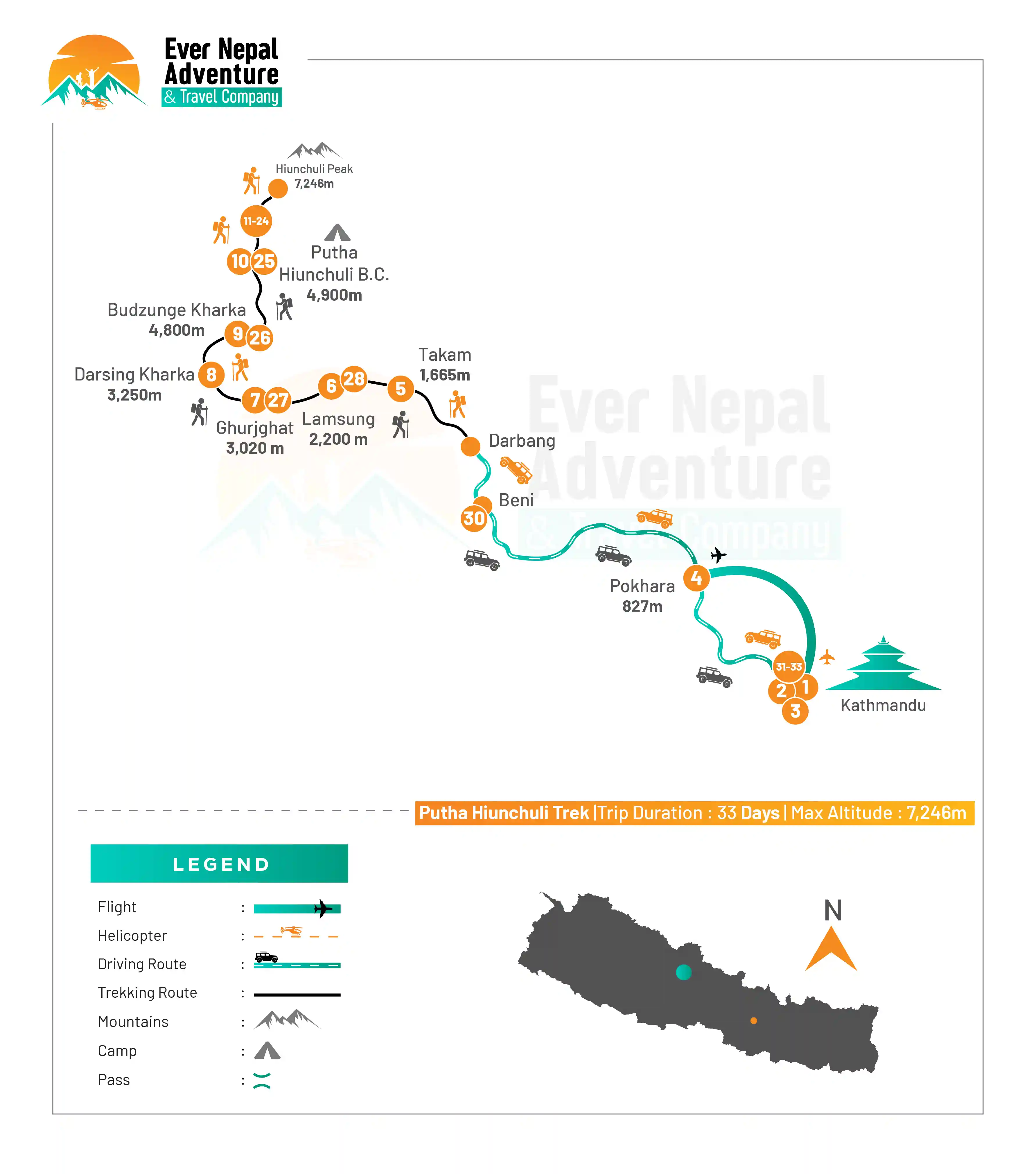
Trek Route

putha hiunchuli trek

What's included

  • Pick-up and drop-off at Tribhuvan International Airport, Kathmandu.
  • Hotel accommodation in Kathmandu (3-star category) with breakfast.
  • Welcome and farewell dinners in Kathmandu.
  • All meals (breakfast, lunch, and dinner) during the trek and expedition.
  • Teahouse/lodge stay on the trekking days.
  • Camping stays with complete assistance on the higher elevations.
  • Transportation by personal vehicle according to the schedule.
  • Guided sightseeing in Kathmandu. 
  • Experienced trekking and climbing guides, porters, and support staff.
  • Required climbing permits and trekking permits.
  • Group climbing equipment (ropes, ice axes, crampons, etc.)
  • Climbing training and acclimatization support. 
  • Salaries of staff, food, and accommodations.
  • First aid support.
  • Base camp clean-up program.
  • Government taxes and service charges

What's excluded

  • International flights to and from Nepal.
  • Nepal visa fees.
  • Travel insurance.
  • Personal trekking and climbing gear.
  • Personal expenses such as Wi-Fi, hot showers, laundry, and charging.
  • Drinks such as alcohol and soft drinks. 
  • Extra meals not mentioned in the itinerary.
  • Tips for the guides, and porters.
  • Costs incurred by any delays or unforeseen situations (weather, health, flight changes, etc.).
  • Cost of equipment rental or individual purchase in Kathmandu.
  • All other services that have not been mentioned in the “Cost Includes” section.

Packing List for Putha Hiunchuli Trek

It is necessary to take equipment that has been tested for its efficiency before starting the Putha Hiunchuli trek, since it involves trekking for long hours, along with the climate of the mountains. Packing correctly will ensure your safety, comfort, and efficiency during the entire expedition. Gear must be adaptable and layered, as this trek will take you from valleys down to glacier zones. The following is a list of all the gear you will need for your Putha Hiunchuli Trek.

Head

  • Wide-brimmed sun hat

  • Warm woolen beanie

  • Balaclava (or face mask) for high-altitude wind and cold

  • Neck gaiter

  • UV-protected sunglasses

  • High-SPF sunscreen

  • Lip Balm with SPF

  • Extra batteries included in the lightweight headlamp

  • Facial wipes

Hands

  • Waterproof shell gloves

  • Insulated Expedition Gloves (for High Altitude Use)

  • Light fleece gloves (for lower sections)

Upper Body

  • Moisture-wicking base layers (2-3 sets)

  • Thermal inner layers

  • Fleece jacket

  • Insulated down jacket (high quality, expedition grade).

  • Outer shell jacket that is waterproof and windproof

  • T-shirts for trekking that dry quickly

  • Long-sleeved hiking shirts that are breathable

  • Light puffy jacket (compressible on trekking days).

  • Rain Jacket (High Altitude Resistant)

Lower Body

  • Waterproof trekking pants

  • Insulated pants for use at high altitude

  • Two sets of fleece or softshell trousers

  • Thermal innerwear bottoms

  • Light trekking pants for lower elevations

  • Windproof overpants for glacier and summit approaches

Footwear

  • Mountaineering boots for high altitudes (compatible with crampons)

  • Lightweight trekking shoes (for lower trails)

  • Waterproof gaiters

  • Wool trekking socks (6-8 pairs)

  • Thick insulated socks for high camp use

  • Lightweight slippers or camp sandals

Toiletries

  • Toothbrushes and toothpaste

  • Biodegradable soap

  • Quick-dry towel

  • Toilet paper (multiple Rolls)

  • Hand sanitizer

  • Wet wipes / facial tissues

  • Small shampoo bottle

  • Moisturizer for cold weather protection

Accessories

  • Trekking poles (strong, adjustable)

  • Large duffle bag (expedition grade)

  • Daypack (30-40L).

  • Sleeping bag with a temperature rating of -20 °C - 30 °C

  • Water bottles or Hydration System

  • Filters or tablets for water purification

  • Dry bags for clothes and electronics

  • Sunglasses case

First Aid Kit

  • Diamox is used to treat altitude sickness

  • Painkillers: Ibuprofen and paracetamol

  • Antibiotics (as prescribed)

  • Antiseptic wipes

  • Bandages and gauze

  • Blister care kit

  • Anti-diarrhea medication

  • ORS (rehydration Salts)

  • Prescription medicines for personal use

Climbing Gear / Technical Gear

  • Climbing harness

  • Helmet

  • Crampons for boots

  • Ice axe

  • Carabiners, both locking and non-locking

  • Ascender/descender (Jumar plus figure 8 or ATC).

  • Climbing Ropes (usually included in group gear, but familiarity with the ropes is essential)

  • Snow gaiters are optional depending on the conditions

Electronics & Miscellaneous Items

  • Use a camera or smartphone

  • Power banks / Extra Batteries

  • Solar Charger (Recommended for Long Expedition)

  • Universal travel adapter

  • Headlamp batteries backup

  • Binoculars

  • Journal or notebook

  • Snacks (energy bars, almonds, chocolates, etc.)

Special Gear for Women

Women's Special Gear Women bring comfort and personal hygiene items to the Putha Hiunchuli Trek. Due to the remoteness and high altitude of the camping, it is important to prepare properly. Some of the specific gears for women on this trek include: 

  • Underwear (quick drying, thermal sets).

  • Sport bras (2-4 pairs), 

  • Feminine pads/tampons, 

  • Sanitary pads/tampons, 

  • Lip Balms with SPF, 

  • Thermal leggings, or ear warmers,

  •  Fleece Headbands or Ear Warmers, 

  • Small Travel Towels

Documents Required

In order to make sure that your trekking and mountaineering experiences are legal and smooth, you'll need to obtain a number of essential travel documents. These documents are used to regulate access to the protected areas, help with conservation efforts, and ensure safety throughout your entire expedition. Here are the documents that you must bring with you on this trip.

  • Annapurna Conservation Area permit: This is required to enter the Annapurna Conservation Area and the surrounding conservation areas, which connect the Putha Hiunchuli route. The Nepal Tourism Board, located in Kathmandu, or a trekking agency registered with the Nepal Tourism Board, can issue you a permit. The cost is approximately NPR 3,500 (about $25) for foreigners, NPR 1,000 ($8) for SAARC nationals, and NPR 100 dollars for Nepalese.

  • Dhorpatan Hunting Reserve Permit: This permit is required to enter the Dhorpatan area. Permits are issued by the Department of National Parks and Wildlife Conservation in Kathmandu or other authorized agencies. The fee for foreigners ranges between NPR 3,000 and 5,000 ($25 to $40), depending on duration.

  • Permit for Putha Hiunchuli: The Nepal Mountaineering Association grants a permit to trek up to the summit of Putha Hiunchuli (7.246m). The charge will depend upon the time of year. The costs vary from $250 to $500 for each person, depending on the season.

  • Restricted Zone Permit: There are some remote areas of the Dhaulagiri area where you will be required to get a Restricted Zone permit. The fees will be approximately $20-30 per week per person.

  • Original Passport: Every trekker or climber is supposed to carry an original passport, which should have at least a six-month validity from the day he enters Nepal.

  • Passport Photos: You will be required to provide six passport-size photos.

  • Full travel insurance cover: It must cover high-altitude treks (over 7,500m if applicable), helicopter evacuations, and medical treatment for altitude sickness

Frequently Asked Questions

How difficult would you rate the Putha Hiunchuli Trekking?

Trekking to Putha Hiunchuli, which can also be referred to as Putha Hiunchuli trekking, is regarded as one of the hardest trips to make. This trek involves trekking for a long distance and across difficult terrains. There are also difficult technical climbs near the summit. It is important that one acclimatizes oneself before embarking on this trip.

Do I have to be a previous climber for this adventure?

The minimum requirement is basic trekking; prior experience in high altitude climbing is highly recommended. During this expedition, you will learn how to use crampons, ropes, and ice axes. The terrain above base camp is technically and physically demanding. Fitness and mental strength are equally important.

What is a good season to trek Putha Hiunchuli?

The spring season (April to May) and the autumn (September through October) are ideal. During this time, visibility and weather are excellent. As well, snow conditions make climbing safer than in winter or during the monsoon. These seasons have the highest chance of success for a summit attempt.

How cold does the journey become in winter?

The temperature becomes different depending on altitude. When the altitude is high, temperatures could be below- 20 deg Celsius or- 30 deg Celsius. It could be colder due to the wind. This mostly happens at night. It is very important to dress for cold temperatures.

Is there a high risk of altitude sickness on this trek or hike?

Yes, altitude illness is a serious challenge. The trek will reach a height above 7,000 meters, where oxygen levels can be very low. Acclimatization days have been included to minimize the risk.

What kind of accommodation is available for the trek?

In the lower regions, there are teahouses and simple lodges. As you progress higher in altitude, the accommodation becomes less luxurious and more like camping. In base camps and higher camp areas, tents are fully supported. Because of its remoteness, the facilities are minimal.

How is the food handled during an expedition?

The meals are prepared on site by the support staff. Lower sections have a mix of local and basic foreign meals. The food at higher elevations is simple, high in energy, and nutrition-focused. In order to hydrate and provide energy for the climbers, they often offer hot drinks. These include tea, porridge, soup, and other hot beverages.

How safe is the Putha Hiunchuli climbing?

The climb can be relatively safe when guided with the help of experienced mountaineers. However, the expedition is high-risk due to weather conditions, altitude, and glacier conditions. Safety equipment, like fixed lines and ropes, is used on the technical sections. Monitoring weather conditions and adequate preparation help lower the risk level of such activity.

What training do you undertake before going to the summit?

You get trained in basic mountaineering on the base camp and high camp levels. You will learn how to operate the equipment, including things like climbing harnesses, ice axes, and crampons. Before beginning the climb, everything to do with ropes is learned and rehearsed.

What about charging devices and the internet?

The charging options are very limited in high altitudes. Some teahouses will charge extra for using solar power. The internet is usually unavailable and unreliable beyond the mid-altitude region. You should always carry extra batteries, power banks, and chargers for your entire trip.

User Review