Tibet Overland Tour via Lhasa - 8 Days

Tour Info

trip code

DE-0038

Starting Point/ End Point

Kathmandu

Accommodations

Lodge/ Tea House

Max Altitude

3900m

Duration

8 days

country

Tibet

Trip grade

Easy

Activities

City Tour , Flight and Tourism

Best Season

April, May, June, September, October, November

Overview

A tour to Tibet overland is one of the best ways to explore the beauty and culture of Tibet. This journey begins from Kathmandu, Nepal - the home to ancient temples (Pashupatinath and Boudhanath), cultural heritage, and colorful markets. By starting the journey from Nepal, you can add a rich mix of culture and scenery before entering Tibet. The tour offers an opportunity to experience the changing landscape, including beautiful hills and mountains, along with snow-capped mountains and clear blue skies. At the same time, you can experience and explore Tibetan culture and lifestyle, where people and nature are closely associated and where Buddhism is reflected through monasteries and prayer flags. The Tibet overland tour is one of the best and most memorable experiences for all tourists and travelers.

Details 

A Tibet overland tour offers a rare opportunity to experience the landscapes, spiritual heritage, and unique culture of Tibet in a simple and relaxed way. By beginning this journey often from Kathmandu, Nepal, you can immerse yourself in the breathtaking Himalayan scenery and experience the region’s rich traditions. Kathmandu is a lively city known for its ancient temples, cultural heritage, and colorful markets. You can visit Pashupatinath Temple and Boudhanath Stupa, which reflect strong spiritual traditions. Starting the journey from Nepal adds a rich mix of culture and scenery before entering Tibet. By travelling via road throughout the journey, you can witness changing landscapes, from green hills to wide open high mountains. This journey provides a chance to view the beautiful sights of the snowy peaks, the sky, and nature.

In the Tibet overland tour, you get the chance to see the lifestyle of the Tibetan people. The small villages, local homes, and friendly people reflect a lifestyle that is closely connected to nature and spirituality. As the culture of Tibet is based on Buddhism, you can find this reflected in the monasteries, prayer wheels, and prayer flags. These all cultural attractions give a deeper and meaningful meaning to your tour.

The road journey throughout the tour allows more time for you to enjoy quiet lakes, mountain passes, and the beauty of the surroundings. A Tibet overland tour offers both adventure and relaxation, making it a great experience for those who want to enjoy nature, culture, and peaceful travel moments together.
Highlights

  • Warm welcome and stay for 2 nights in Kathmandu.

  • Visit UNESCO World Heritage sites such as Swayambhunath stupa, Pashupatinath temple, Boudhanath stupa, and Bhaktapur Durbar Square. 

  • Have a scenic flight from Kathmandu to Lhasa. 

  • Explore Lhasa city along with their culture and local markets.

  • Visit Jokhang Temple and walk around Barkhor Street. 

  • See the beautiful Potala Palace. 

  • Explore the Sera monastery and Drepung monastery. 

  • Drive through stunning landscapes, high passes, and lakes. 

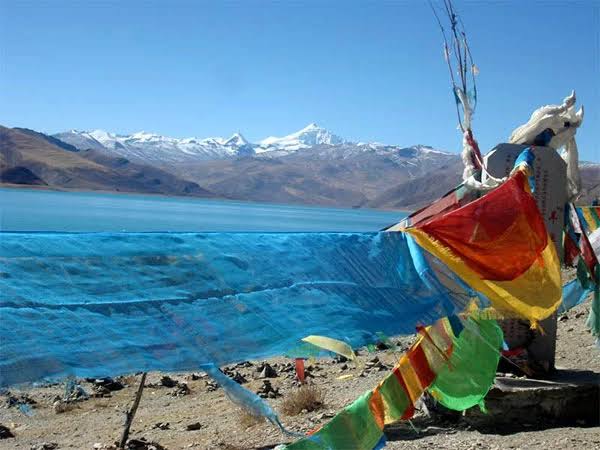
  • Visit Yamdrok Lake and enjoy mountain views.

  • Explore Tashilhunpo Monastery. 

  • Enjoy views of beautiful mountains like Everest, Cho Oyu, and Shishapangma. 

  • Experience local food, culture, and traditions.

Itinerary

Day 1: Arrival in Kathmandu

Your Tibet overland tour begins once you arrive at TIA (Tribhuvan International Airport). Upon reaching TIA, the EverNepal representatives warmly welcome you and help you transfer to your standard hotel. After you arrive at your hotel, you check into the room and rest there. Then, if you are interested in exploring the places, you can visit the nearby places and buy souvenirs. In the evening, you are invited to a welcome dinner where you meet all the representatives. Then, you start eating the delicious cuisine. After that, you return to your premium room where you spent the night. 

  • Max Elevation: 1400 meters (Kathmandu)

  • Travel Distance: 5 to 6 kilometres

  • Travel Hours: 20 to 30 minutes   

  • Accommodation: 3-star Hotel

  • Meals Included: Dinner

Day 2: Kathmandu sightseeing tour

After a warm breakfast, you need to be ready for a sightseeing tour. This day is fully allocated for exploring the UNESCO World Heritage site that is located in Kathmandu Valley. You, along with your guide, go for a sightseeing tour in a private vehicle. You visit several UNESCO world heritage site such as 
Syambhunath stupa: This stupa is located at the top of the hill. It is famous for the ancient carvings and panoramic views across the Kathmandu Valley. The Syambhunath stupa is also called the monkey temple. 
Pashupatinath Temple: The Pashupatinath Temple is situated at the bank of the Bagmati River. This sacred Hindu temple that is dedicated to Lord Shiva is popular for its centuries-old architecture and sacred rituals. 
Boudhanath Stupa: Located in the northeast direction of Kathmandu valley, this stupa is one of the largest spherical stupas in the world. It is famous for its enormous white dome shape. This stupa has four pairs of eyes facing in the four cardinal directions. These eyes watch the people and their doings. 
Bhaktapur Durbar Square: This durbar square is situated in the Bhaktapur district. It is well known for its medieval palaces, intricately carved temples, and Newar craftsmanship. This is a living museum of Nepalese art, culture, and history.

Max Elevation: 1440 meters (Kathmandu)
Accommodation: 3-star hotel
Meals Included: Breakfast, Lunch and Dinner

Day 3: Flight from Kathmandu to Lhasa

Your journey to Tibet begins from this day. Following a hearty breakfast, you are transferred to TIA for a scenic flight to Lhasa. Upon arriving at the airport, you take a flight, offering a breathtaking view of green hills, the Yarlung Zangbo River, and mountains like Mount Everest, Makalu, Lhotse, and Cho Oyu. After around 1 hour, you arrive at Gonggar airport (Lhasa). Once you arrive at the airport, you are transferred to your hotel. After that, you can visit the nearby places. At night, you return to your hotel, where you eat a delicious dinner before staying overnight. 

Max Elevation: 3,650 meters (Lhasa)
Flight Hours: 1 hour 
Accommodation: Hotel
Meals Included: Breakfast, Lunch and Dinner

Day 4: 1st Full day sightseeing tour in Lhasa

Day 4 is allocated to exploring the places of Lhasa. After an early warm breakfast, your first day sightseeing tour starts. You, along with your guide, go to explore the Jhokang temple - a spiritual heart of Tibetan Buddhism. This temple is popular for housing the sacred Jowo Shakyamuni statue. Moreover, you also visit Barkhor Street, which serves as the pilgrimage circuit (kora) around the 7th-century Jokhang temple. This street is known for its vibrant atmosphere, traditional Tibetan shops, and as a center of religious and cultural activity. 

Later, you also explore the Norbulingka (a jewel park) or Tibetan teahouse. The Norbulingka is the traditional summer palace of the Dalai Lamas in Lhasa. They are popular for serving butter tea, offering a glimpse into daily Tibetan life. After exploring these places, you return to your hotel, where you eat a warm dinner before staying overnight. 

Max altitude: 3,650 meters
Accommodation: Standard Hotel
Meal: Breakfast, Lunch and Dinner

Day 5: 2nd Full day sightseeing tour in Lhasa

This day is also dedicated to exploring the places of Lhasa. Your 2nd day sightseeing tour begins after you eat a leisurely breakfast. You, along with your guide, go for a visit to the Potala Palace - a grand historic palace that served as the winter residence of the Dalai Lamas till 1958 AD.  It is renowned for its massive structure, beautiful architecture, and religious and political importance. In addition to that, you also visit the Sera monastery. It is one of the largest Tibetan Buddhist monasteries and is known for its lively debates among the monks. Additionally, you also visit the Drepung monastery. It is the largest Tibetan monastery in the entire world. This monument is popular for its historical importance and large monastery. Moreover, it is also known for its Buddhist learning. Once you have explored all these places, you return to your hotel and have dinner and spend the night. 

Max altitude: 3,800 meters
Accommodation: Standard Hotel
Meal: Breakfast, Lunch and Dinner

Day 6: Drive from Lhasa to Gyantse and then to Xigatse

Following a relaxed breakfast, you pack your belongings and head towards Gyantse in a private vehicle. Before arriving at Gyantse, you need to traverse through Yamadroke Lake, Kora La pass and Kamba La pass. After around 5 hours of scenic drive, you arrive at Gyantse. Here, you can explore the Palkhor Choede - popular for harmoniously hosting multiple Buddhist sects within one complex, and the Kumbum monastery - famous for being the largest and most magnificent chorten (stupa) in Tibet. Once you finish exploring these monasteries, you take a seat in the vehicle and head towards Xiagtse. After around 1.5 hours of a picturesque drive, you arrive at Xiagtse, where you eat dinner and stay overnight.

Max altitude: 3,950 meters
Travel distance: 340 km
Travel hours: 6 hours 30 minutes  
Accommodation: Standard Hotel
Meal: Breakfast, Lunch and Dinner

Day 7: Drive from Xigatse to Kerung

In the early morning, you receive a hearty breakfast. After that, you continue your journey to Kerung. Before starting the journey, you first visit the Tashilhunpo Monastery. Once you visit the monastery, you take a seat in the vehicle and head towards Kerung. You cross the Sakya and Tingri settlements, then pass Pelkhu Tso, Lalung La Pass, and Saga before arriving at Kerung. On the way to Kerung from Xigatse, you get an opportunity to witness turquoise Pelkhu Tso Lake, Lalung La pass, Gyirong Valley and mountain views such as Mt. Everest, Cho Oyu, and Shishapangma. After a scenic drive of around 9 hours, covering a distance of 558 km, you arrive at Kerung, where you eat a relaxed dinner before spending the night. 

Max altitude: 3,900 meters
Travel distance: 558 km
Travel hours: 9 hours 
Accommodation: Standard Hotel
Meal: Breakfast, Lunch and Dinner

Day 8: Drive back from Kerung to Kathmandu

Your journey concludes on this day. After a hearty breakfast, you continue your drive to Kathmandu, following the route via Rasuwagadhi, Syabrubesi, Dhunche, and Trishuli. While you are on a scenic drive, you have a chance to witness deep gorges, the Trishuli River, terraced farms, the Tamang village, and views of grand mountains like Langtang Lirung and Ganesh Himal. After a scenic drive for around 9 hours, covering a distance of 175 km, you arrive at Kathmandu. 

Max altitude: 2,000 meters
Travel distance: 175 km
Travel hours: 9 hours 
Accommodation: Standard Hotel
Meal: Breakfast and Lunch

Trek Route

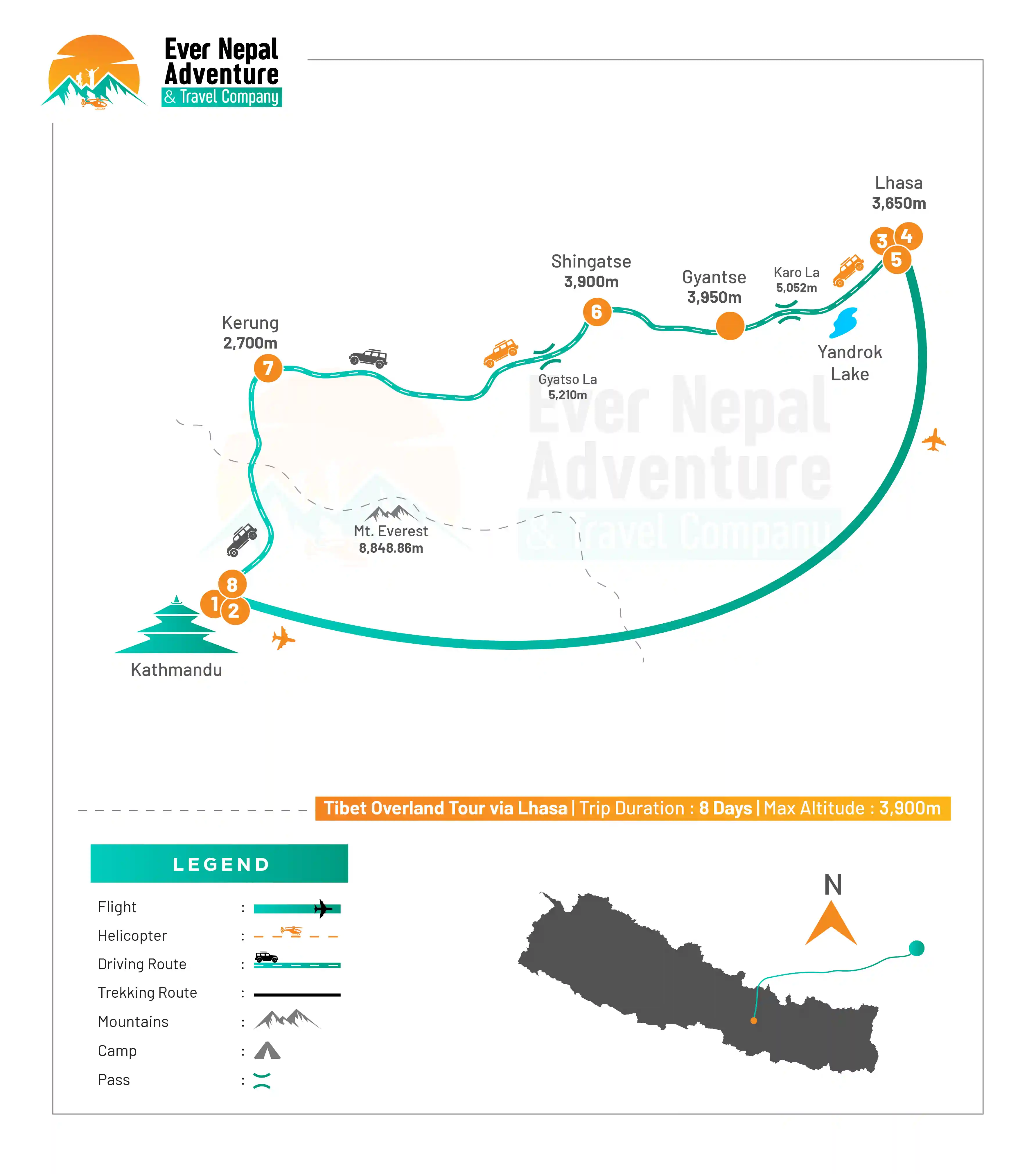
Tibet Overland Tour via Lhasa route map

What's included

  1. Tibet travel permit.
  2. Private transportation throughout the journey.
  3. Experienced English-speaking Tibetan guide.
  4. Accommodation on twin sharing room basis.
  5. Daily breakfast, Lunch and Dinner.
  6. Government taxes and Service charge.

What's excluded

  • Any type of insurance.

  • Personal expenses like beverages and gratuities.

  • Cost of Nepal re-entry visa.


Packing List for Tibet Overland Tour

The Tibet Overland Tour is a journey through huge high altitude terrain, through open roads, passes and cultural towns within the Tibet Autonomous Region. Driving long distances, hot sun, cold winds and changing weather conditions are part and parcel of the adventure. Dressing smart and layering is essential for staying warm, comfortable and ready to go on the road trip.


Head

  • Warm woolen beanie

  • Buff or neck gaiter

  • UV-protection sunglasses

  • Climbing sunglasses 

  • Lightweight headlamp with extra batteries

  • Sun hat or cap

  • High-SPF sunscreen

  • Lip protection cream

  • Face moisturizer

  • Personal hygiene wipes


Hands

  • Lightweight inner gloves

  • Waterproof outer gloves

  • Heavy insulated summit gloves

  • Hand warmers (optional)


Upper Body

  • Thermal base layers 

  • Lightweight trekking t-shirts

  • Long-sleeved trekking shirts

  • Fleece jacket

  • Waterproof shell jacket

  • Windproof outer layer

  • Insulated summit jacket

  • Lightweight puffy jacket


Lower Body

  • Thermal inner pants

  • Trekking trousers

  • Waterproof shell pants

  • Insulated climbing pants

  • Comfortable camp pants

  • Fleece lined pants


Footwear

  • Waterproof hiking boots

  • Peak climbing boots.

  • Flip-flops or sandals for outdoor wear

  • Gaiters

  • Woolen trekking socks

  • Liner socks

  • Summit push boots

  • Climbing Equipment

  • Climbing harness

  • Ice axe

  • Crampons


Ascend and descend Equipments

  • Locking carabiners

  • Helmet

  • Safety ropes and slings

  • Trekking poles


Climbing backpack

  • Duffel bag

  • Toiletries

  • Toothbrush and toothpaste

  • Biodegradable soap

  • Quick-dry towel

  • Toilet paper

  • Hand sanitizer

  • Small shampoo bottle

  • Wet wipes

  • Nail clipper

  • A moisturizer and cold cream


Accessories

  • Water bottles

  • Water purification tablet or Filter

  • Power bank

  • Universal travel adapter

  • Portable Solar Charger (Optional)

  • Camera or mobile phone

  • Snacks and energy bars

  • Notebook or journal


First Aid Kit

  • Diamox

  • Personal prescription medicines

  • Pain relievers

  • Medical tape and bandages.

  • Blister treatment kit

  • Antiseptic cream and wipes

  • Anti-diarrheal medicine

  • Oral rehydration salts

  • Oral/parenteral medications for cough and cold symptoms


Specific Gears for Women

For women on road trips to Tibet, these are the extra essentials that will be useful for their comfort. With the following additional gears, the comfort and hygiene is enhanced by significant amount. 


  • Sports bras

  • Thermal leggings

  • Comfortable undergarments

  • Sanitary pads or tampons

  • Personal skincare products

  • Moisturizing lotion

  • Lip care products

  • Travel-size hygiene products

  • Fleece headband

  • Hair ties and clips


Documents Required

To enter Tibet and move about in controlled border areas, proper documentation is required. Usually all permits are arranged through an authorized travel agency.

  • Tibet Travel Permit: This is the most important permit for all the foreigners traveling in Tibet Autonomous Region. Otherwise no one is allowed into Tibet.

  • Chinese Group Visa: For those entering Tibet by Nepal or via China, a Chinese Group Visa is needed. Tourist visas are not valid for Tibet overland tour only.

  • Passport: Original passport with a minimum of 6 months validity required for visa application, permission, and for entry to the border.

  • Passport-Sized Photos: Carry 3 to 6 recent passport size photos for permits and documentation on the trip.

  • Travel Insurance: Travel insurance to cover high altitude, medical and helicopter evacuation is highly recommended as terrain is remote and there is a risk of high altitude scenarios.

Frequently Asked Questions

How long is the driving distance each day on the Tibet Overland Tour?

Daily driving hours can vary between 4 to 8 hours depending on the route and road conditions. Travel hours can feel longer some days with crossing high mountain passes. Stops are made for sightseeing, meals, and acclimatization; to make the journey comfortable and safe.

How is the road condition during the overland journey in Tibet?

Road conditions are generally hard and paved on major highways, but may be rough, dusty or winding in remote mountain areas. Roads might be uneven near high passes and in rural areas. These roads, however, are common in their driving experience and safe and managed.

Can I get a SIM card or mobile data in Tibet?

Yes, in major cities such as Lhasa, Chinese SIM Cards are available. But there is a requirement for registering with a passport. In addition to cities and towns, mobile data is also available in rural areas, albeit with lower signal strength and coverage. Signal quality is lower or may not exist in high altitude areas when traveling toward them.

How should I prepare for long hours of road travel?

Drinking plenty of fluids is recommended, bring snacks and possibly have some motion sickness tablets. In long drives wearing comfortable clothes and having a neck pillow helps. There are also some short walks that can be taken during the stops to promote blood circulation and fatigue alleviation during the trip.

Is there any restriction on photography during the tour?

Most areas outside, monasteries, and landscapes are fine for photo taking. Not all religious sites will allow photos inside the temple, but some will. When taking photographs always do so with the guidance of the guide and never offend the local people or customs, particularly in sacred or military sensitive areas.

What kind of toilets and washrooms are available on the route?

Toilets facilities vary from basic western toilets in hotels to simple squat in remote areas. If you are traveling for a long time, public restrooms can be quite basic. It is highly recommended to bring tissue paper and sanitizer and wet wipes for comfort and hygiene.

Do I need oxygen support during the Tibet Overland Tour?

For most travellers, oxygen is not needed, but portable cylinders are carried in case of an emergency. The trail does go high into the Himalayas close to Mt Everest so there will be some people who will feel mild breathlessness in the initial days of the climb.

What happens if I feel sick during the journey?

If you are feeling unwell, the guide will keep watching and will potentially recommend you to rest, drink fluids or descend to a lower altitude if needed. For emergency support vehicles are always available and travel itineraries contain acclimatisation stops, which minimise health risks.

Can I customize the Tibet Overland Tour itinerary?

Yes, most trips can be tailored depending on the time taken, and interests, and entry and exit points. But, routes are yet to be confirmed by the authorities in Tibet Autonomous Region, so any changes need to be arranged by an authorised travel agency.

Is the Tibet Overland Tour safe for solo travelers?

Yes, it is safe in general, as travelers have to travel in organized groups with licensed guides. Solo independent travellers are not allowed to do this tour. Experienced drivers and proper planning and guided support make the journey safe even in remote areas in high altitudes.


User Review